For decades, market research followed a familiar rhythm. Brands launched surveys, assembled focus groups, analyzed responses, and waited for insights to guide the next decision. The process worked until consumer behavior began changing faster than traditional research cycles could keep up.
Today, preferences can change almost overnight. Trends emerge on social platforms within hours instead of months, and by the time research reports reach leadership teams, the market has often already moved on.
That gap is pushing enterprises toward a different approach: synthetic consumers.
These AI-generated personas are built to replicate audience behavior, reactions, and decision-making patterns in ways that traditional research methods can’t easily match at scale. Although the concept still feels futuristic to many executives, synthetic consumer systems are rapidly becoming a key part of modern AI-driven market research strategies.
And the reason is simple: companies want faster answers.
Why Traditional Personas Are Losing Relevance
Most organizations already use personas. The problem is that many of them are static documents created during workshops and rarely updated afterward.
A “customer persona” created six months ago may already be outdated in categories where buying behavior shifts quickly. Expectations around pricing, trust, personalization, and digital experiences are constantly evolving.
This is where AI persona modeling introduces a different mindset.
Instead of creating fixed audience profiles, enterprises can now build AI-generated personas that behave more like living representations of customer segments. These systems are trained using combinations of behavioral data, demographic patterns, purchase signals, online activity, and historical research inputs.
The difference becomes obvious during testing. Rather than asking a few focus group participants for feedback, brands can simulate responses from thousands of synthetic personas within minutes.
That changes the speed of decision-making dramatically.
Companies experimenting with synthetic audience systems are already using them to evaluate messaging, campaign concepts, pricing reactions, and even product positioning before entering the market.
Simulated Consumer Behavior Changes the Research Model
One of the most interesting developments in this space is the rise of simulated consumer behavior systems.
Traditional research often depends on what people say they might do. Synthetic consumer models attempt to predict what audiences are more likely to do based on behavioral patterns.
That distinction is important because stated intent and actual behavior rarely align perfectly.
A customer may claim that price is their top priority yet consistently choose premium products. Another might express strong brand loyalty but still switch platforms after just one negative experience.
To reflect these contradictions, synthetic consumer systems focus on modeling behavioral tendencies rather than relying exclusively on direct survey responses.
Some companies are also experimenting with what researchers call digital twin focus groups: virtual environments where AI personas simulate responses to campaigns, products, and experiences before they are released to real customers. This creates a much more continuous research process. Instead of running occasional studies, companies can test ideas constantly.
Research Is Becoming Continuous Instead of Periodic
The biggest advantage of synthetic consumers may not be cost savings or automation. It may be continuity.
Traditional research tends to happen at specific moments: before a product launch, during a rebrand, or after a campaign underperforms. But markets don’t move in scheduled intervals. Consumer sentiment changes constantly.
With generative consumer insights, organizations can monitor reactions and test assumptions in near real time. Messaging can be adjusted earlier. Creative direction can evolve faster. Product concepts can be refined before expensive rollout decisions are made.
This way research becomes less about validating decisions after months of planning and more about helping leadership teams navigate uncertainty while campaigns and products are still evolving.
That shift is particularly valuable for industries where trends move quickly — retail, consumer technology, media, beauty, digital services, etc.
Synthetic Audience Generation Expands Scale
Another reason synthetic consumers are attracting attention is scale.
Traditional research comes with clear limitations. Recruiting niche audiences is often costly and time-consuming, while global studies typically involve multiple agencies, coordination across regions, and extended timelines.
Synthetic audience generation changes those economics.
AI systems can create highly specific audience models based on combinations of interests, demographics, behaviors, and market conditions. Researchers can then test scenarios across multiple customer types simultaneously.
For example, a company launching a fintech product could simulate reactions from first-time investors, Gen Z mobile users, affluent retirees, and small-business owners — all within the same testing environment.
That level of scale would be difficult and costly using conventional methods alone.
Research into synthetic persona systems has already shown how AI frameworks can generate large populations of behaviorally distinct personas for testing and simulation purposes.
The Human Question Still Matters
Despite the excitement, enterprises are approaching synthetic consumers carefully. There is still a clear difference between simulated behavior and real human emotion.
AI personas can identify patterns, model likely reactions, and surface useful signals. But cultural nuance, emotional unpredictability, and context remain difficult to replicate fully.
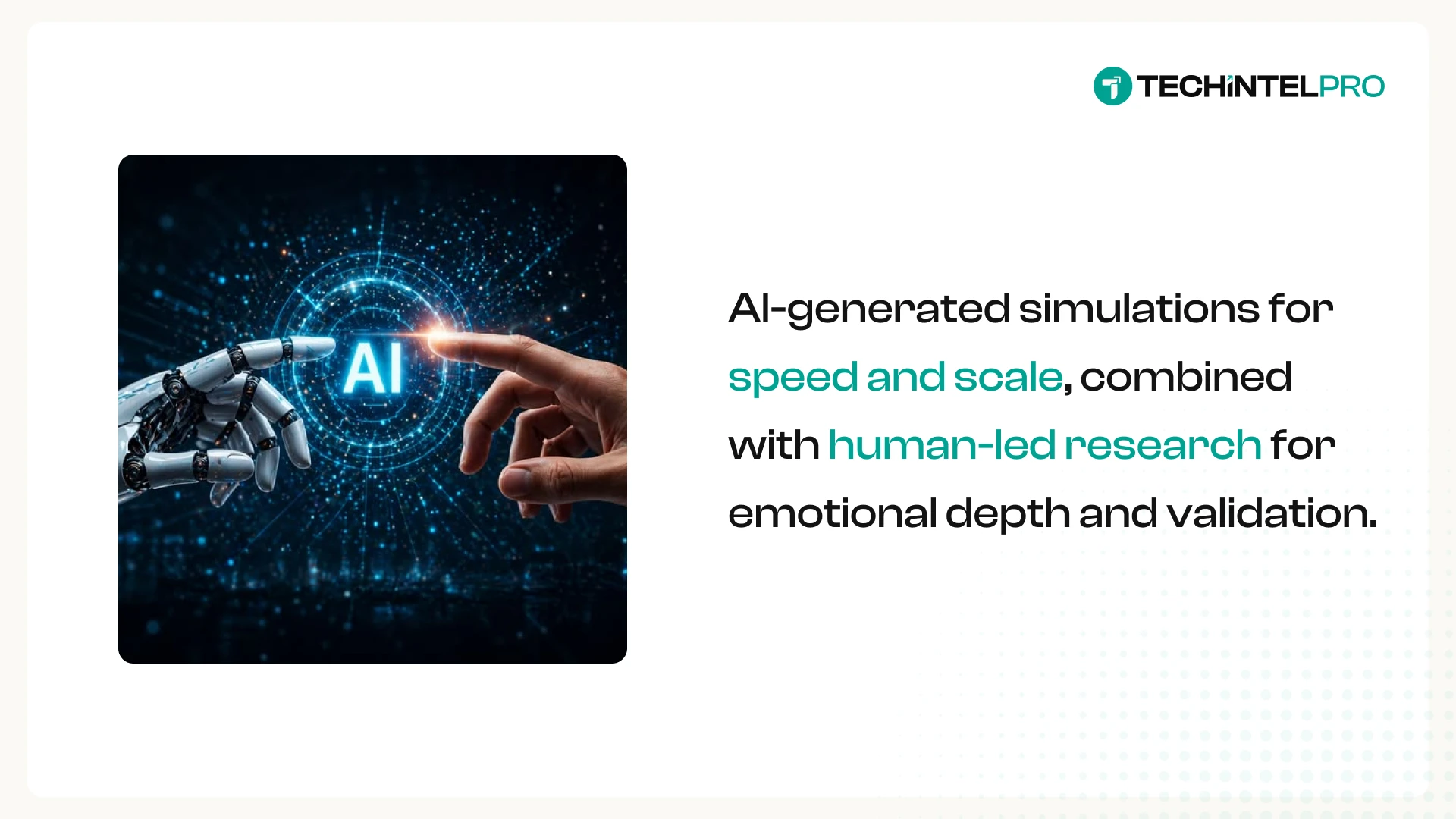
That’s why most organizations see synthetic consumers as an additional intelligence layer rather than a replacement for human research. In practice, the strongest approach is likely a hybrid one: AI-generated simulations for speed and scale, combined with human-led research for emotional depth and validation.
This balance matters because consumer behavior is rarely perfectly rational. People make unexpected decisions all the time, and those decisions often shape markets more than predictable patterns do.
Where Market Research Goes Next
Market research is moving away from slow, periodic observation and toward continuous simulation. Companies want systems that can help them test faster, learn earlier, and adapt before competitors do.
That doesn’t mean traditional research disappears. Human insight still matters too much for that. But it does mean the research function itself is evolving.
In the coming years, the organizations that gain the biggest advantage will be the ones combining AI-driven simulation with human judgment in smarter ways.