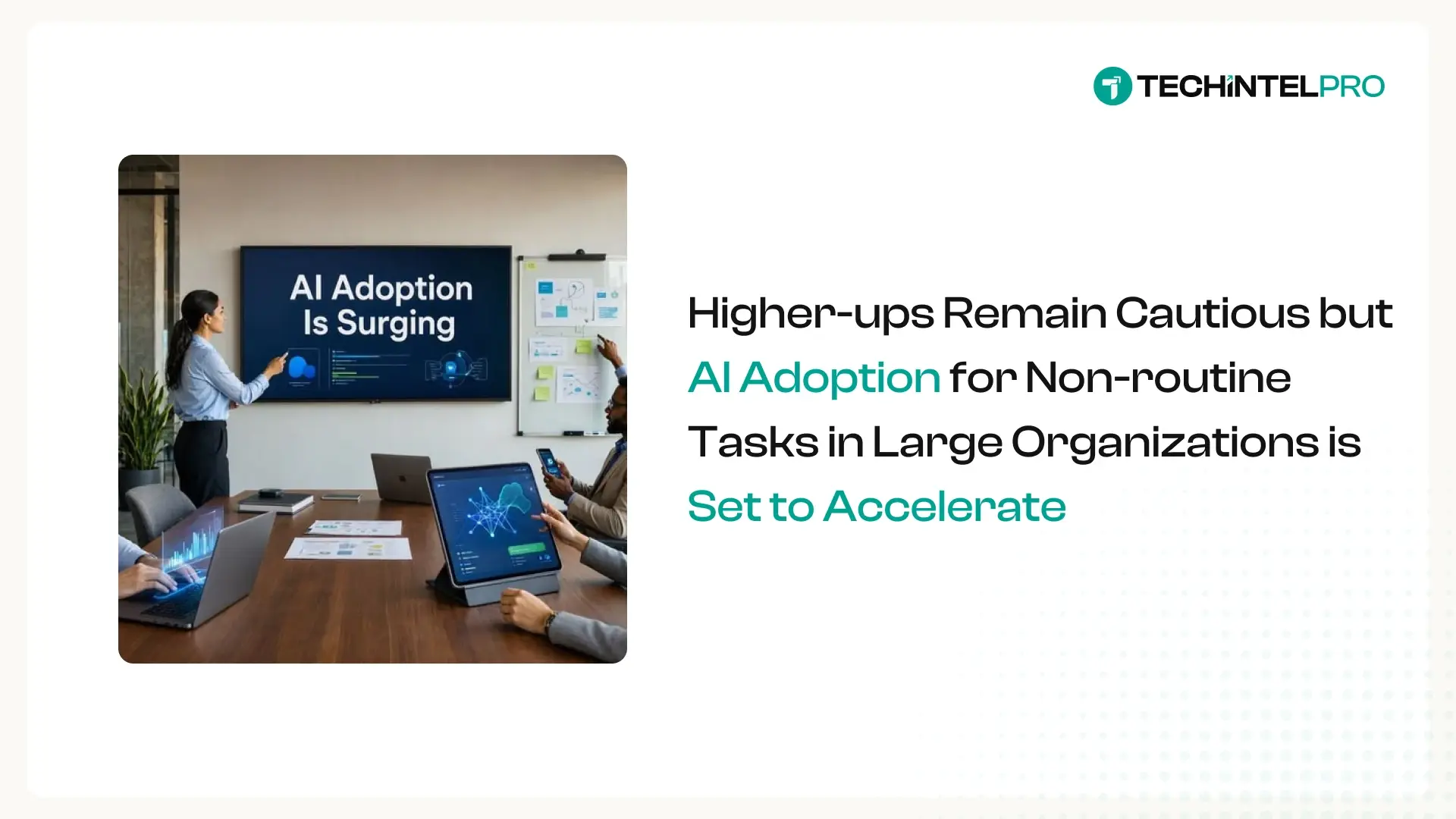
One of the primary benefits of AI for an organization is its automation of repetitive or routine tasks in a business environment. AI automation is business is especially beneficial for large organizations, where there are many gears grinding and the streamlining of a routine task can have organization-wide benefits.
The question arises, however: can AI make the leap and actually be used for non-routine tasks that have a huge impact on the organization? It is imperative to examine the validity of AI in decisions that can affect an organization’s finances, operation, or any other critical capability. Using AI for routine tasks such as compiling the minutes of a meeting or sending reminders to employees is different from using it when taking a decision about changing a supplier, overhauling cybersecurity structure, or entering a new country.
What are Non-routine Tasks in a Large Organization?
Non-routine tasks in a large organization are tasks where daily know-how often goes out of the window. Decisions regarding these can have far-reaching consequences. Usually, these are decisions reserved for the upper and middle management.
Does AI Have a Role in Non-routine Tasks?
AI technology solutions have played a pivotal role in automating a large amount of work in big, multinational organizations. Artificial intelligence in enterprises can streamline and reduce work by recognizing patterns, following set methods, and acting upon data available. For instance, AI in large organizations can auto-reply to mails, update figures in databases, and schedule meetings.
However, when it comes to non-routine tasks, it is these patterns that sometimes need to be broken. Often these are decisions taken after thorough study of markets, by large teams, and after considering and modelling various scenarios.
AI can play a role in this process. It can model scenarios, make data available quicker, and help in research. However, higher-ups in large organizations are cautious about enterprise AI adoption for such tasks.
They warn that what AI lacks is judgement and sound judgment is often the catalyst for the successful completion of a non-routine task.
“An AI system can draw on an engineer’s knowledge, but when it comes to applying that knowledge, it doesn’t have an engineer’s judgment”, said Dustin Johnson, CTO and Founding Partner, Seeq.
“AI should reduce noise, connect evidence, and accelerate detection. When a serious incident occurs, customers still need a person who understands their environment, can interpret the situation, and is accountable for what happens next,” said Aaron Hambleton, Senior Vice President of Product & Services, SecurityHQ.
Thus, senior business managers are urging cautious use of AI in large organizations and not relying on it wholly for tasks where sound judgement is paramount.
The Future
However, things could be changing. As the capability of AI strengthens and it becomes more integrated into the business landscape, it is slowly but surely becoming more important in business decision-making, including non-routine tasks. In an article published in the journal Strategy Science, it was found that business plans generated by AI were judged more favorably by investors in comparison to those formulated by entrepreneurs in a startup competition.
It was also found that AI did work that resembled that of a human assistant to a strategist in terms of its effectiveness. AI’s role was not limited to just bringing up data. Rather, it was tasked with formulating strategies as well.
In a case documented by McKinsey, a software company used AI to narrow down a list of 40 million public and private companies to 15 as suitable acquisition leads. It then further supported the completion of three of these acquisitions.
Hence, even with thought leadership advising caution, the AI train is running at full speed and enterprise AI adoption is widening. AI is being integrated into non-routine decision-making not because of a preconceived notion that it would make things easier but because it is showing real results in testing and trials.
Bridging the Gap from Adoption to Returns
Large enterprise AI adoption has been quick and wide. In a McKinsey survey of large organizations (those with revenue above $1 billion), 40% of respondents revealed scaling AI agents in 2026, up from 27% in 2025. 80% of respondents reported that AI boosted their productivity. However, in the same survey, the impact of AI on EBIT (Earnings Before Interest & Taxes) was only registered by 37% of responders, about the same as 2025.
It can be seen thus, that while AI use on an individual level is having a positive impact, the organization-wide effects tend to be mixed or uncertain. While adoption is large-scale, results are still lagging behind when it comes to large organizations.
Final Thoughts
AI for routine tasks is now commonplace, but large organizations still often shy away from relying on AI for critical tasks. Even among those advocating for the use of AI in large organizations for these tasks, there is an element of caution being advised. Leaders in this space are adamant that AI automation in business cannot replace human judgment.
Instead, the prevailing thought among industry leaders is optimizing AI in large organizations for critical decisions, but keeping a human layer involved as well. By combining these two layers, large organizations are looking to extract the maximum potential out of AI and gear it towards increasing returns, instead of just automation of AI for routine tasks.