
 Shradha Vaidya
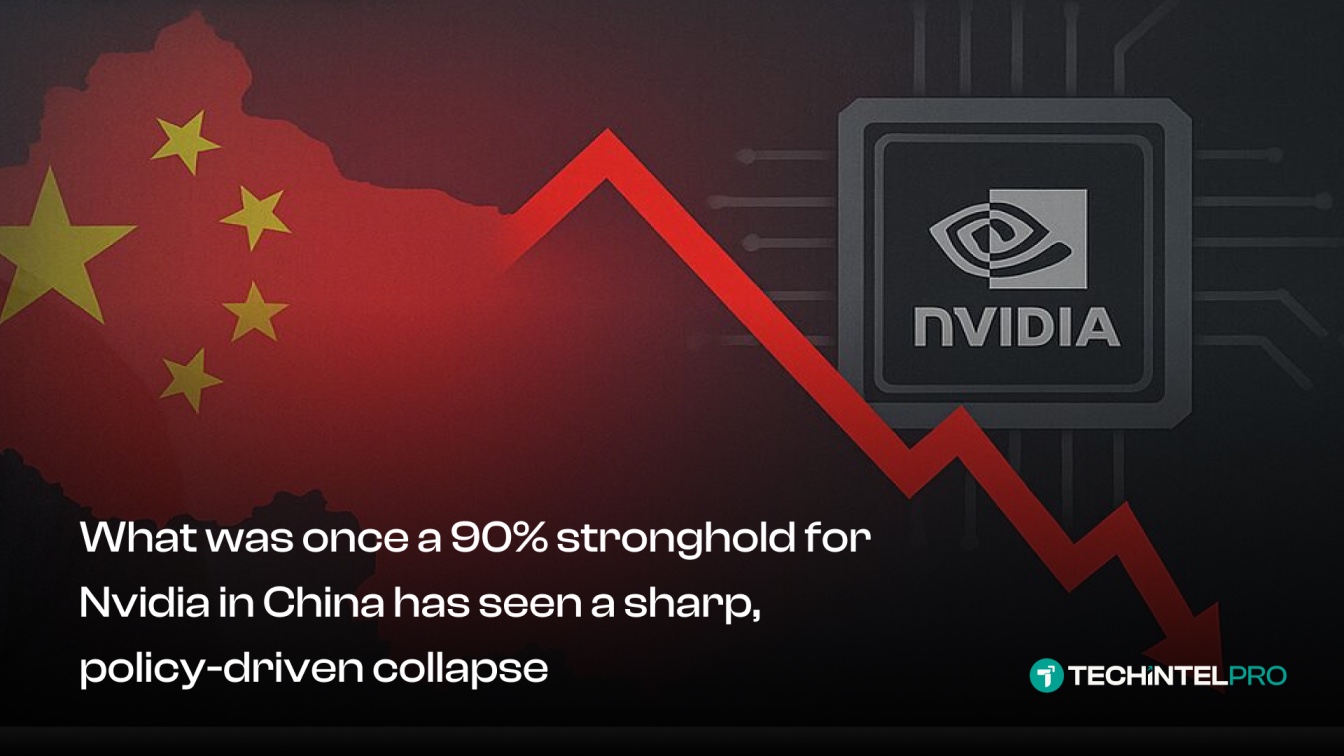
When Jensen Huang recently said that Nvidia’s market share in China has fallen to zero, it didn’t come across as a dramatic headline. It felt more like a reality check for the entire AI industry.
Because not too long ago, Nvidia wasn’t just present in China; it was dominant.
A couple of years back, Nvidia controlled somewhere between 90% and 95% of China’s AI GPU market. Its chips were everywhere – from hyperscale data centers to AI research labs. If you were building serious AI systems in China, chances are you were using Nvidia hardware.
That’s what makes the current situation so striking. This wasn’t a slow decline caused by competition or changing demand. It was a sharp drop, almost overnight in industry terms.
The key force at play here isn’t a competing firm; it’s regulatory policy.
The dominant factor here isn’t market competition, but regulation.
From 2022 onward, the US government placed export limits on advanced AI chips to China, including high-performance Nvidia GPUs such as the A100 and H100. Even when Nvidia introduced reduced-performance versions to stay within the rules, those chips were later pulled into the increasingly strict export restrictions as well. At that point, Nvidia wasn’t really competing in China anymore; it simply couldn’t sell its core products there.
China wasn’t a side market for Nvidia. At its peak, the region contributed roughly 20–25% of Nvidia’s data center revenue, which is the same segment driving the company’s AI boom. The impact of losing that level of contribution goes beyond quarterly earnings—it can fundamentally change how a company approaches growth.
Demand from the US, Europe, and other regions remains solid, but offsetting the loss of a market like China is far from simple, particularly given its rapid pace of expansion.
Jensen Huang hasn’t exactly stayed quiet about this. His argument is pretty direct: cutting China off from US chips might not slow it down, but push it to move faster.
If Chinese companies can’t rely on Nvidia, they’ll build their own alternatives. And once those alternatives mature, they won’t just serve China, but start competing globally.
That’s the part that worries industry leaders. What starts as a restriction could end up creating a whole new set of competitors.
And that shift is already happening.
Companies such as Huawei are ramping up investment in AI chips to help offset the gap left by Nvidia. In parallel, Chinese developers are adapting their software to run on domestically produced hardware, steadily reducing reliance on foreign technology.
If this trend persists, it may lead to the formation of two separate AI ecosystems: one anchored in the United States and another emerging within China.
That would represent a sharp departure from the more interconnected global tech environment of just a few years ago. And for Nvidia, getting back into China—if that even becomes possible—won’t be as simple as picking up where it left off.