
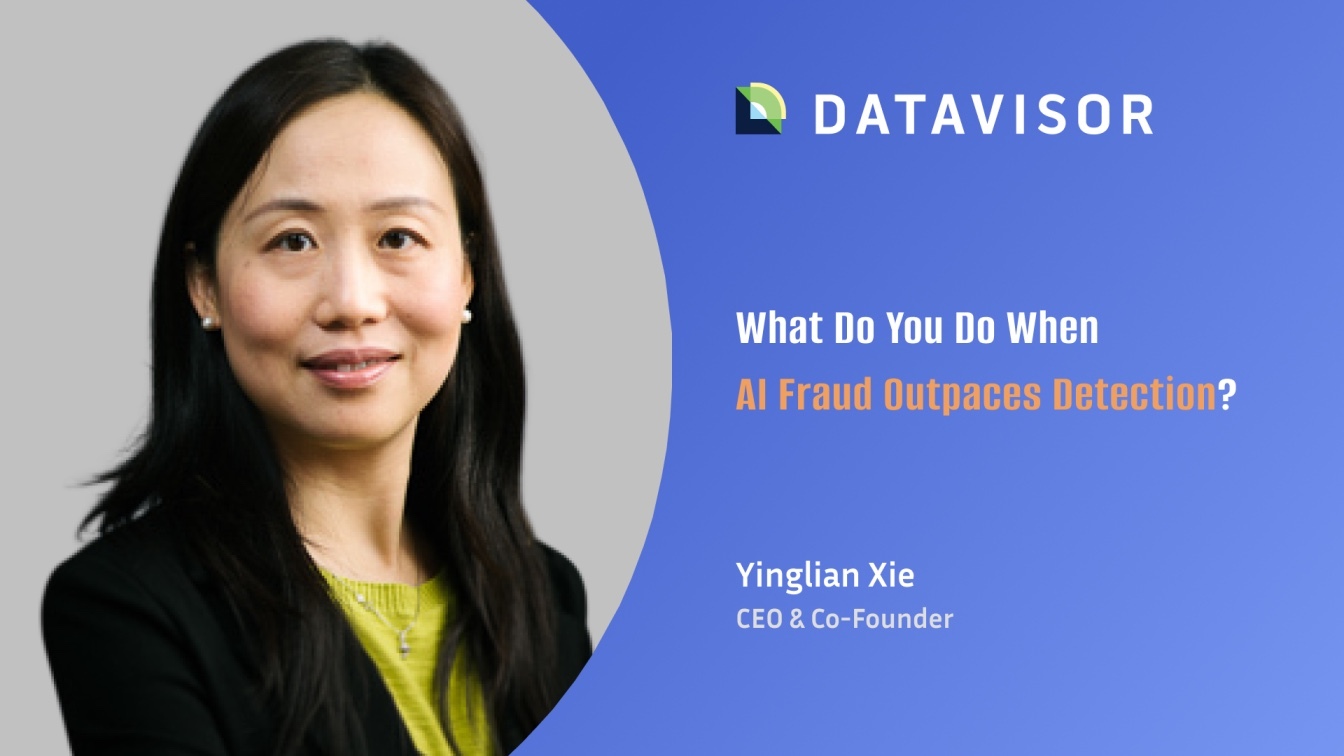
AI fraud is no longer just more sophisticated; it’s faster than the systems designed to detect it. And when detection lags, even the best AI becomes ineffective.
Yinglian Xie, CEO of DataVisor, unpacks why the real challenge isn’t adopting AI, but operationalizing it. She explains how fragmented data, siloed teams, and delayed decision-making are creating an “AI readiness gap,” and what it takes to close it: from unified data foundations and connected workflows to real-time, AI-driven execution across detection, investigation, and response.
My journey started in academic research, where I focused on detecting large-scale system abuse and emerging cyber threats. At Microsoft Research, I was studying how to identify threats by finding correlations between seemingly unrelated events. That work exposed a fundamental blind spot in traditional fraud systems.
Most systems at the time focused on isolated signals and predefined rules. That approach worked when fraud was simpler, but it broke down as attacks became more coordinated and subtle. Fraud is no longer just about obvious anomalies; now it's about hidden relationships across users, devices, and behaviors that traditional systems could not connect.
I also saw how reactive these systems were. By the time a rule was created, the attack had already evolved. The gap between how quickly fraud was changing and how slowly systems could respond was a key driver in the founding of DataVisor. We wanted to build machine learning–first systems that could uncover emerging fraud patterns in real time and detect coordinated attacks before they caused damage.
The AI readiness gap reflects a deeper operational issue, not just a lack of technology. Our report shows that 74% of leaders see AI-driven fraud as a top threat, yet 67% struggle with the infrastructure and data needed to defend against it. Only 23% feel they have the right foundation in place. We are seeing that this gap is driven by fragmented data, siloed teams, and operating models that are not built for real-time decision-making.
To successfully close this gap, it requires unified data, connected workflows, and operating models designed for continuous, real-time execution. Moving from reactive to proactive systems.
The biggest shifts in attacker behavior and tooling are speed and scale. Fraudsters are able to use AI to automate attacks, generate synthetic identities, and run coordinated campaigns that closely mimic legitimate behavior. These attacks are happening faster than before. 52% of leaders say fraud velocity is their biggest challenge, especially with real-time payments, which reduces the window to detect and respond.
At the same time, fraudsters are not constrained by legacy systems or governance. They can adapt quickly, while many institutions are still dealing with fragmented data and slower processes. Both of these lead to an imbalance, allowing attackers to stay ahead.
To achieve a unified view, it starts with data. Organizations need a unified data layer that brings together the full customer lifecycle. Just as important is breaking down silos across fraud, AML, and risk teams so they can share this data and operate from the same view.
When systems and workflows are connected, organizations can detect patterns that would otherwise be missed and speed up operations that would otherwise be slowed by disconnected systems.
AI agents are changing how fraud teams operate by turning intent into action. With platforms like Vera, DataVisor’s conversational AI agents for fraud and AML, teams can give instructions in plain language and have the system carry them out across detection, investigation, and reporting. This removes a lot of the manual work that slows teams down and allows them to respond more quickly. It also helps surface insights and support investigations in a more consistent way.
We are also seeing a shift in how leaders think about AI. 50% now rank investigator assistance as the top use case, ahead of detection. The value is not just in identifying risk, but in helping teams act on it faster.
The biggest shift is speed. Fraud is now happening at a pace where traditional review cycles no longer function. With real-time payments and faster onboarding, institutions have far less time to detect and stop suspicious activity. This requires a move to continuous, real-time decision-making. Teams need access to more signals and the ability to act immediately, rather than relying on delayed reviews or manual handoffs.
At the same time, customer experience cannot be an afterthought. Leaders are balancing two pressures. 52% say fraud velocity is their biggest challenge, but they also know that adding friction can hurt growth. To ensure that customer experience is not compromised, fraud teams need more precise detection, better use of data, and faster decisions that reduce risk without disrupting legitimate users.
To start taking meaningful steps to begin closing the AI Readiness Gap, organizations should start by addressing the data foundation. 48% of organizations cite data fragmentation as a top challenge, and without unified data, it is very difficult to build effective AI defenses.
The next step is reducing silos across fraud and AML functions. 81% of organizations are already considering a more unified approach, reflecting a growing understanding that shared data and coordinated workflows are necessary to improve visibility and response.
From there, organizations need to move beyond isolated AI use cases and start operationalizing AI across the full lifecycle, including detection, investigation, and decision-making. Closing the gap ultimately comes down to aligning data, workflows, and operating models so institutions can respond in real time and keep pace with increasingly sophisticated threats.
Yinglian Xie is CEO & Co-Founder of DataVisor, a leading Silicon Valley-based technology company, providing advanced fraud management solutions powered by artificial intelligence. Before founding DataVisor, Yinglian worked at Microsoft Research, where her focus was on advancing the security of online services with big data analytics and machine learning. Yinglian completed both her Ph.D. and post-doctoral work in Computer Science at Carnegie Mellon University and currently holds over 20 patents in her field. A highly-regarded researcher, author, and conference contributor, Yinglian is widely regarded as one of the most influential figures in the areas of artificial intelligence, machine learning, and big data security.
More about Yinglian: 
DataVisor is the most comprehensive fraud and financial crime prevention platform powered by sophisticated AI and modern machine learning capabilities. DataVisor empowers customers to protect against future attacks before they happen by detecting and acting on rapidly evolving fraud patterns in real time. DataVisor’s adaptable solution and data-driven approach provide businesses with unparalleled protection in an ever-evolving digital landscape. DataVisor’s award-winning solutions and continuous innovation make it the trusted partner of choice for Fortune 500 companies and leading organizations worldwide, specializing in financial services, banking, credit unions, fintech, and payments.
Learn more at datavisor.com
Tell others what you think of TechIntelPro.



 Rate us on G2

