
Newsletters are no longer just a publishing format. They’re fast becoming the backbone of the modern media business.
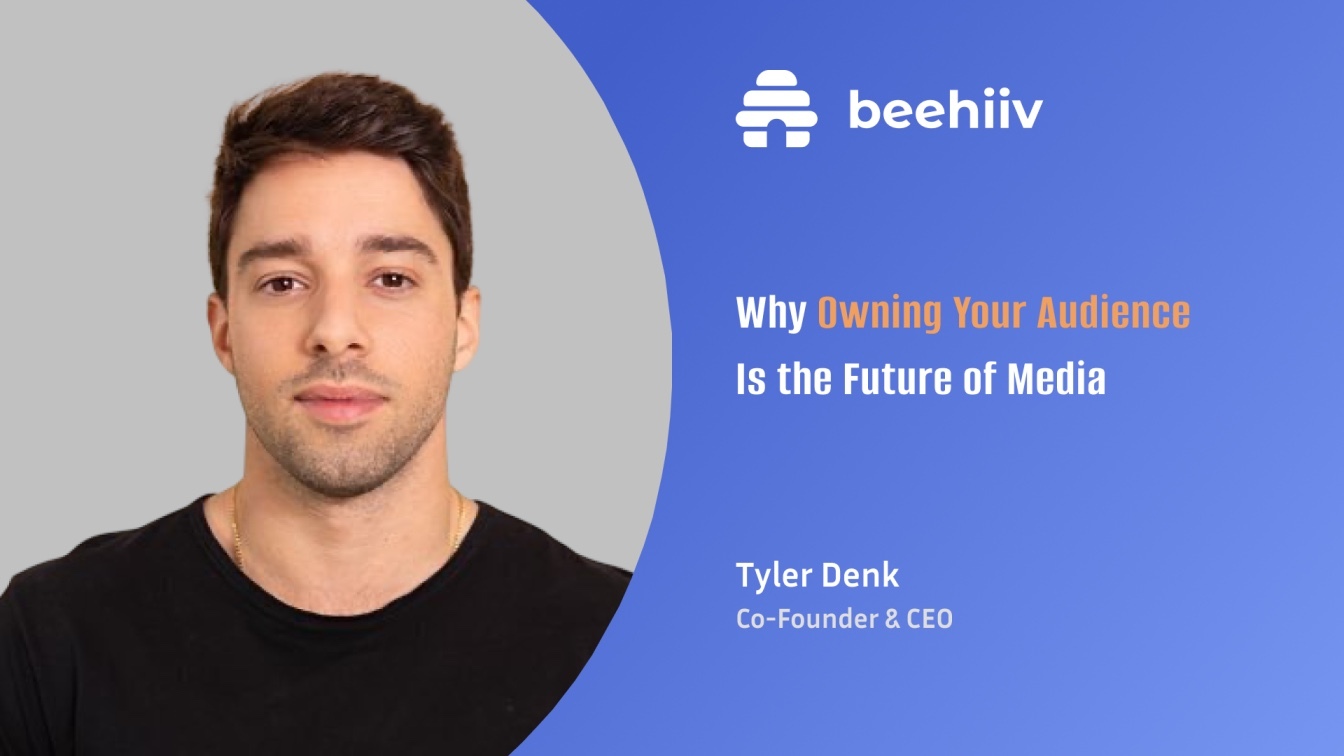
Tyler Denk, Co-Founder & CEO of beehiiv, talks about why the inbox has turned into one of the most valuable spaces in media today. From independent journalists building profitable newsletter businesses to legacy publishers rethinking how they connect with readers, Tyler unpacks the bigger shift toward audience ownership and sustainable monetization.
The timing is fitting: Tyler will be on stage at SXSW this week with Scalable Co-Founder Jasmine Enberg for a candid, tactical conversation on what actually drives sustainable growth in the creator economy today.
Honestly, this recognition belongs to the beehiiv Ad Network team. Newsletters are one of the most trusted, direct channels between a writer and their audience. That intimacy is what makes them so valuable to marketers. But the buying experience never matched the opportunity. When we acquired Swapstack in 2023, we rebuilt the entire marketplace and layered AI on top of it. Our models analyze audience signals, publisher content, and historical performance to match the right advertiser with the right newsletter in real time. Publishers on beehiiv went from earning roughly $500K a month in advertising at the start of 2025 to over $1M a month by year-end. We just launched On-Demand Ads: premium sponsorships available whenever you want them, without the wait or the back-and-forth.
The real scoreboard is whether we're building infrastructure that works at every level of the market – from the independent journalist earning real dollars from the business they built, to our major news and media titles like the Washington Post, which just launched Verified, a weekly newsletter about the creator economy from WP Creative newsletter. When legacy media and independent creators are building on the same platform, that tells you something about where the content economy is actually heading. Maybe where it already is.
Everyone in that room understood that the old distribution model was broken. Some have already made the move. I just mentioned the Washington Post. We also have Time, Newsweek, The Texas Tribune, and Stocktwits building on beehiiv. But a huge portion of legacy media organizations are still dependent on platforms they don't own and can't control. What made it interesting was having both ends of the spectrum in the same room: legacy media journalists and executives sitting alongside independent creators like Tom Alder from Strategy Breakdowns, and newer news outlets like The Nerve, which launched on beehiiv just a few months ago and is already profitable.
That's the tension. The awareness is there. I gave my talk on audience ownership, and the room was with me the whole way. But awareness doesn't grow your audience. Action does. That's what we're here for.
The instinct that gets people into journalism is almost the opposite of the instinct required to run a business. You become a reporter because you want to chase stories, not profits. When journalists go independent, the editorial side clicks immediately. The part that feels foreign is the financial architecture. What do I charge? How do I structure a paid tier? Should I run ads or does that compromise my credibility?
That's exactly the problem we're solving. We also created the beehiiv Media Collective to specifically support journalists making that transition, giving them the tools and resources they lose when they leave a traditional newsroom. And the Ad Network takes the monetization piece further. The goal is to make the business side as easy as possible so journalists (and all of our creators) can focus on the content.
Legal cover, health insurance, and editorial support, to name a few. At a legacy outlet, there's a lawyer reviewing copy, HR managing benefits, and an entire team working to get your byline in front of people. You don't think about any of it because it just exists. The moment you go independent, you realize the infrastructure was doing enormous invisible work.
And then you have to focus on distribution, too. At a major publication, your story gets promoted through channels you never had to build. When you leave, you're starting from zero on that front without even realizing it was something you'd have to think about.
The Media Collective provides many of those services so that you can succeed as an independent journalist. We can't replicate a newsroom. But we can try to make sure the absence of one doesn't stop you from doing your best work.
The independent journalist's challenge is scale and time. They know exactly who their reader is, and the relationship quality is incredible. The challenge is growing from 5,000 to 50,000 without losing what made it special. The large media organization's challenge is almost the inverse. They have scale and brand recognition. What they may lack is a real understanding of who's actually in their audience. Wendy McMahon said it best at our London conference: newsletters provide intimacy and authority. That's what legacy media is chasing right now.
The good news is that the tools exist to bridge that gap. The independent journalist is already building direct relationships by default. The legacy media organization has to consciously make that shift by investing in owned channels.
The practical change is that your incentives finally align with your readers instead of a platform algorithm. I always use the Amazon versus Shopify analogy. If you sell on Amazon, Amazon owns the customer. You're just a vendor. Shopify takes the opposite stance: here's the infrastructure, but the merchant owns every customer relationship. Most publishers have spent years building on the Amazon model without realizing it. beehiiv is built to be the Shopify of this space. You own your list, your data, your relationships. We're just the infrastructure that makes it possible.
On the revenue side, the difference is dramatic. Creators and publishers who own their subscribers can tell an advertiser: I have 80,000 subscribers, here’s who they are, here's what they click on, here's my open rate over the last 90 days. That's a completely different conversation than "I get about 300K monthly page views, give or take." And with our Ad Network, even a creator or journalist with 15,000 subscribers can access the same premium brand relationships that used to require a dedicated sales team. Netflix and Roku aren't just for the big outlets anymore.
The thing I'm most acutely aware of is that we cannot become the thing we were built in opposition to. The whole thesis of beehiiv is that publishers got burned by platforms that eventually put their own interests ahead of the people publishing on them. Facebook did it. Twitter did it. That means our responsibilities are structural, not philosophical. We don't take a cut of subscription revenue. That's a deliberate decision to keep our incentives aligned with publishers, not extracting a percentage of everything they earn.
The harder responsibility is access. The best tools in media have historically concentrated at the top. Our job is to make sure the independent journalist with 8,000 subscribers gets access to the same monetization infrastructure as a major publisher. And to make sure they have the tools and support to scale.
The way we think about it is simple: AI should handle everything that isn't journalism, so journalists can focus on everything that is. Matching a sponsor to a newsletter, tracking campaign performance, optimizing distribution, analyzing audience data – that's infrastructure work. Our AI does it. That frees up a reporter to develop sources, chase stories, write, and do the editorial work to build a loyal audience.
The risk is when AI gets used to shortcut the journalism itself. Our job at beehiiv is to make the infrastructure faster and smarter, so that the journalist can enhance the journalism. I mentioned The Nerve earlier, but that's just one example. Oliver Darcy, Lachlan Cartwright, Kat Tenbarge, Ryan Broderick, Richard Lawson, David Begnaud, who has built his own media company on beehiiv while remaining a CBS News contributor. The list keeps growing. These are serious journalists building real businesses and never compromising on the reporting.
For me, it's simple: when going independent is a viable economic decision for every journalist. There are already creators and journalists building extraordinary businesses on beehiiv. Real sustainability looks like that becoming the norm – reporters building large, loyal followings, making a reliable living, and owning and building real media businesses. The work continues, just through a different infrastructure. One that we are building.
Owned audiences, better monetization, AI removing the operational overhead that used to require a full staff…those conditions are certainly being created. If more and more journalists actually make the leap and build on their own, that's the question I'll be watching over the next five years. I hope they do. And that's exactly what beehiiv is here to support.
Tyler Denk is the co-founder and CEO of beehiiv, the all-in-one platform that brings together newsletters, websites, and every tool you need to grow and earn. He is also the author of the Big Desk Energy newsletter.
More about Tyler: 
beehiiv is a fast-growing all-in-one content platform designed for creators, publishers, and media organizations to launch, grow, and monetize newsletters, websites, and digital businesses – all without taking a cut of user revenue. Founded by former Morning Brew product leads, beehiiv provides powerful email, web, analytics, and monetization tools alongside innovations like native podcast hosting, AI site builders, and real-time user data, helping over 100,000 publishers reach hundreds of millions of readers monthly. With seamless onboarding, advanced segmentation, and an integrated ad network, beehiiv empowers users to fully own their audience, brand, and business in the rapidly evolving creator economy. beehiiv owns the content economy.
beehiiv is trusted by leading media brands and high-profile creators, including TIME, The Boston Globe, LA Magazine, Texas Tribune, The Washington Post, TechCrunch, and top names like Arnold Schwarzenegger (“Arnold’s Pump Club”), former CNN senior reporter Oliver Darcy, Product Hunt, The Ringer, Blockworks, Milk Road, and more.
Learn more at beehiiv.com
Tell others what you think of TechIntelPro.



 Rate us on G2