Organizations aren’t short on insights; in fact, they’re buried under them. Valuable research sits scattered across decks, tools, and teams, rarely showing up when real decisions are made.
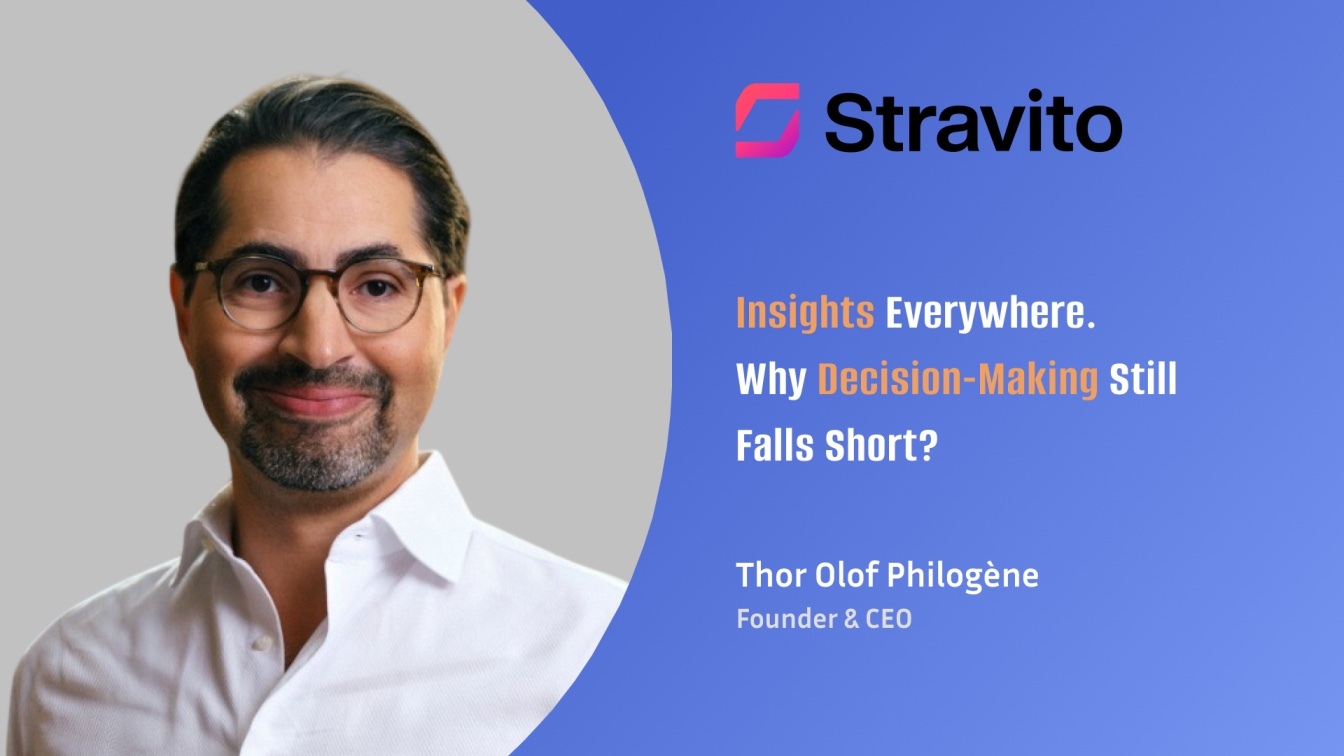
Thor Olof Philogène, CEO & Founder of Stravito, explains why this gap persists and what it takes to close it. From rethinking how insights are surfaced and applied, to combining AI’s processing power with human judgment and trust, he lays out a clear path to turning dormant knowledge into decisions that actually hold up under pressure.
Before founding Stravito, I spent my career building companies at the intersection of technology and commerce, most recently as Chief Revenue Officer and VP Growth at iZettle, the European fintech (acquired by PayPal for $2.2bn in 2018).
The same pattern kept surfacing, both from my own experience and from conversations with leaders across industries.
The problem wasn’t a shortage of data – organizations were sitting on a vast amount of high-quality research – but teams couldn't find and apply what they already had. Teams repeatedly commissioned new studies not because the answers didn’t exist, but because existing insights were buried in decks, scattered across systems, or siloed between teams, and rarely accessible when decisions were actually made.
Stravito was founded to close the gap between insight and action, helping global brands turn what they already know into better commercial decisions.
It usually comes down to speed, fragmentation, and confidence. If it takes too long to find relevant insights, teams often won’t wait.
At the same time, insights are often spread across teams, markets, and formats, which makes it difficult to know if you’re seeing the full picture or just part of it.
And even when research is accessible, often there’s an interpretation gap: translating raw research into clear action takes time and expertise most teams can’t spare. The result: major decisions go forward without the intelligence that already exists to inform them.
AI excels at processing information — synthesizing large volumes of research and surfacing patterns quickly. But it doesn’t replace judgment or accountability. It can’t determine what matters most to the business, how to weigh trade-offs, or what risks are acceptable. Those decisions should remain with people.
AI is also only as strong as the context it's given. It can analyze what the data says, but not always how it should be applied within a specific market, brand, or product. And crucially, AI doesn't know what it doesn't know. If it's only working with part of the picture, it will generate a confident-looking answer based on incomplete information. That's a real risk when the stakes are high. The good news is you can design around this. The right system will explicitly identify what it needs to answer with confidence, and flag where the gaps are.
And this ties nicely to trust. If outputs aren't grounded in verified, source-backed information, teams hesitate to act on them. Speed without credibility isn't useful. That's where the combination matters: AI handles the heavy lifting, but human expertise provides context, confirms direction, and ultimately decides what to do next.
Most enterprise AI tools today are optimized for speed. They generate quick answers or summaries, but often lack the depth, sourcing, structure, and rigor required for complex business decisions.
The gap we set out to close was turning those outputs into answers that decision makers can actually rely on. Stravito’s Deep Research Agent does this by planning and executing multi-step research, working across complete documents, and grounding its outputs in verifiable, source-backed evidence from a company’s own knowledge, rather than unverified information from across the web.
The result is analyst-depth, citation-backed answers that stand up to the level of scrutiny commercial decisions require.
Much closer than often expected because the issue is rarely a shortage of data, it's often that what already exists sits unused in static PDF reports rather than informing the next decision.
Many organizations already have detailed segmentation studies and consumer research. Stravito AI Personas bring those to life, letting teams simulate how different consumer groups might respond to an idea, a message, or a product — in hours, not weeks.
It’s not a replacement for fresh data or real consumer testing, but a way to accelerate early-stage exploration so teams can focus on the most promising ideas before investment is committed. Think of it as an early warning system, not a final validation tool.
Scaling a high-growth company teaches you that adoption is the real challenge, not just building a great product. We saw first-hand how quickly momentum builds when something is intuitive, trusted, and clearly tied to outcomes people care about.
Enterprise adoption follows the same principle, but it’s less linear. It happens across teams, regions, and levels. You have to prove value early and design for scale from the start.
That’s shaped how we build Stravito. We prioritize fast time to value, making it easy for teams to access and apply insights immediately, while ensuring the platform supports global, cross-functional use.
It also reinforced how critical trust is. Adoption only scales if people believe in the outputs, which means grounding everything in source-backed research and aligning with how decisions are actually made.
All three, depending on what's at stake.
AI will increasingly gather, synthesize, and pressure-test information — shifting teams from finding answers to evaluating them. That's a meaningful change. But human judgment remains non-negotiable when decisions involve ambiguity, trade-offs, or consequences that are hard to reverse.
The future isn't AI replacing decision-makers. It's AI raising the baseline, so that when humans do make the call, they're doing it faster, with better evidence, and with greater confidence in the outcome.
Thor Olof Philogène is CEO & Founder of Stravito, an AI-powered enterprise knowledge management solution that allows employees at Fortune 2000 organizations to store, discover, share, and integrate consumer insights in seconds. Today, the business counts world-leading brands such as Heineken, Comcast, and Nestlé as customers.
Prior to Stravito, Thor was Chief Revenue Officer and VP Growth at fintech company iZettle (now Zettle by PayPal following a $2.2bn acquisition in 2018). Thor holds a M.Sc. in Business Administration from Stockholm School of Economics.
More about Thor: 
Stravito is the Insights Intelligence Platform global brands trust to ensure their major decisions are backed by the full weight of their existing knowledge.
The platform unifies research in a secure space where teams ask strategic questions and receive synthesized, source-cited answers via the Stravito AI Assistant. AI Personas – built from your own segmentation studies – simulate authentic consumer perspectives, enabling teams to stress-test products, campaigns, and strategies in real-time. The result: evidence-backed decisions, accelerated market impact, and commercial momentum.
Founded in Sweden in 2017, Stravito is trusted by global leaders including Nestlé and Comcast. The company is ISO 27001 certified, SOC 2 Type II attested, and has been recognized in the Financial Times’ FT 1000 list of Europe’s fastest growing companies.
Learn more at stravito.com
Tell others what you think of TechIntelPro.



 Rate us on G2