
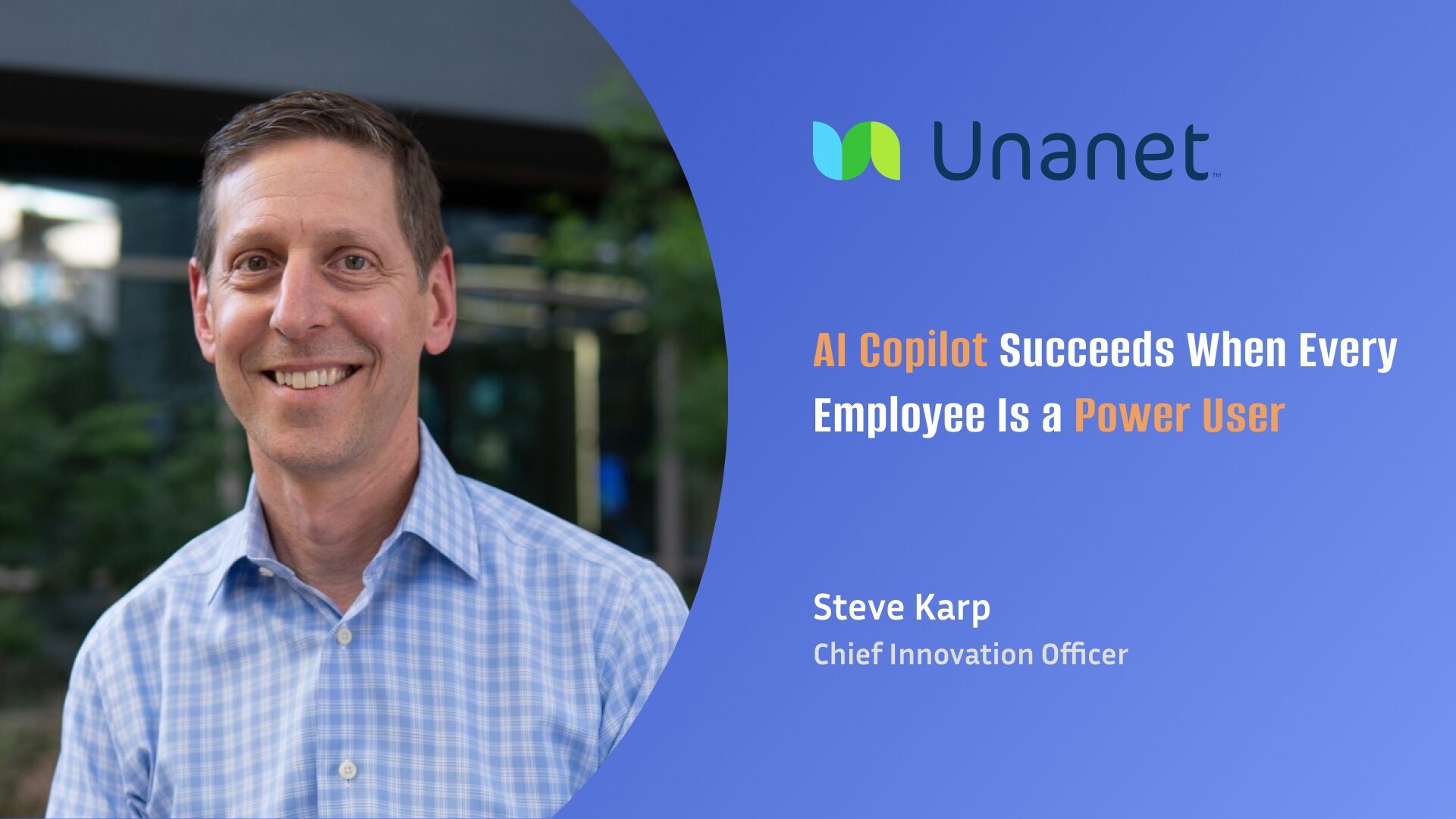
This fall, the software provider Unanet unveiled ChampAI, its platform of natural language copilots for companies in the worlds of government contracting and architecture, engineering, and construction (AEC). ChampAI today is comprised of Champ for Proposals and Champ for ERP, powered by Wyatt, and with more to come.
For Unanet, a tech company that is widely viewed in those markets as progressive, AI-forward, and customer-focused, ChampAI represents an important, boundary-pushing evolutionary step. The new AI platform is no ordinary chatbot. Its copilots are purpose-built for the AEC and government contracting industries, all integrated within Unanet’s ERP and growth solutions.
We spoke with Steve Karp, Unanet’s Chief Innovation Officer, to understand how ChampAI natural language copilots work, what makes them different from the legions of chatbots now populating the landscape, and how they raise the bar in terms of what a copilot should do for a business and the people within it.
Most chatbots are efficiency boosters, nothing more, nothing less. They help people execute tasks and find answers faster. ChampAI copilots are much more than that. Yes, they are adept at executing multi-step tasks and answering queries. But really, they are context-aware effectiveness drivers for people. They amplify the talent, experience, and skills people bring to their jobs, whether they work in project management, accounting and finance, business development, sales and marketing, operations, or the C-suite. They put a company’s cumulative institutional knowledge, data, and experience, along with predictive insights, at people’s fingertips when they’re needed, in the flow of their work and inside the tools they use regularly. ChampAI copilots also recognize each user’s unique role and tailor actions, responses, and recommendations accordingly. Ultimately, they help people be more productive, make better decisions, and add value to the business.
The ChampAI platform of AI copilots essentially puts an always-on, context-aware subject matter expert alongside all your employees. If I’m an executive and I want to know how KPIs are tracking compared to previous years, or if I’m an entry-level accounting team hire who wants to get up to speed on certain accounting concepts, all I need to do is ask ChampAI.
But it’s not just these query-based interactions that make ChampAI an intelligent teammate. Within a lot of companies, software systems might have a small minority of dedicated “power” users. ChampAI copilots provide a friction-free natural language experience, so every employee can be a power user. All it takes is a bit of prompting know-how, and they’re on their way — no need for highly specialized training or bouncing between multiple systems for answers. It’s all simple, natural, and fast.
Yes, it does. ChampAI as a platform puts multiple AI agents to work on people’s behalf — another aspect of its “intelligent teammate” role.
There’s a cast of agents for projects and accounting. There’s a proposal-creation agent to get proposals far down the drafting path and ready for a human touch. There’s a librarian agent to pull insight from a company’s business development knowledge base. These are just a few examples. The AI agents within the ChampAI platform are trained to autonomously execute a wide variety of tasks, freeing people for higher-value work like relationship-building and innovating on projects.
First, focus on the quality of your data. The quality of output from a copilot depends on the quality of data feeding it. So be sure your data is clean and well-managed according to clearly defined standards. Your AI tools need the ability to readily access data across systems. If it’s stuck in siloed systems, that’s an issue. Optimally, you want a single, tightly integrated digital environment where data flows across systems to your AI tools.
Also, ensure there is human-in-the-loop validation with all your AI tools as part of a broader, clearly defined AI governance program. Be intentional about building a culture that encourages people to explore and regularly use the AI tools at hand. ChampAI requires little to no training to use, but a bit of guidance on crafting prompts goes a long way.
Checks and balances are essential within any application of AI. As powerful a tool as AI is, the models on which it relies can drift over time. That makes consistent human oversight of AI’s output a must. Companies need to have formal processes and structures in place where human beings regularly evaluate how their AI tools are performing — their AI agents, their AI copilots, all of it.
Security and data sovereignty are two things we take very seriously with the AI we embed within our systems. These are non-negotiables for our customers, so they’re non-negotiables for us. Unlike many off-the-shelf LLM integrations, each ChampAI copilot is built on a governed reasoning layer that keeps customer data secure and separate from model training. It’s also important to note that our solutions enforce strict access controls across the platform, full audit logging, and role-based policies, so every query is traceable, every action is validated, and every output is explainable.
Each ChampAI solution is powered by advanced natural-language and agentic AI that lets users simply ask questions or execute tasks using everyday language. Behind the scenes, ChampAI leverages large-language-model intelligence and machine learning to understand context, unify and analyze data across systems, and take informed action that feels intuitive, not technical.
Each ChampAI solution will expand across every team and every stage of the project lifecycle — from pursuit to delivery to closeout. We envision AI helping users make better, faster decisions in the flow of work, turning everyday requests into powerful insights and enabling every user to become a power user.
“ChampAI” as a brand is rooted in our customer experience. Unanet’s annual customer conference is called Champions, so we thought the name was a good fit. Much like the conference, our hope is that each ChampAI solution will help every day Unanet users become power-users (“champions”) of their Unanet solutions, and by extension, impact their businesses.
Steve Karp leads the strategic assessment and Go-to-Market execution of a broad portfolio of innovative solutions for Unanet customers to access through the company’s ERP & CRM platforms, including AI-powered workflow tools and embedded financial automation solutions. In this role, he champions the continued adoption and use of emerging technologies to develop products helping Unanet customers achieve better business outcomes.
With more than 30 years of strategic and operating experience in the SaaS, Financial Technology & Payments industries, Steve has held senior leadership roles in Strategy, Product, Sales, Finance, and Operations over his career. Prior to joining Unanet in December 2022, he served as Chief Product Officer at OSG, a leading B2B provider of print and digital solutions to consumer billers across a wide range of verticals. Previously, Steve has held executive leadership positions at Upserve, Cardtronics, Worldpay, Truist, and Allpoint. Throughout his career, he’s remained dedicated to embracing innovative, groundbreaking solutions to deliver products that fulfill customer needs.
Unanet is the leader in AI-first ERP and growth software for project-based businesses. Trusted by more than 4,200 government contractor, architecture, engineering, and construction firms, Unanet unifies financials, projects, and pursuits with built-in automation and compliance—all supported by a dedicated customer success team. This empowers leaders to make confident, real-time decisions that drive growth from pipeline to profit.
Learn more at www.unanet.com
Tell others what you think of TechIntelPro.



 Rate us on G2