Enterprise endpoints are multiplying and slipping out of sight. What you can’t see, you can’t secure.
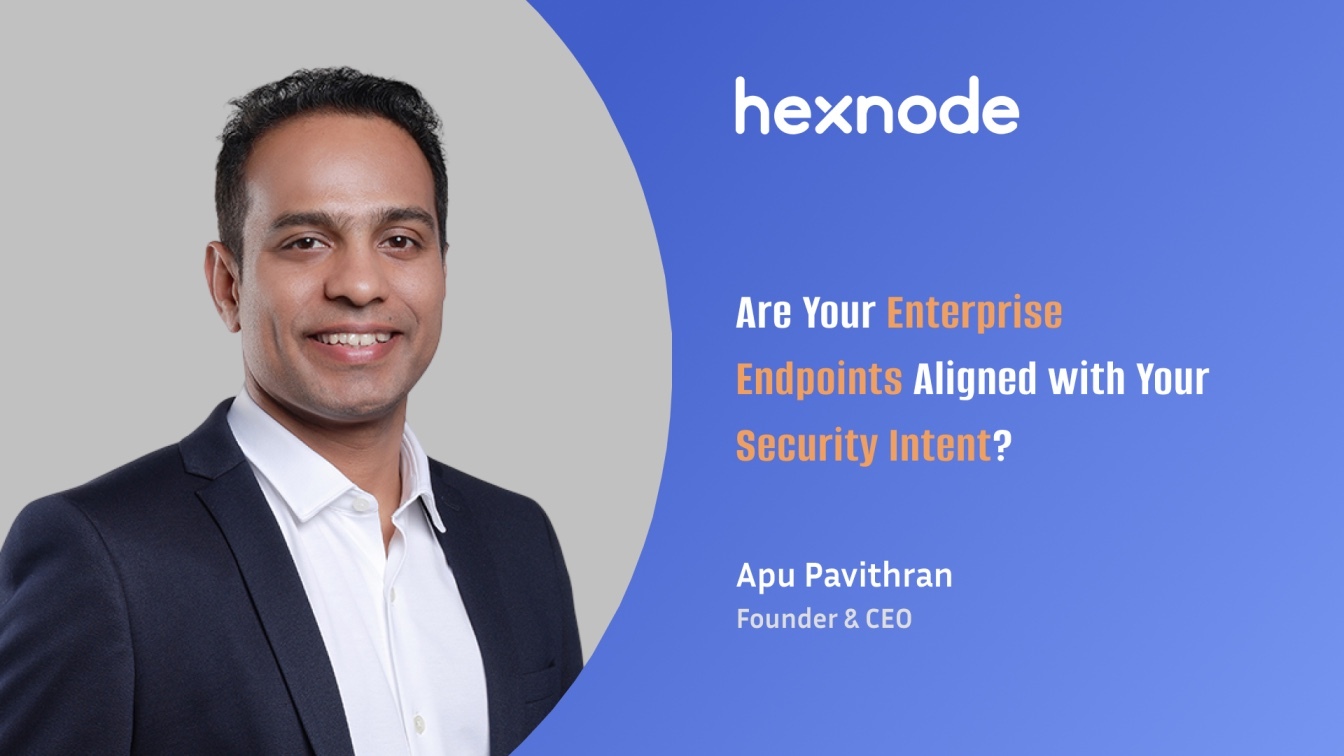
Apu Pavithran, Founder & CEO of Hexnode, shares how modern UEM can bring endpoints back under control with continuous monitoring, contextual visibility, and smarter enforcement across devices. He explores why one-time enrollment falls short, and how enterprises need to shift towards real-time governance—where every device is continuously assessed, aligned, and secured as environments evolve.
In 2013, enterprise IT was caught in a major operational disconnect. The industry was still relying on legacy systems designed for static, office-bound computers, while the actual workforce was rapidly shifting toward mobile, borderless environments. Every new category of device brought its own separate management console, and what seemed manageable at a smaller scale quickly evolved into a highly fragmented and chaotic landscape.
The real catalyst for Hexnode was seeing that this fragmentation wasn't just an administrative bottleneck—it was a fundamental security flaw. As the Bring Your Own Device (BYOD) shift accelerated, corporate data began flowing across hardware and networks that IT couldn't completely monitor. Admins were forced to stitch together entirely different tools just to maintain basic security postures, and every manual handoff between those disjointed systems created blind spots for attackers to exploit.
We realized that if endpoint management was to be the primary gatekeeper, the entire framework had to change. The endpoint had effectively become the new perimeter. Hexnode was born to orchestrate this new architecture of device trust —merging device administration and security into a single, cohesive platform that protects the organization's data without slowing down its people.
The industry’s early blind spot was a preoccupation with the "moment of enrollment." Success was measured by the initial handshake—whether a profile was pushed or an app installed. We viewed this as a dangerous oversimplification. Endpoints aren't static; they drift and constantly change environments.
We realized the real challenge wasn't just getting a device managed, but keeping it in continuous compliance. We focused on the "persistence of governance"—maintaining visibility and control long after provisioning to ensure a device's behavior stays aligned with security intent in real-time.
Another significant oversight was the rigid definition of a "corporate endpoint." The industry treated BYOD, kiosks, and IoT as peripheral, assuming that if a company didn't own the hardware, it wasn't core infrastructure. We recognized that the moment a single byte of enterprise data touches any device, it becomes a critical security node.
In reality, the true enterprise boundary is the data itself. Trust shouldn't be inherited by device type; it must be earned through consistent, cross-platform policy enforcement. While others built silos for different hardware classes, we built a unified framework for a rapidly diversifying device landscape.
From the very beginning itself our aim was to get things done with fewer clicks. Mind you, enterprise security is not simple – but it also doesn't have to be over-complicated. We try to keep everyday workflows front and center, ensuring advanced controls are intuitively organized and accessible when needed, rather than cluttering the screen. Administrators do not think in isolated capabilities; they think in terms of outcomes—enrolling devices, enforcing compliance, and resolving issues. By keeping these workflows coherent and intuitive, the platform remains approachable even as its capabilities grow more sophisticated.
Our interactive dashboard anchors this approach, providing a unified, bird's-eye view into endpoints belonging to various operating systems, compliance statuses, and various other parameters.
Beyond visibility, we recognize that as the endpoint landscape expands, even the best interface needs an intelligent companion. This led us to develop our AI-driven endpoint security tool, Hexnode Genie. Rather than forcing admins to memorize complex syntax or manually dig through data, Hexnode Genie translates natural language into custom scripts, executes critical actions, and queries deep device insights. This represents our broader vision for the future of unified endpoint management (UEM): a shift from being a passive tool of record to an active, intelligent partner.
As macOS became more common across business fleets, the gap between how local administrator credentials were governed on Windows and how they were handled across the macOS environment became harder to ignore. Teams that had already put stronger password rotation and post-access controls in place for Windows increasingly needed that same level of discipline on macOS as well.
Our focus was on establishing privileged access parity. In a hybrid ecosystem, if one part of the fleet has strong administrator account controls and another depends on looser operational practices, then the environment is only as strong as its least-governed endpoint. This creates a dangerous "governance gap" where security is uneven and operational complexity is doubled.
By extending Hexnode LAPS capability to macOS, we are enabling teams to apply a singular, disciplined governance model across their entire infrastructure. This solves the persistent privileged access challenges that often plague non-standard setups and newly provisioned devices. We are effectively removing the "platform tax" from security, allowing CISOs to ensure that their identity and access policies are enforced with absolute architectural integrity, regardless of whether the hardware is running Windows or macOS.
In IoT environments, endpoints drift quickly from their intended state—moving outside approved conditions or going offline without much warning. At scale, the question is not just “Can I see the device?” It is also “Can I trust what I’m seeing, and can I act on it immediately?” With UEM, that starts with a unified asset inventory. Admins should not have to manage scanners, sensors, kiosks, laptops, and phones through separate silos. They need one operational picture that shows how all those endpoints are behaving, even if the policies applied to them are different.
However, basic identification is only the baseline. True UEM visibility must be context-aware. It is not enough to simply know an IoT device exists; a UEM identifies precisely what it is, maintaining real-time data on its vendor, firmware version, and physical location. This depth of insight is what allows IT teams to manage configuration drift. In a task-specific environment like IoT, a modern UEM continuously tracks device posture against approved baselines. If a security patch is removed or a default password is reinstated, the UEM flags that drift and acts on it.
This continuous monitoring is exactly how a UEM transforms visibility from a passive observation into enforceable control. In a Zero Trust model, if an IoT device moves outside a geofenced location or falls out of compliance, the UEM immediately treats that as a change in trust posture. Coupled with conditional access, the UEM triggers the right response in real time—stepping up authentication, restricting access, or blocking the device altogether until its posture is restored.
Furthermore, this real-time data serves as the backbone for regulatory compliance, providing instant, audit-ready evidence for frameworks like HIPAA, GDPR, or NIS2. Ultimately, we are turning the "chaos" of IoT scale into a disciplined, manageable, and highly visible extension of the enterprise security stack.
Closed tool ecosystems have become an active liability in enterprise security. Enterprises are already operating across heavily fragmented stacks, and in that kind of environment, a UEM platform cannot afford to function as an isolated island. It has to serve as a clean operational layer that connects device management with the systems around it, from identity to security.
The modern security ecosystem relies on a "chain of trust" where Identity and Access Management (IAM), Security Information and Event Management (SIEM), and Endpoint/Extended Detection and Response (EDR/XDR) each govern a specific domain. IAM manages access, SIEM orchestrates signals for investigation, and EDR/XDR focuses on detection and response.
The UEM’s strategic role is to provide endpoint context that makes those systems smarter. It should not only push live posture and compliance signals into access decisions but also be capable of ingesting insights back from the stack. Without this bi-directional flow, a UEM remains a passive repository of data rather than an active participant in the security lifecycle.
We recognized early on that relying purely on third-party integrations forces IT teams to constantly stitch disjointed tools together, just to achieve basic security outcomes. To solve this fragmentation, we built Hexnode XDR and Hexnode IdP to fit right into our UEM ecosystem. This provides our customers with seamless convergence across endpoint management, identity verification, and threat response.
At the same time, we ensure that Hexnode remains fully open to interoperate seamlessly with the rest of the industry's leading tools. If a UEM cannot deliver both native cohesion and deep external extensibility, it is actively working against the IT team.
When it comes to expanding the platform, our filter is straightforward: does a new capability help IT admins make a better endpoint decision or take a safer endpoint action? We do not chase industry buzzwords or add features just to inflate a marketing checklist. Whether we are building a native capability from the ground up or engineering a deep, bi-directional integration, our engineering efforts are guided by how much practical value they deliver to the IT team.
That discipline matters because every feature has a hidden cost. It affects product clarity, operational focus, administrative overhead, and customer learning curves. We stay focused on the control plane—ensuring that every addition reinforces Hexnode’s role as the authoritative source of truth for device trust. True focus isn't about how much you can add; it’s about how much you can simplify while maintaining absolute security integrity.
The way we think about it is simple: while the scale of an organization may differ dramatically, the core requirements do not. Startups and Fortune 100 companies alike need strong visibility, reliable control, and automation that removes operational friction. What changes is the environment in which those needs exist—how much complexity a team can manage, how quickly they need to see value, and how broadly they need to scale.
That is why we have been deliberate about not building separate products for different customer segments. Instead, we have focused on creating a unified platform that adapts to the operational realities of each organization. For a startup, that means fast time to value and simplicity without compromise. For a large enterprise, it means the depth, scalability, and policy control needed to operate across teams, regions, and thousands of devices.
Our goal is to make sure Hexnode grows with the customer. A startup should never have to replace the platform as it scales, and a global enterprise should never feel constrained by it.
Apu Pavithran is the visionary Founder & CEO of Hexnode, the enterprise software company behind Hexnode UEM, Hexnode XDR, Hexnode IdP and Hexnode UEM MSP. With over 15 years of experience in enterprise software and cybersecurity, Apu has transformed Hexnode from a small startup into a global leader trusted by organizations in over 130 countries. An avid writer featured in Forbes, TechCrunch, Entrepreneur, etc., Apu frequently shares insights on leadership, enterprise IT, and the evolving future of work.
More about Apu: 
Hexnode is a leading provider of enterprise solutions that streamline device management, user identity, and endpoint security. Hexnode’s platforms include Hexnode UEM for autonomous and AI-powered endpoint management, Hexnode XDR for intelligent threat detection and response, and Hexnode IdP for secure, context-aware identity and access management. Empowering businesses in over 130 countries, Hexnode continues to build a seamless ecosystem of connected tools, one solution at a time.
Learn more at hexnode.com
Tell others what you think of TechIntelPro.



 Rate us on G2