Modern workplaces are flooded with communication, yet employees are struggling with clarity. The more companies communicate, the more disconnected and overwhelmed their workforce often becomes.
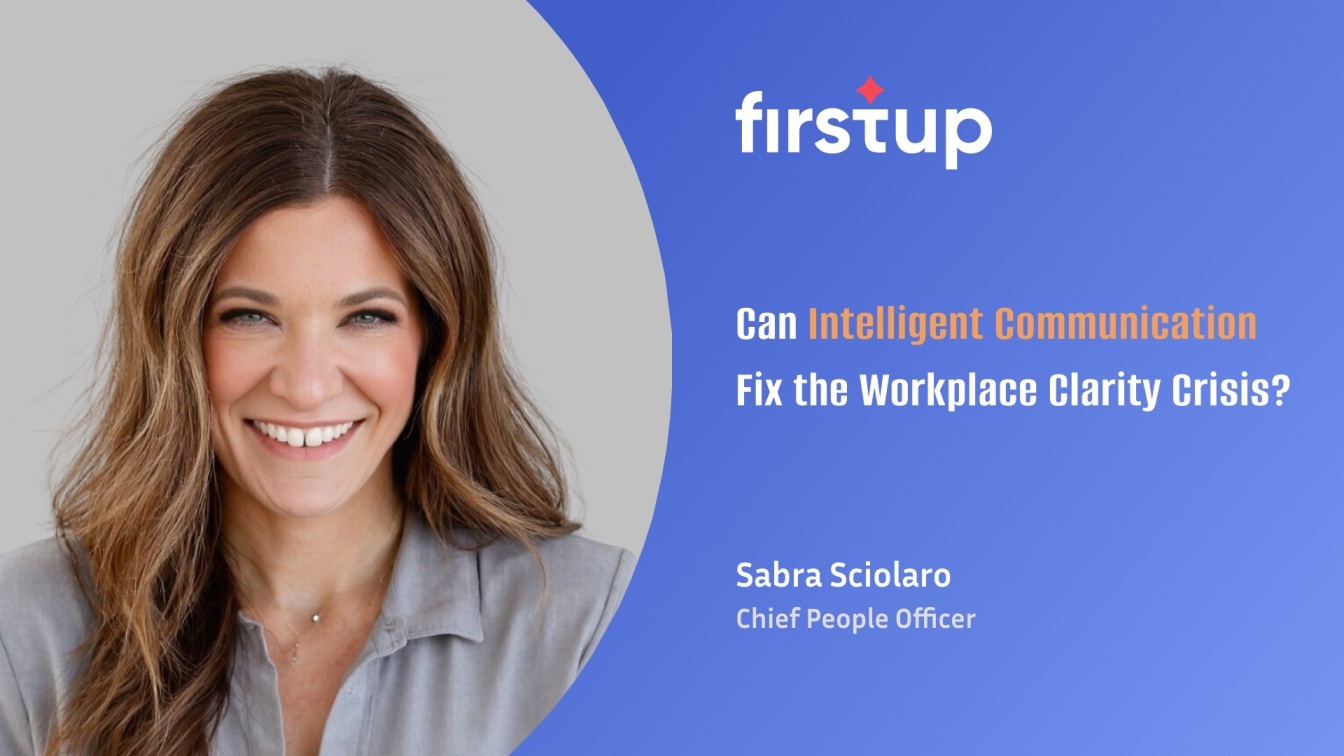
Sabra Sciolaro, Chief People Officer of Firstup, explains why communication must evolve from a broadcast function into a strategic business system. She shares how intelligent communication can reduce noise, improve alignment, strengthen onboarding and culture, and help organizations build more focused, high-performing workforces in the age of distributed work and AI.
My experience across different industries has reinforced a consistent principle: people strategy only works when it is directly tied to business outcomes. Early in my career, I quickly learned that to be an effective partner to the business, HR had to deeply understand the business model, financials, and goals. To ensure that talent, performance, and communication systems are effective, you first have to be clear on the outcomes the business is working toward.
The cross-industry exposure also shaped a pragmatic approach. There is less emphasis on programs for their own sake and more focus on what demonstrably improves business performance.
At Firstup, that translates into a disciplined focus on clarity and alignment. We are a fully distributed company operating in a competitive environment, so the People function is structured to reinforce accountability, performance, and connection to company goals. This includes building transparent performance systems, ensuring leaders can effectively communicate priorities, and creating mechanisms that connect employees to the company’s mission and strategy in a measurable way.
The most consistent gap across industries is clarity. Employees want more clarity, while leadership teams believe they are already providing it.
In practice, leadership invests time in crafting communications and assumes alignment follows. Employees, however, experience an overwhelming volume of messages, updates, and system notifications. The burden shifts to them to interpret meaning, determine priority, and understand what is actually relevant to their role.
This creates a predictable tension: leadership becomes frustrated because they believe they have been clear, while employees remain uncertain about priorities and expectations.
The breakdown is not just in messaging, but in execution. Communication is rarely operationalized as a core business system. Instead, it remains fragmented across channels and dependent on individuals to reinforce it. Managers effectively become the manual distribution layer, who are responsible for translating, prioritizing, and contextualizing information without consistent tools or structure to do so.
As a result, even well-intended communication does not consistently translate into clarity or action. Closing this gap requires treating communication as an operational discipline that is designed with the same rigor as other critical business systems, with clear ownership, targeting, reinforcement, and measurement.
Organizations are moving away from activity-based measures of productivity toward more outcome-based models. In distributed environments, visibility into work is inherently lower, so clarity of goals, priorities, and expectations becomes significantly more important.
At the same time, alignment has become more difficult because many staff populations — especially frontline and deskless employees that make up 80% of the workforce — report having trouble accessing information. Firstup’s own research found that many employees either do not know where to find critical updates or feel company communications are not relevant to their day-to-day role. At the same time, organizations continue relying heavily on channels like email, even though many deskless employees have limited access to it. The result is often information overload for some employees and information gaps for others, creating inefficiency, frustration, and disconnect across the workforce.
In response, leading organizations are focusing on:
Organizations are recognizing that productivity is driven by clarity, not engagement alone.
Traditional internal communication has often been treated as a broadcast function: send a message, track opens or clicks, and assume the information landed. Intelligent communication shifts the focus from distribution to action and measurable business impact.
At Firstup, we help organizations deliver communication that is targeted, personalized, and connected to specific business outcomes. That means ensuring employees receive the right information at the right time, in the right channel, with clear next steps tied to organizational priorities.
The measurement component is equally important, and not just “did they receive it?” Organizations need visibility into whether employees actually understood the message, took action, changed behavior, or became more aligned as a result. That could mean tracking onboarding progress, benefits enrollment completion, manager follow-through, training participation, or understanding of strategic priorities.
Ultimately, intelligent communication becomes a business system rather than a messaging layer. It helps reduce noise, improve alignment, accelerate decision-making, and create more consistent employee experiences across distributed and frontline workforces.
What makes this role unique and especially fun is that we operate as customer zero. We treat ourselves as the first users of our own platform, intentionally utilizing all aspects to solve our own challenges around onboarding, alignment, and culture.
Onboarding is an example of where this comes to life. We have built structured onboarding journeys that we are genuinely proud of. These journeys are not static: they are designed to evolve, with content that builds, reinforces key information, and helps employees deepen their understanding of the business while connecting to our culture. We consistently see very positive feedback from new hires around clarity, pacing, and the ability to absorb information more meaningfully.
For alignment, we made a deliberate shift to treat communication as a business system. Today, nearly 80% of our content is tied directly to strategic priorities, product innovation, and business outcomes, rather than general updates. This has created significantly more focus and clarity across the organization. Since implementing this model, we have seen more than a 20% increase in employees reporting that they understand our strategic priorities.
More broadly, the customer zero approach ensures we are continuously testing, learning, and refining. We use the platform to drive engagement, reinforce priorities, enable leadership visibility, and create feedback loops that inform both internal execution and product development.
The customer zero model is central to how innovation happens at Firstup because it creates a continuous feedback loop between internal experience and product development. We are not evaluating the platform in theory — we rely on it to support real business outcomes across onboarding, alignment, engagement, and communication within our own organization.
Employee feedback is incorporated through several channels, including:
AI will absolutely increase the speed and volume of communication, but more communication does not automatically create alignment or a stronger culture. In many organizations, employees are already overwhelmed by noise and competing priorities. AI can either reduce or amplify that friction.
If companies simply use AI to produce more content faster, employees will become even more overloaded and disconnected. The organizations that succeed will be the ones that use AI intentionally to reduce noise, deliver more relevant communication, and help employees focus on what matters most.
High-performing cultures will also require greater intentionality from leaders. Employees increasingly expect transparency, personalization, flexibility, and a clearer connection between their work and company priorities. Organizations that treat communication as a strategic business discipline — not just an HR function — will be far better positioned to build trust, improve execution, and retain talent.
Sabra Sciolaro is Chief People Officer at Firstup, the world’s first intelligent communication platform — a SaaS platform used by 40% of Fortune 100 companies to connect with employees, deliver personalized communications, and generate engagement insights across the employee journey.
Sabra is an HR executive with cross-industry leadership experience and a strong background in strategic human resources service delivery, with a focus on aligning business and people practices. Passionate about building exceptional employee experiences, she believes people are at the heart of every organization’s success and is committed to creating environments where employees feel valued, empowered, and inspired to perform at their best.
More about Sabra: 
The Firstup Intelligent Communication Platform equips organizations to improve productivity, retention, labor efficiency, safety compliance, and revenue performance by activating their workforce. The platform ensures every employee, including deskless frontline staff, knows what actions to take, when to take them, and why they matter. Through mobile-first access, intelligent personalization, and automated workflows, Firstup reduces operational gaps and enables teams to execute confidently and consistently.
Learn more at firstup.io.
Tell others what you think of TechIntelPro.



 Rate us on G2