
Marketing today isn’t short on tools; it’s drowning in them. Disconnected platforms, stitched workflows, and AI that responds but rarely acts have turned execution into a constant grind.
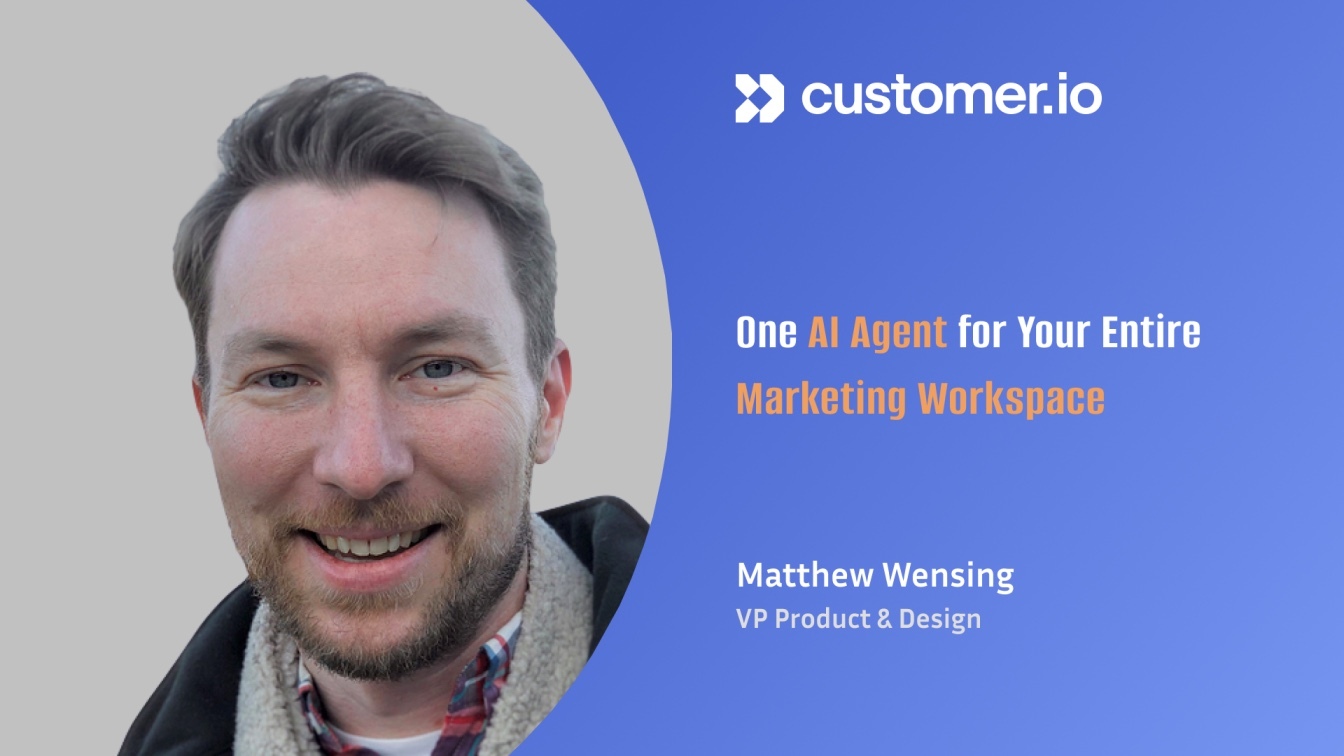
Matthew Wensing, VP Product & Design of Customer.io, dives into the shift from fragmented tools to a single AI Agent with full workspace context, why memory and continuity matter more than prompts, and how Customer.io is closing the gap between intent and execution. From reimagining architecture with core primitives to introducing Goals as a new way to measure impact, Matthew lays out a system where marketing learns, compounds, and gets sharper over time.
Marketing teams everywhere spend lots of time stitching together platforms that aren't built to work together. There's a tool for each channel, a spreadsheet for results, and a separate analytics layer to make sense of it all. Customer.io has always tried to reduce that complexity, and this launch is the clearest expression yet of how far that commitment has evolved. The AI Agent is at the center because the old model (where AI responds to questions) isn't always enough anymore. We wanted one Agent with full context across your workspace. Not a drawer full of disconnected tools. One Agent that knows your business, gets smarter the more you use it, and compounds over time. And that’s exactly what we built.
The hard part wasn't the AI itself. It was actually giving the Agent real continuity. The old architecture had rigid, purpose-built tools. We replaced that with five primitives: read, write, bash, cron, and message. We did this so that the Agent could interact with Customer.io the same way a user does. However, what really separates our AI Agent from other AI tools is persistent memory. When you analyze a campaign's performance and then ask the Agent to fix the underperforming email, it already knows the full context. That continuity is rare, and the goal is that the context and impact will only compound over time and get smarter and more helpful as you continue to collaborate with it.
Today, success usually gets measured campaign by campaign. Goals actually flips that. You define an outcome once, then you can track all the campaigns that impact it. For example, let's say you set a goal of tracking conversion of new (free trial) users to a paid plan within 14 days. You connect every campaign contributing to this goal. Then, you can see the overall impact of all these combined efforts, clearly. The numerator and denominator are always visible — no mystery percentages, no confusing data. We're making tracking attribution easier and clearer than ever. What I find particularly interesting is that this isn't just a new metric or way to track success; it's a new mental model. Goals are the scoreboard. Campaigns are the levers. Before now, you couldn't see both at once. This changes how teams plan, not just how they report.
Previously, if you wanted AI reasoning inside a journey, you were wiring up webhooks, managing external services, handling all the failure points in between, and porting over your work from another LLM into Customer.io. LLM Actions changes this. It's a native integration. You write the prompt using Liquid (our personalization language) with variables to inject real customer and event context, define your outputs, and Customer.io handles the model call. Less setup, lower latency, fewer points of failure. The output can personalize a message or drive branching logic downstream from the prompt. Your campaigns now have a brain built in! And you didn't have to build a branch for every scenario to get there.
This is something we've wrestled with at Customer.io for a long time. How do you build a product that both a technical and non-technical marketer/user can get real value out of, without compromising either experience? With this launch, the answer came from keeping product, design, and other teams in very close conversation throughout. The UI refresh wasn't cosmetic — it was about reducing cognitive load so the underlying power doesn't feel overwhelming. Universal Search is a good example: instead of making users learn where everything lives, the workspace just becomes searchable. The Agent itself does a lot of this work, too. When you can describe what you want in plain language, and it builds the campaign, the segment, and the logic, you've removed the expertise barrier without removing any of the capability. The sophistication is still there. We just stopped requiring people to know where all the levers are before they can pull them.
Matthew Wensing is the VP of Product & Design at Customer.io. With over 20 years of experience as a founder, inventor, evangelist, and startup executive, he brings a thoughtful, user-centric approach to building tools that empower marketers and product teams alike. His deep background in product strategy and entrepreneurial leadership has shaped his ability to turn complex problems into elegant solutions.
Prior to joining Customer.io, Matthew founded several companies and held numerous product leadership roles across the startup landscape. At Customer.io, he now leads the Product and Design teams, shaping the company’s roadmap and championing innovation across the organization. Based in Austin, Texas, he enjoys balancing outdoor activities (traveling to ski!), mentoring early-stage founders, and watching their family of 6 grow up faster every day.
More about Matthew: 
Customer.io is a leading AI-powered customer engagement platform designed for tech-savvy organizations to create personalized customer journeys that engage, convert, and scale. Use first-party data to send meaningful messages across all channels, including email, in-app, push, SMS, and webhooks. Today, 8,000+ brands trust their messaging needs with Customer.io. Founded in 2012, Customer.io is a globally distributed, remote-first company named one of the fastest-growing private companies on the 2025 Inc. 5000 list.
Learn more at customer.io
Tell others what you think of TechIntelPro.



 Rate us on G2

