
More spend doesn’t win in programmatic advertising. Better bidding does.
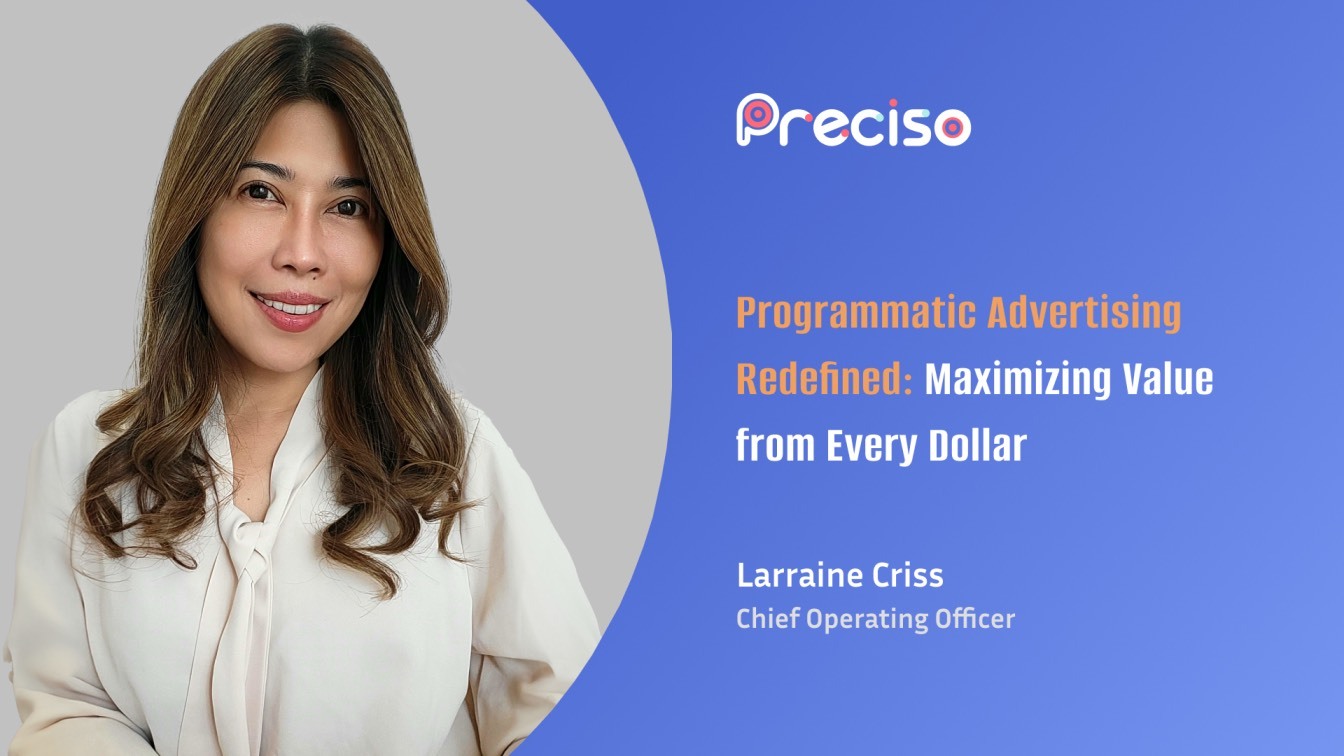
In this conversation, Larraine Criss, COO at Preciso, unpacks what it takes to level the playing field in programmatic advertising – from evidence-led operating decisions and bid-level precision to scaling performance without wasting spend. She shares candid perspectives on where adtech still breaks, how Preciso designs around those fault lines, and why disciplined bidding logic is the real engine of sustainable growth.
I bring a strong bias towards evidence-based decision-making because I have learned from experience that not all requests are inherently valid. In practice, it means that before committing budget or resources or making operational decisions, I focus on understanding the proof of concept to see if the request has any underlying business impact.
Conversely, I actively guard against my natural tendency to move quickly and decide independently. As a COO, I’m becoming more conscious of not defaulting to that, as I know collaboration adds so much value.
Whenever a decision involves execution, I always make an effort to involve department managers, so the decisions I’m approving on behalf of the company are grounded in operational reality and supported by the teams who will deliver them.
The Preciso platform was built to address one of the biggest bottlenecks in display advertising, which is programmatic redundancy. Our solution brings precision by controlling how often, when, and to whom ads are shown. It helps brands reach the right audience at the right time and reduce unnecessary impressions or overexposure. As a result, our partners get more value from every dollar spent.
The advantage is created across all three of those areas. Preciso Smart-Bid is budget-agnostic, meaning it doesn’t favour advertisers simply because they can spend more. And instead of trying to exhaust a daily budget, the system focuses on identifying and bidding on the opportunities that truly align with specific campaign goals. This allows smaller merchants to compete fairly for the same quality traffic as large brands.
Ultimately, we focus on bidding precision and the client’s objectives, rather than looking at the spending power of the advertiser.
When performance marketing scales, what usually breaks first is not the adtech infrastructure but the bid decision or logic quality. As volume increases, many existing systems and DSPs struggle with pacing, frequency control, and bid efficiency, leading to wasted spend, inconsistent performance, or declining ROAS.
At Preciso, we focus on being able to scale bid decision quality alongside volume. While what we offer is highly scalable, in part because we have a cloud-based infrastructure for the server, our principal priority is maintaining real-time bidding logic and signal accuracy as a campaign grows. The platform is uniquely agile, and we can ensure performance, efficiency, and reliability alongside scalability.
For me, the most underestimated inefficiency in the value chain is still bidding logic structure. Even though programmatic is a mature industry, very few platforms truly prioritise bid decision quality, even though it is key to both the user experience and long-term marketing performance.
This is understandable from a business perspective, because quantity scales revenue more easily, so bidding logic with a focus on quality signals, rather than sheer volume, is still not the norm. It is, however, fundamental to our offering at Preciso.
The biggest friction happens when product ambition is driven purely by either commercial vision or operational comfort. When ambition is determined exclusively from a commercial perspective, it can be market-relevant but operationally complex. When it’s driven entirely from the operational side, it may be easier to deliver but lack market impact.
We resolve this by anchoring product ambition on proof of concept and measurable business output. These parameters allow us to validate relevance and, at the same time, quickly align teams to move forward without slowing execution or overbuilding in the wrong direction.
Being in a fast-paced industry, we plan our next moves by first analysing current market trends and then looking ahead to identify potential opportunities. Lastly, we align these collected insights with the performance and successes of our past implementations. This approach allows us to make informed decisions as customer volume and spend grow.
Larraine Criss is a seasoned adtech and programmatic specialist with a strong, 15-year track record in building and scaling online advertising businesses. Her expertise spans AI-driven strategies, programmatic media buying, real-time bidding technologies, and cross-border e-commerce.
At Preciso, she leads commercial partnerships and global business development. Prior to joining Preciso, Larraine was Chief Product Officer at MainAd and Founder & CEO of Netpromedia, which provides ad ops and data analysis support for European digital advertising companies. She is an expert in end-to-end business flow, from concept through to R&D and marketing.
More about Larraine: 
Preciso is a fast-growing adtech company whose flagship Smart-Bid technology makes it easy for advertisers to launch successful programmatic campaigns easily and at scale. The company’s Ultima native advertising solution creates personalised campaign creatives and automatically embeds them within web pages to combat banner blindness and drive meaningful engagement at scale. It also uses customer journey modelling and AI to optimise the bidding and buying process in real time, ensuring only the most relevant ad placements are secured, boosting relevance and engagement, and minimising ad wastage and associated carbon emissions. Founded in Italy by Piero Pavone in 2020, Preciso now has teams in seven countries.
For more info, visit preciso.net.
Tell others what you think of TechIntelPro.



 Rate us on G2