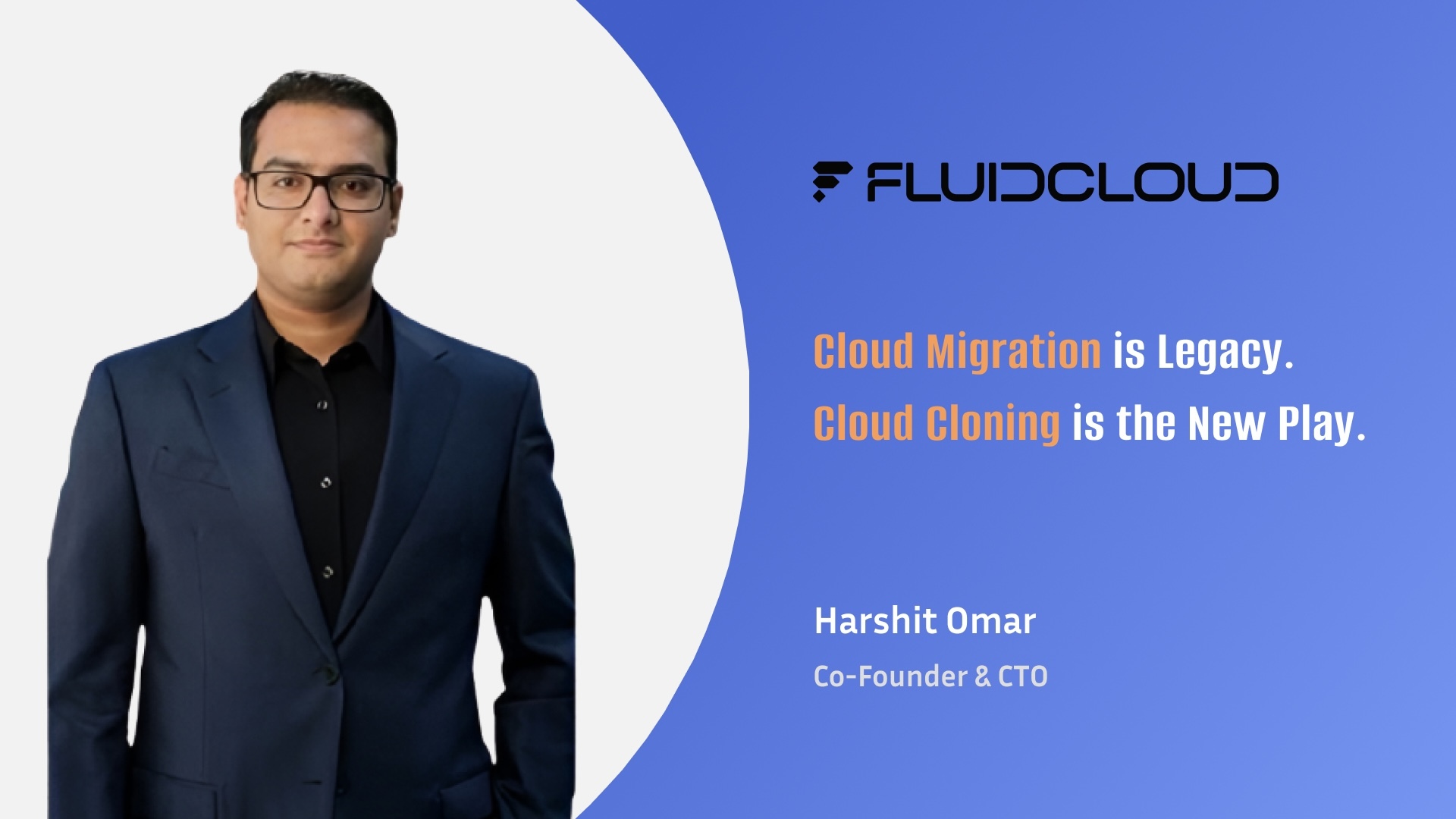
Migration was the past. Cloning is the new cloud power move. And the CTO leading this shift is Harshit Omar, the architect behind Cloud Cloning™.
Harshit breaks down how FluidCloud was born from real migration pain and how Cloud Cloning™ changes the way enterprises think about portability and resilience. He gets into the mental model shift required for IT leadership, the IP behind their mapping foundation, and how tomorrow’s cloud architecture will be designed to execute workloads across providers. No heavy lifting or movement needed.
The problem is close to our heart, and we have experienced this pain of cloud migration ourselves when Accurics was acquired by Tenable in 2021. We had to close our cloud account and shift everything to Tenable’s cloud account. Additional triggers were in 2023 OpenTofu due to the Hashicorp licensing fiasco and the Broadcom VMware acquisition. The need for a flexible infrastructure intensified due to such disturbances in the industry, and there was no solution found.
The main reason for multi-cloud complexity is the ecosystem. Cloud infrastructure has its own ecosystem. You have services like compute, network, storage, and their dependencies, which are unique to each cloud provider. On top of that, you have security, performance, and monitoring tools. Changing infrastructure means changing the ecosystem completely. It requires special skills for each provider. So multi-cloud is increasing engineering efforts and gaining expertise of every cloud provider, and then maintaining security, performance, etc., is not easy. FluidCloud solves the problem of portability and friction between the cloud providers, which reduces the engineering efforts to a great extent.
Migration is a big decision and it requires multiple stages, taking months to complete. Some of the key stages are: planning, provisioning, testing, cutover, etc. Cloud cloning is like copy-pasting your infrastructure, which takes care of planning, provisioning, and testing stages all at once. Unlike migration, where decisions have already been made based on many assumptions, cloud cloning helps make better decisions. Create as many clones of your infrastructure as you like in multiple providers and look for yourself what is working and what is not, no assumptions needed.
This is a great question. We have filed multiple patents to come up with our unique capabilities. One of them is the mapping between the cloud providers with all their services and dependencies, which helps us create that portability. Portability and resilience go together. There has been a lot of adoption of cloud-agnostic technologies, but still, it requires the base infrastructure, and that is not portable. Resilience becomes difficult now that it requires multiple maintenance activities for each cloud provider. Our mapping technology is so powerful that we can discover an active running infrastructure in a cloud provider and convert that into any other cloud provider. When we do so, the whole process is fully transparent and visual, and you get everything on the same platform.
Oh, the possibilities are endless. Now, with that freedom, CIOs get an upper hand in negotiations with cloud providers. They no longer embrace limitations or restrictions of a particular cloud provider. Why not try 4+ or 5+ cloud providers and take advantage of every cloud provider per business needs? Anticipate outages and smaller RTO/RPO numbers. More robust resilience planning and execution. Better decision-making, better strategic partnerships. There are so many ways CIOs can take advantage of this freedom through FluidCloud.
It's our positioning and value proposition. Yes, this space is dominated by the hyperscalers, but their core business is to provide the infrastructure services to their customers. Hyperscalers will strive to grow and keep improving their services. The only challenge they will always have is to easily onboard a customer coming from another hyperscaler or another infrastructure provider. FluidCloud doesn’t own any hardware and only uses native cloud APIs to provision infrastructure. Our main value proposition is a kind of distraction for all the hyperscalers.
You don't build startups for today; they're built for the future. People will be moving workloads across multiple cloud providers, and with the scarcity of AI infrastructure, there will be new cloud providers, and outages will become a common phenomenon. We envisioned this long ago and started backtracking the shape of the product to achieve the solution needed. It's counterintuitive product development. We are practitioners, so we are well aware of the problems and challenges that help build the right product needed, and innovation is only to support that goal. We have all been in the industry for quite some time and brought all the dev best practices from day one. We do 50+ automated migrations multiple times a day through our custom framework developed in-house just for quality control. We are the first to know if any cloud APIs are changed without notice.
We have all the necessary building blocks. Our mapping is one of our core functionalities, empowering everything. This mapping is between all cloud providers and their respective services, so one of the ways is to use it to configure and provision GPUs in other cloud providers without changing your base cloud. Another way to use it is to quickly deploy your AI stack and its dependency services from existing cloud providers into other clouds, enabling faster development.
Sentient infrastructure – the workloads decide the best and most efficient, suitable cloud platform for themselves and move around from one provider to another based on various factors. Licensing changes, cost constraints, upcoming outage, security issues, performance issues, etc. All these are triggers for the decision to change a cloud provider. It's like a Hypervisor layer on Hyperscalers, and then the whole cloud infrastructure becomes a compute pool.
Harshit Omar is the Co-Founder & CTO of FluidCloud, where he's building the future of cloud infrastructure—enabling businesses to seamlessly migrate, replicate, and optimize workloads across multi-cloud environments. He was previously the first engineer at Accurics, where he led core development efforts on its policy engine and cloud security platform. With deep expertise in Go, Kubernetes, Terraform, and cloud compliance, Harshit has spent over a decade designing resilient systems across AWS, Azure, and GCP. His mission now is to eliminate cloud lock-in and make infrastructure as portable and resilient as code.
FluidCloud is redefining what’s possible in multi-cloud infrastructure. Designed for Infrastructure and DevOps teams, the FluidCloud Platform is the first solution to let you clone, migrate, restore, and optimize infrastructure across clouds in minutes. FluidCloud empowers organizations to run workloads wherever it makes the most sense—without cloud provider lock-in. Built on Infrastructure as Code and cloud-native orchestration, FluidCloud leverages Cloud CloningTM technology to deliver full visibility, automation, and resilience in complex multi-cloud environments. With FluidCloud, businesses adapt as priorities shift—unlocking true cloud freedom.
Learn more at www.fluidcloud.com
Tell others what you think of TechIntelPro.



 Rate us on G2