
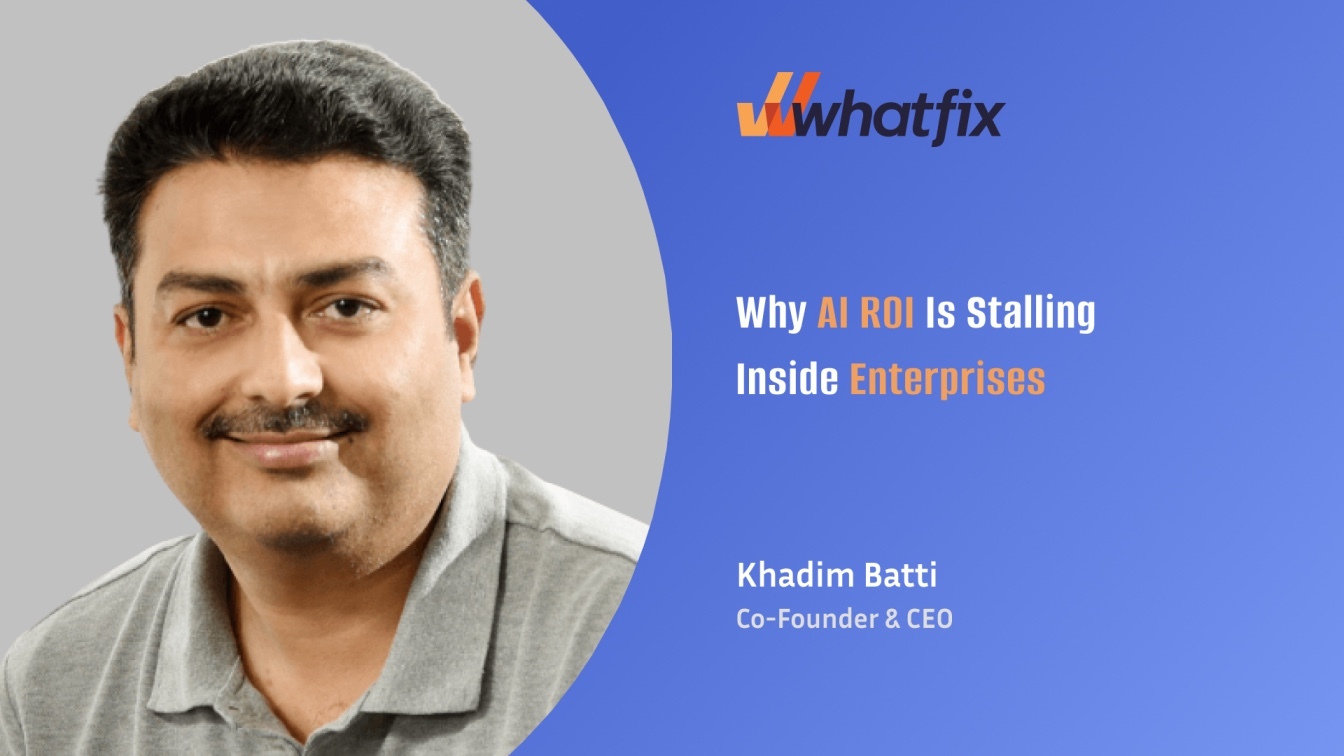
Billions are being spent on AI. The real question is: who’s actually using it?
In this conversation, Khadim Batti, Co-Founder & CEO of Whatfix, explains why enterprise-wide adoption has become the biggest obstacle to realizing AI’s promised ROI. He discusses how organizations can embed AI directly into everyday workflows, the evolution of Digital Adoption Platforms into intelligent orchestration layers, and why the next phase of enterprise transformation will depend on making AI usable, trusted, and seamlessly integrated into how employees actually work.
Enterprises have invested heavily in AI tools, yet most employees are not using them effectively, or at all. In 2025, it became clear that the biggest barrier to AI ROI was not the technology itself, but getting people across the organization to actually adopt it.
With thousands of applications already in use and every vendor now shipping its own AI tool, employees are experiencing decision paralysis. They are unsure which tool to use, when to use it, or how it fits into their day-to-day workflow. That uncertainty slows execution and quietly erodes the ROI organizations were expecting.
The way forward is to bring AI directly into the flow of work with continuous, contextual guidance. This is where Digital Adoption Platforms (DAPs) play a critical role. Instead of asking employees to learn new systems or switch between tools, DAPs embed guidance, knowledge, and automation directly into the applications where work happens. This reduces cognitive load, removes friction, and helps employees realize value immediately.
At Whatfix, we enable this through ScreenSense, our AI engine that understands application context and user intent in real time. It helps employees take the right action at the right moment, without overwhelming them. As a result, customers see significantly higher adoption and faster time to value because AI becomes a natural part of how work gets done, not an added layer to manage.
Enterprise-wide adoption is ultimately a digital transformation challenge. Technology deployment alone does not transform an organization. Transformation happens when behavior changes at scale. Whatfix enables that shift by connecting AI capability, human workflows, and governance into a unified adoption layer, ensuring that AI investments translate into measurable business outcomes.
Historically, DAPs were used primarily as an in-app training layer. They helped onboard users through walkthroughs, tooltips, and contextual instructions, typically as part of initial application rollout or structured training programs. The focus was on helping users learn the interface once they were inside the application. While this is effective for driving basic adoption, this model was largely reactive and centered on predefined flows rather than anticipating user needs in real time.
In 2026, DAPs are evolving into intelligent orchestrators. In practice, this means they move beyond assistance and into coordination. They understand workflows end to end, anticipate where friction is likely to occur, and take action before productivity breaks down.
An orchestrated DAP monitors user behavior in real time, identifies patterns that signal confusion, inefficiency, or risk, and responds with the right intervention at the right moment. That intervention may be guidance, automation, or orchestration across multiple systems. Instead of forcing employees to jump between tools, the DAP helps connect work across applications.
The result is a shift from reactive support to proactive optimization. DAPs move from helping users navigate software to shaping how work flows across people, applications, and AI tools. This enables a more scalable model of human-AI collaboration, where technology adapts to how people work, rather than the other way around.
It represents a fundamental shift in how work gets done. Traditionally, employees needed to know which application to open, which screens to navigate, and which fields to complete to finish a task. That “click to complete” model required deep system knowledge and created friction whenever applications changed or new tools were introduced.
The “state intent and let the system execute” model changes that dynamic. Employees express what they want to accomplish, and AI understands the intent, orchestrates actions across systems, and guides or executes the workflow as appropriate. For example, instead of logging into multiple platforms to process a customer refund, an employee can state the intent, such as “process a refund for this order,” and the system coordinates the necessary steps across applications, with the right checks and confirmations.
Day to day, this reduces time spent on manual execution and navigation, while increasing time spent on judgment, problem-solving, and exception handling. It also lowers dependence on extensive training or deep system expertise, because the interface adapts to the user’s intent and context rather than forcing the user to adapt to the software.
At Whatfix, we’re building toward this future with products like Seek, our agentic AI assistant. Seek provides unified access across tools and knowledge and can assist with real tasks inside business workflows. The goal is to close the gap between intent and outcome, while keeping humans in control.
The reframing came from watching AI evolve from peripheral use cases to the core layer shaping workflows, decisions, and strategy execution. For years, AI was something you added to applications to make them smarter. Today, it interprets intent, orchestrates multi-step processes across systems, and delivers outcomes without employees navigating individual tools. At that point, AI stops behaving like a feature and starts functioning like an operating system.
For business leaders, this has three major implications. First, AI cannot be managed as a collection of point solutions. It must be treated as foundational infrastructure that directly impacts productivity, risk, and execution. Second, success is no longer measured by how many AI tools are deployed, but by how effectively humans and AI collaborate inside real workflows. Third, traditional top-down models of training and change are no longer sufficient.
As digital transformation accelerates, with sprawling tech stacks and deeply AI-integrated workflows, static enablement cannot keep pace. Leaders need platforms that learn and evolve with individual users, adapt in real time, and continuously translate AI investment into business outcomes.
That’s the gap Whatfix is closing. We help enterprises orchestrate adoption, govern behavior, and build trust at the point of work, ensuring AI systems and employees operate together effectively.
The organizations that win in 2026 will treat AI not as a tool to deploy, but as an operating fabric to orchestrate, embedding governance, enablement, and human-AI collaboration into how work actually gets done.
In a real enterprise environment, a continuous learning layer refers to analytics that operate across live workflows and improve them based on observed intent and measured outcomes. This approach supports digital transformation by connecting insight, execution, and governance across both employee experience and customer experience use cases.
Enterprises operate across multiple applications. A single workflow often spans systems such as Salesforce, SAP, Workday, and custom internal tools. A continuous learning layer, therefore, tracks intent across applications rather than within one product. Cross-application analytics allows teams to observe where users hesitate, repeat steps, or abandon tasks as they move between systems. These patterns provide signals about intent and where current workflows fail to support it.
Intent detection evaluates behavioral sequences such as navigation loops, repeated corrections, partial completion, or overrides. These signals help infer what a user is trying to accomplish, whether that user is an employee completing a business process or a customer progressing through a digital journey. When intent signals indicate friction, the system identifies the likely source and prepares a response aligned to predefined rules.
Within DAPs, these insights can trigger contextual actions inside the flow of work. In some cases, guidance is generated dynamically using GenAI, based on the specific friction detected and the surrounding context. This allows support content to reflect the user’s intent and the exact step where progress slows, rather than relying only on prebuilt walkthroughs.
Enterprise governance remains central. Systems do not modify workflows autonomously without oversight. Administrators define approval thresholds, compliance rules, and brand constraints. Human review remains part of the loop, particularly for changes that affect regulated processes or customer-facing experiences. The system accelerates detection, recommendation, and measurement, while decision authority stays with teams.
Each intervention is evaluated using outcome measures such as task success rate, time to completion, error reduction, or conversion progression. Results feed back into the analytics layer, improving how intent is interpreted across future interactions.
For employee experience and learning teams, this model reduces reliance on periodic training updates and manual analysis by improving workflows as work happens. For product leaders focused on customer experience, it supports faster refinement of digital journeys based on observed behavior rather than delayed review cycles. Across both use cases, the continuous learning layer enables digital transformation efforts to scale with complexity while remaining measurable, governed, and responsive.
Simulation is becoming essential because enterprises can no longer afford to discover user friction, workflow errors, or process failures after go-live. The cost of getting it wrong is too high. Organizations are adopting a "simulate-before-ship" approach, meaning every new workflow or system change is rehearsed in a safe, risk-free environment before it's released to real employees or customers.
What has changed is the pace and concentration of change. Digital transformation now introduces multiple workflows, policies, and AI-driven decisions at the same time. Errors propagate quickly across interconnected systems, rollback options are limited, and customer-facing failures carry immediate revenue and trust impact. Tolerance for discovering friction after go-live has declined sharply.
Simulate-before-ship addresses this shift by moving validation earlier in the lifecycle. Instead of assuming readiness, enterprises use application simulations and AI-powered roleplay scenarios to rehearse how work will actually be executed. These simulations surface behavioral friction, edge cases, and compliance constraints before production exposure, turning readiness into evidence rather than expectation.
This is the problem space that Whatfix addresses with Mirror. It is an AI-first simulation and roleplay platform that combines realistic enterprise application simulations with adaptive AI-driven roleplay. It enables teams, particularly in customer-facing roles, to practice workflows and conversations together in a single, risk-free environment, helping organizations surface execution risk early and prepare teams before change reaches live systems.
Henceforth, simulate-before-ship is no longer a specialized practice. It is becoming a practical requirement for executing enterprise change with speed and control.
When human–AI symbiosis works, it feels less like “using AI” and more like the organization finally running the way it was meant to. Humans stay in charge of direction, judgment, and ethics, while AI quietly clears the noise by handling the data grind, the repetitive clicks, and the system complexity that usually slows work down.
When this synergy clicks, decision-making accelerates and innovation compounds. AI provides contextual insights right within workflows, anticipating needs and guiding users toward better outcomes. Employees move from managing tools to achieving results.
Behind this success lies a foundation of trust, transparency, and responsibility. People understand how and why AI makes recommendations and know they can intervene when judgment is required. Guardrails like explainability, data privacy, and ethical design are hardwired into the system, making responsible AI the engine of enterprise growth, not a compliance checkbox.
At Whatfix, this vision takes shape through our AI Agents, designed to operationalize responsible, human-led AI:
Together, they create a continuous feedback loop where AI assists, adapts, and learns while humans direct, decide, and lead.
This balance redefines success itself. As AI absorbs the routine, humans elevate the strategic. New roles emerge to guide and govern AI systems, ensuring fairness, accuracy, and business alignment. The enterprise becomes more agile, innovative, and secure.
Leaders need to focus on three priorities: embedding AI into the flow of work, building trust through governance and transparency, and measuring success by outcomes rather than deployment.
The biggest mistake organizations make is treating AI as a separate destination that employees have to go to, learn, and remember to use. That creates friction and slows adoption. AI becomes truly usable only when it is embedded into existing workflows and tools, so it shows up at the moment of need. When employees feel immediate benefits in their day-to-day tasks, such as fewer clicks, faster answers, and fewer errors, adoption becomes natural rather than forced.
Trust is the second pillar. Users and leaders need confidence that AI is secure, compliant, and as free from bias as possible. That requires strong guardrails to validate outputs, reduce errors, and protect sensitive data, alongside clear accountability for how AI is used. Just as important, AI decisions must be explainable. When employees understand what the system is doing and why, they are far more likely to rely on it and use it responsibly. DAPs s play a critical role here by monitoring AI-driven actions, explaining system behavior, reinforcing compliant usage, and building confidence as AI agents assume greater operational responsibility.
Third, leaders must measure success by outcomes, not by how many AI tools have been rolled out. The real metric is how effectively humans and AI co-deliver results. Are employees more productive and less frustrated? Are processes faster and more accurate? Are customers seeing better, more consistent experiences? The leadership mandate is to orchestrate human–AI symbiosis: embed safeguards, protect trust, and enable the right balance between autonomous decisions and human oversight.
At Whatfix, we’re closing the gap between rapid technological change and human enablement. Our platform helps AI become usable, trusted, and outcome-driven for every employee by providing continuous, contextual guidance, intelligent analytics, and safe simulation environments where people can learn and experiment without risk. We’re not just simplifying software, we’re redefining how AI works for people.
Ultimately, the leaders who succeed in 2026 will be the ones who stop treating AI as a feature and start treating it as the operating fabric of their business, with employees and AI agents working side by side to deliver faster, more accurate, and more resilient outcomes.
Khadim Batti is the Co-Founder and CEO of Whatfix. He co-founded Whatfix with Vara Kumar in 2014 with the mission of empowering individuals and organizations to freely use and experience the maximum benefits of technology.
Khadim is a seasoned global executive with over two decades of industry experience driving business growth through product development and cutting-edge innovations. Under his leadership, Whatfix has achieved its tenth consecutive year of growth, pioneering the concept of ‘userization,’ which places the responsibility of being user-centric on the technology itself.
More about Khadim: 
Whatfix is an AI platform advancing the “userization” of enterprise applications, empowering companies to maximize the ROI of their digital investments. Powered by a proprietary AI engine ScreenSense, Whatfix continuously interprets application workflow context and user intent to boost user productivity, ensure process compliance, and elevate user experience across applications and AI agents. The product portfolio includes a Digital Adoption Platform (DAP), Mirror for hands-on system simulation and AI Roleplay-based training, and Product and AI agent Analytics for no-code insights.
With seven offices across the US, India, UK, Germany, Singapore, and Australia, Whatfix supports 700+ enterprises, including 80+ Fortune 500s like Shell, Schneider Electric, and UPS Supply Chain Solutions. Backed by investors such as Warburg Pincus, Softbank Vision Fund 2, Dragoneer, Peak XV Partners, Eight Roads, and Cisco Investments, software clicks with Whatfix.
Learn more at whatfix.com
Tell others what you think of TechIntelPro.



 Rate us on G2

