Contracts were never meant to slow businesses down. Yet for years, they’ve quietly done exactly that.
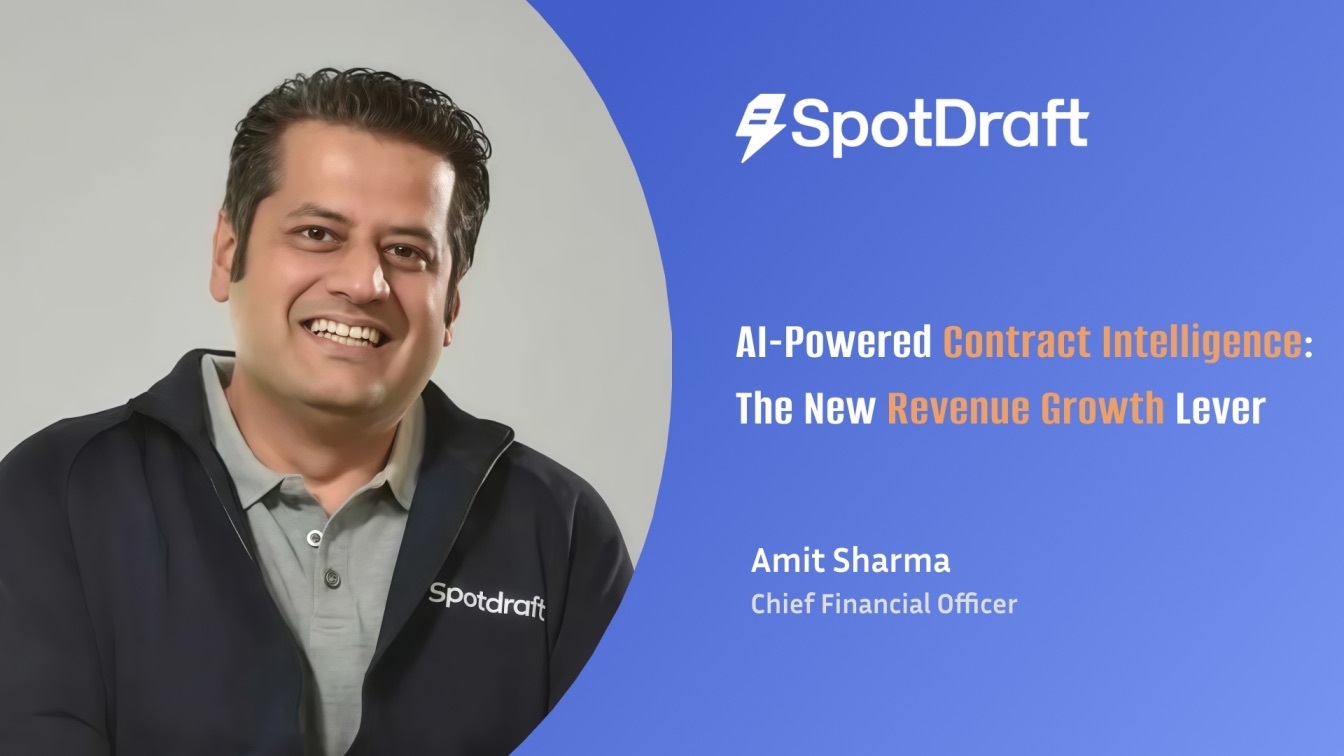
Amit Sharma, CFO at SpotDraft, breaks down how contract intelligence is transforming legal from a back-office function into a strategic business enabler. From a finance leader’s lens, he explains why contracts now sit at the intersection of revenue, risk, and operational speed—and why organizations that treat them as static documents are leaving value on the table.
The combination of market timing and mission is what drew me in. Legal technology is at an inflection point. Contract management has evolved from a back-office function to a strategic lever for business velocity. SpotDraft's recent Series B raise and the traction they've built with over 400 organizations globally showed me this wasn't just about managing growth, but about architecting the financial infrastructure for a category leader.
The opportunity to work with a founding team that deeply understands both the legal pain points and the technology solutions was compelling. Coming in at this stage means I can help shape the financial strategy that will take SpotDraft from a high-growth startup to a sustainable, market-defining company.
Three areas demand immediate attention. First, building robust financial systems and processes that can scale with our 100% YoY growth in customer acquisitions. We need infrastructure that doesn't become a bottleneck as we expand.
Second, developing a data-driven approach to unit economics and customer acquisition costs, particularly as we scale our GTM operations across the Americas and establish our presence in EMEA. Understanding the true profitability of different customer segments and geographies will be critical.
Third, strengthening our financial planning and analysis capabilities so we can make informed investment decisions – knowing when to accelerate spending and when to optimize efficiency. The Series B raise gives us runway, but capital discipline will differentiate us in this market environment.
Contract management sits at the intersection of revenue, risk, and operational efficiency – all critical financial drivers. From a CFO's perspective, poor contract processes create hidden costs throughout the organization. Revenue leakage from missed renewals, unfavorable terms that weren't caught during negotiation, or compliance penalties from contractual obligations that weren't tracked – these all flow through the P&L.
What makes SpotDraft particularly valuable is that it transforms contracts from static documents into dynamic business intelligence. When you can reduce contract turnaround from 19 days to 3 days, as our research shows is possible with automation, you're directly impacting sales velocity and revenue recognition timing. When you have visibility into all contractual obligations and renewal dates, you can forecast more accurately and manage cash flow more effectively.
The platform essentially de-risks the business while accelerating growth – that's a powerful combination for any finance leader.
The fundamental shift is from "growth at any cost" to "growth with efficiency." In pure growth mode, you're often willing to accept higher customer acquisition costs and longer payback periods because you're establishing market position. But as you scale, the focus shifts to repeatability, predictability, and profitability.
Operationally, this means several things: developing more sophisticated models around customer lifetime value and segmentation. Not all revenue is equal. It means tightening the connection between marketing spend and pipeline generation, between sales capacity and quota attainment. It also means building the infrastructure to support larger enterprise deals while maintaining the efficiency of our mid-market motion.
From a capital allocation perspective, we move from broad experimentation to concentrated investment in proven channels. We need to demonstrate not just that we can acquire customers, but that we can do so efficiently, retain them effectively, and expand within accounts systematically. The growth metrics matter, but the efficiency metrics become equally important.
Geographic expansion requires a disciplined, stage-gated approach with clear financial milestones. For the Americas, where we already have presence and traction, it's about optimization and scaling what works: increasing sales capacity in proven segments, expanding marketing in channels with demonstrated ROI, and building the customer success infrastructure to support retention and expansion.
EMEA represents a newer market for us, which means a more measured approach initially. We need to establish product-market fit in specific countries, understand the regulatory landscape, and build local partnerships before scaling aggressively. I'd approach this with clear hypotheses about customer segments, pilot programs with defined success metrics, and staged investment that's unlocked by hitting specific milestones, whether that's customer acquisition costs, win rates, or early retention signals.
The key is maintaining financial flexibility. We'll model multiple scenarios, establish clear decision points, and ensure we're getting actionable data from the market quickly. Geographic expansion can be a significant capital sink if not managed carefully, so we'll balance ambition with pragmatism.
The capital strategy needs to align with our stage of development and strategic objectives. Right now, with $54 million from our Series B, we have the runway to execute on our current plan. But a CFO needs to be thinking several moves ahead.
Long-term, I see our capital strategy evolving through several phases. Near-term, it's about deploying this capital efficiently to hit our growth and market position objectives, demonstrating that we can scale responsibly. In the medium-term, we need to build optionality. That might mean positioning for another equity round if we identify significant market opportunities that warrant acceleration, developing strategic partnerships that could include capital components, or building toward financial self-sufficiency if market conditions favor that path.
The financial structuring piece comes into play as Spotdraft matures, thinking about optimal capital structure, potentially exploring debt facilities as we build more predictable revenue streams, or considering strategic M&A if there are capabilities we need to acquire to strengthen our platform.
My experience across fundraising, acquisitions, and financial structuring means I can evaluate the full toolkit. Sometimes it's a partnership with strategic investment. Sometimes it's acquiring a complementary technology or team that accelerates our roadmap by 18 months. The goal is matching the capital approach to the specific business need and market opportunity, rather than defaulting to a single playbook.
The narrative we're building is about the transformation of legal from a cost center to a strategic enabler, and SpotDraft's position at the center of that transformation.
The data points are compelling: we've achieved 36% share of voice in our category, up from just 5% a year ago. We're seeing 100% YoY growth in customer acquisitions with customers like Airbnb validating our enterprise capabilities. Our recent AI Impact Report showed that contract management is where legal teams believe AI will drive the most value.
But beyond the metrics, the story is about timing and inevitability. Legal teams are facing rising contract volumes, increasing complexity, and pressure to move faster, all while team sizes remain constrained. The old ways of managing contracts – email, Word documents, shared drives – simply don't scale. We're not selling a nice-to-have tool; we're providing critical infrastructure for how modern businesses operate.
For investors, the compelling elements are: a large and growing TAM as more companies recognize contracts as strategic assets, strong unit economics as we scale, a product that's evolving from CLM to contract intelligence, and a team that's demonstrated execution. We're building a category leader, not just a feature.
Finance should be an enabler, not a gatekeeper. My role is to provide the data, frameworks, and insights that allow every leader to make better decisions, whether that's the VP of Sales understanding territory economics, the Chief Product Officer prioritizing feature development based on revenue impact, or the executive leadership team evaluating strategic opportunities.
Practically, this means several things. Building financial literacy across the leadership team so everyone understands our unit economics, burn rate, and key metrics. Establishing clear KPIs that connect individual team objectives to overall company performance. Creating transparency around resource allocation so teams understand not just their budgets, but the "why" behind investment decisions.
I also see finance playing a critical role in operational rigor, helping establish the processes and systems that prevent us from outgrowing our infrastructure. At our growth rate, what works today won't work in six months. Finance can help the organization anticipate those inflection points and prepare for them.
Ultimately, my job is to protect and extend our runway while enabling the business to move fast. That means being a strategic partner who can assess opportunities, quantify risks, and help the team make informed trade-offs. The best finance organizations don't slow companies down; they help them move faster with confidence.
Amit Sharma is building SpotDraft's financial foundation for its next chapter. Amit has been in startups since 2016 and has worked around financial structuring, acquisitions, and fund raises.
As CFO, Sharma oversees all financial operations, strategic planning, and investor relations as SpotDraft scales to meet growing demand for AI-powered contract management solutions. He also plays a critical role in supporting the company's expansion into new markets and potential strategic initiatives.
SpotDraft is an AI-powered contract lifecycle management platform that combines intuitive workflows, business-friendly design, and AI-powered contract intelligence to help legal teams reduce turnaround times, scale operations, and demonstrate measurable business impact. Founded in 2017 by Shashank Bijapur and Madhav Bhagat, SpotDraft has been recognized by Fast Company's Most Innovative Companies 2024 and Forbes Asia's 100 To Watch.
For more info, visit www.spotdraft.com
Tell others what you think of TechIntelPro.



 Rate us on G2