Today, 82 percent of the world's population is subject to different data privacy legislation across 144 countries. In this jungle of complexity, complying with national laws and data sovereignty regulations is a growing challenge for companies working in multiple geographies. To help ensure local compliance, greater control, and security, IT leaders may devote more resources to repatriating data to private cloud infrastructures.
In the UAE, the Personal Data Protection Law (PDPL, 2021) requires companies to store and handle sensitive data in accordance with the local guidelines. Therefore, enterprises and regulated sectors are increasingly prioritizing private cloud infrastructures to ensure not only compliance, but control and efficiency for mission-critical workloads. Unsurprisingly, the UAE private cloud server market is expected to reach USD 11.49 billion by 2030, growing at a robust 13% CAGR.
Before adopting on-premises cloud infrastructures, organizations must strategically plan their on-premises cloud infrastructures to ensure full compliance, while remaining capable of meeting the new scalability and performance demands of modern workloads like Artificial Intelligence (AI) without breaking the bank.
Private Cloud Infrastructures: A Silver Lining
In today’s fast-growing digital economy, public clouds are critical for most businesses. They deliver the needed scalability, flexibility, accessibility, and speed of innovation to keep up with the ever-increasing amounts of data generated. However, in certain scenarios, private clouds may be a better option, and there are three reasons why companies in the UAE might want to repatriate their workloads: security & compliance, new workloads, and cost predictability.
- Security & Compliance: A Private Cloud Outlook 2025 report found that 92% of respondents trust private cloud for security and compliance, propelling the adoption of private cloud systems. 66% of IT leaders also report being “very” concerned with storing data in public cloud environments while maintaining compliance. And with the increasing amount of data privacy legislation around the world, more and more companies are adopting sovereign clouds. For companies bound by regulations like the PDPL, it can help establish on-premises deployments to ensure thorough compliance.
- New Workloads: AI is accelerating at an unprecedented pace, and organizations across the region are continuing to invest in the new technology, supported by government initiatives. The UAE AI Strategy 2031, for example, aims to lift AI's share of national GDP from 9% to 45% by 2031, adding AED 335 billion in value. At the same time, the investments in these data-hungry technologies require a robust data infrastructure, especially in government and enterprise environments. There, AI experiments are often conducted by several teams, pulling unstructured data from everywhere they can. The more quality datasets are available, the better the result. In doing so, these teams are often triggering petabytes (PB) of data moving across the network, causing a spike in capacity and traffic costs. It is not surprising that analysts predict seven out of ten enterprises using AI say that sustainability and digital sovereignty will become the top criteria for choosing the appropriate cloud systems by 2025.
- Cost Predictability: With these trends, government and enterprise cloud spending are booming in the UAE. Analysts are expecting the public cloud market to reach USD 7.35 billion by 2030 at a CAGR of more than 21%. And a “State of the Cloud Report” from 2025 showed that 40% of companies around the world are spending more than 12 million USD per year on public cloud. With this in mind, cost management and optimization are becoming key priorities – especially when it comes to avoiding over-provisioning. Most companies, therefore, value the financial visibility and predictability of private cloud.
Companies are now more likely to pick cloud environments (public, private, or hybrid cloud) based on workload needs and attributes. Depending on what they need, private clouds may be more attractive – especially for data-intensive workloads that either demand high security and compliance, speed, or are highly integrated with other systems.
Enterprises on Cloud Nine: On-Premises Cloud Architecture Implications
With this workload-first mentality, the importance and expectations of the private cloud have increased. IT leaders require the “best of both worlds”, looking for the advantages of a public cloud operating model with the control, security, efficiency, and (cost) predictability of an on-premises solution. A reality shown by a recent IBM study. 85% of C-Suite executives in the UAE are strategically planning to implement hybrid cloud architectures to benefit from the flexibility and cost savings associated with the shift.
But before doing so, organizations that are currently looking to fully or partially repatriate workloads need to consider scalability, flexibility, and total cost of ownership (TCO) without compromising on compliance and resilience. Private clouds can be a solution as they allow companies to adapt and scale their on-premises IT architecture to business-specific requirements and workloads, while enabling greater financial transparency, speed, and predictability. With sovereign cloud architectures, IT managers can physically “hug” their server if they really want to.
Going the private cloud route also allows future-proof storage infrastructures, as on-premises IT infrastructures can have the ability of storage disaggregation, which public cloud providers have been using for years.
Storage Disaggregation: The Blue Sky Thinking for Enterprises
Traditionally, organizations have been expanding their storage capacity by adding new servers. After maxing out the typical three-year warranty on a server, IT managers replaced the entire server (along with the processors, random-access memory, flash, and HDD storage) – a practice that can be both wasteful and costly.
But disaggregating storage and compute and keeping them separate eliminates this problem, as storage and compute can now scale independently. Especially in on-premises cloud architectures, disaggregated storage makes it easier for multiple servers to share the same storage pool. This allows organizations to use resources more efficiently. Instead of investing in servers loaded with maximum storage, it can be better to disaggregate and extract storage from a pool and assign it to applications as needed. As projects ebb and flow, the demand for storage resources transfers from one part of the workflow to another.
Disaggregation also increases the flexibility to adapt to the ever-changing requirements of new applications like GenAI or Agentic AI, massive sets of unstructured data, and use cases. In addition, it lets IT managers adapt their storage resources to potential future changes to the business.
While predicting storage, CPU, GPU, and networking remain difficult, disaggregated storage can eliminate the need for private cloud IT departments to overprovision. Instead, it enables them to scale compute, GPU, and storage capacity independently. It also supplies the IT managers with more freedom to change their resource allocations on the fly.
Time to Go Private?
There’s no shortage of opinions and resources telling why companies in the UAE should or should not repatriate their data and workloads. And there is no one-size-fits-all approach. Security, compliance, independent scalability, cost, performance, location, and talent all must be carefully considered before deciding if a sovereign private cloud architecture is the right choice for the business or the specific applications. While on-premises solutions offer greater control and can lead to better planning and cost predictability, public cloud solutions provide quick(er) scalability and ease of use.
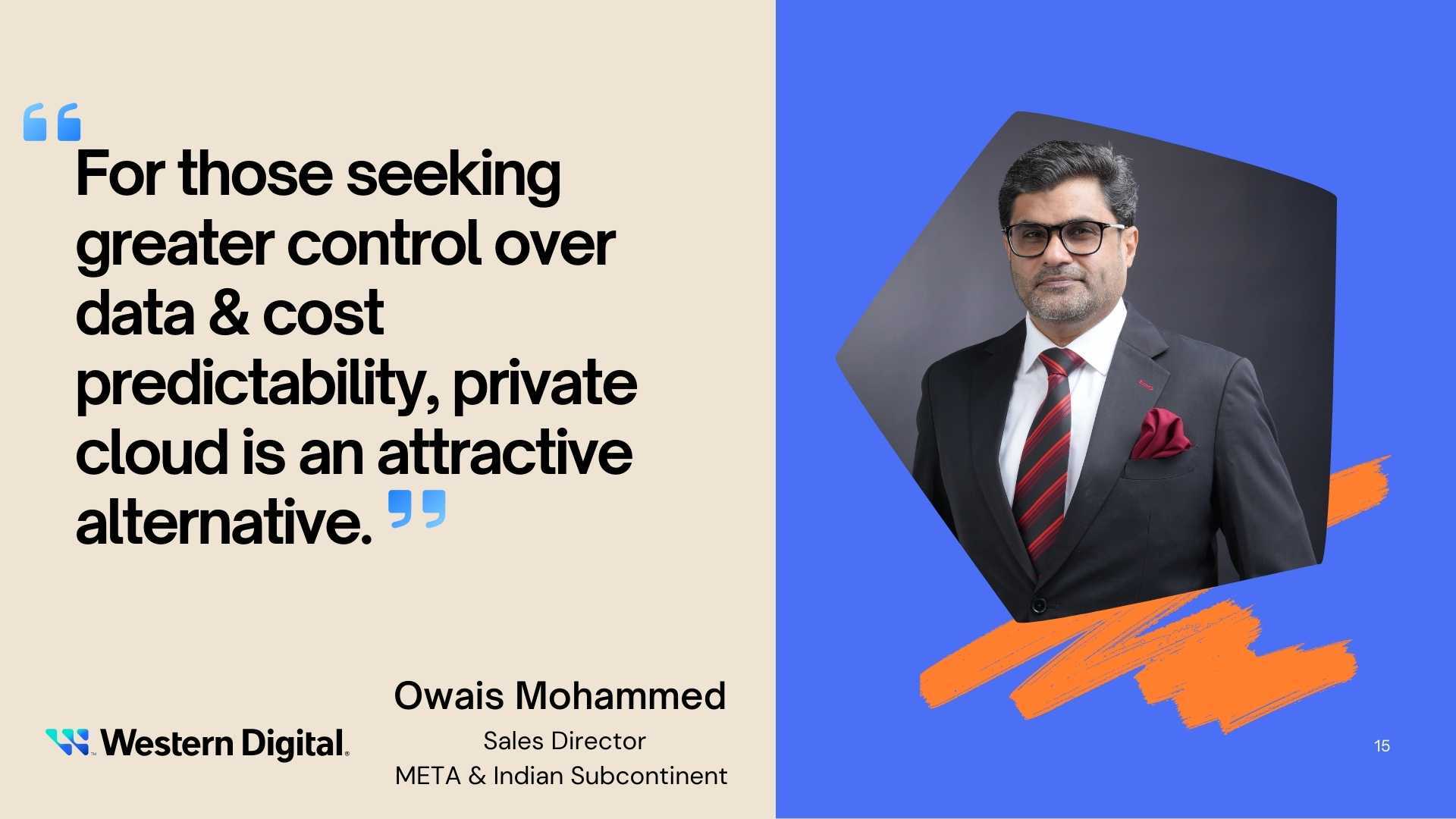
At a time of unprecedented data growth and increasingly intensive workloads, the private cloud architecture route can become an attractive alternative for those seeking greater control over data, cost predictability, and data access.


 Rate us on G2