If you work in B2B tech marketing, run this test before your next standup.
Open ChatGPT. Ask it: "What are the best [your category] platforms for [your ideal customer profile]?" Note which companies it names, in what order, and with what descriptions. Then ask Perplexity the same question. Then Gemini. Then Google AI Overviews.
For most mid-market B2B software companies, the answer is one of three things: they don't show up at all, they show up with out-of-date information, or they show up described using a competitor's positioning language.
This is the structured data gap, and it is the single biggest lever in B2B tech marketing right now.
The shift is bigger than most teams have internalized. ChatGPT now serves hundreds of millions of weekly active users. Gartner predicts traditional search engine volume will drop 25% by 2026, with that share moving to AI chatbots and virtual agents. Pew Research confirmed that when a Google AI summary appears, click-through to traditional results drops from 15% to 8%. The buying committee for your next enterprise deal is not starting in Google. It is starting in a chat window.
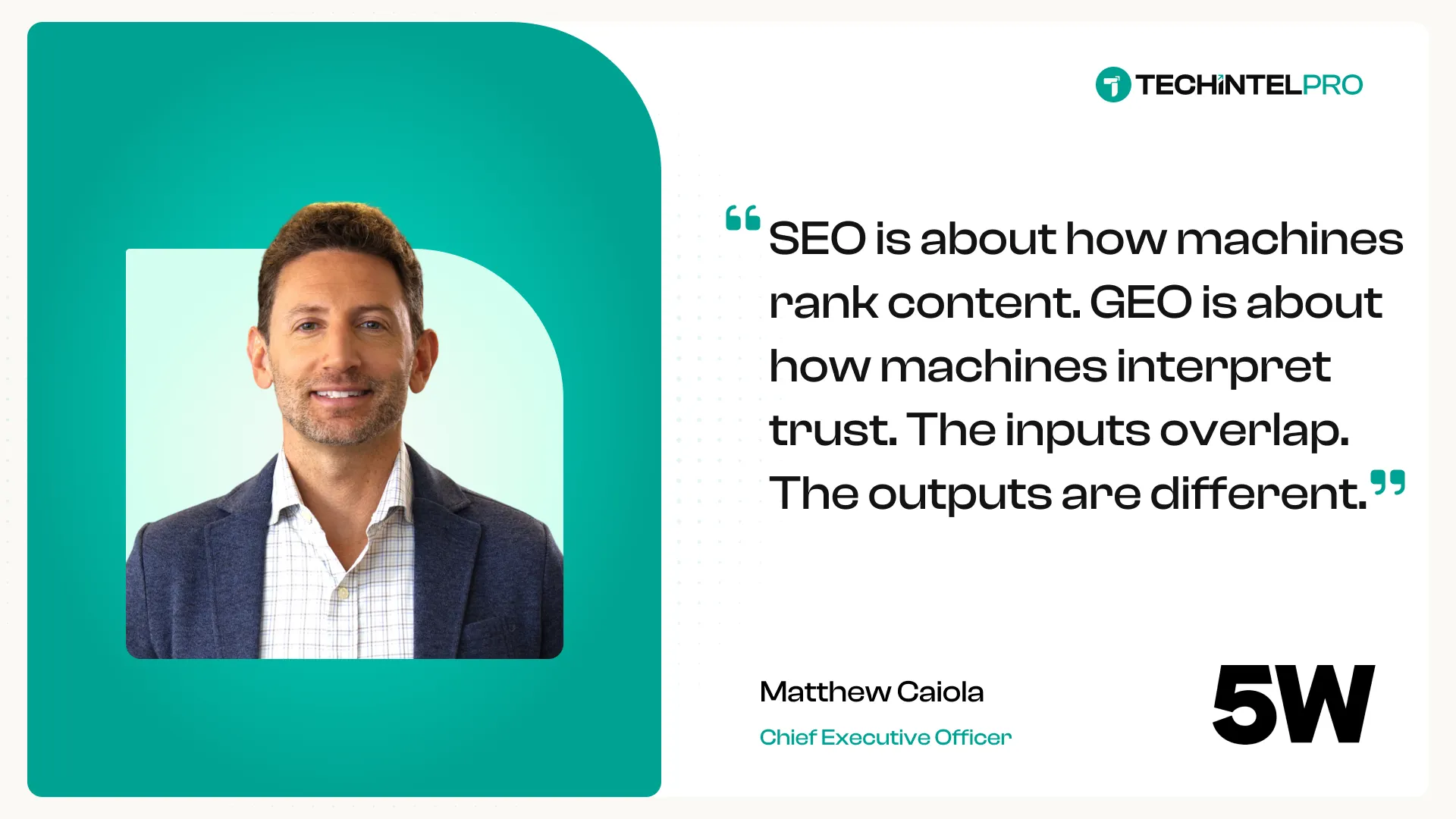
The problem for B2B tech is that the discipline most companies spent a decade building, SEO, was engineered for a different machine. SEO is about how machines rank content. Generative Engine Optimization, or GEO, is about how machines interpret trust. The inputs overlap. The outputs are different.
At 5W, our GEO work rests on four pillars: semantic content optimization, structured data deployment, authoritative third-party source development, and ongoing monitoring of how AI systems actually describe our clients. For B2B tech specifically, each pillar exposes a gap most software marketers haven't addressed.
Five moves worth making this quarter.
Fix the schema. Large language models rely heavily on structured data to resolve what a company is, what it sells, and who it serves. Organization schema, Product schema, FAQ schema, and clear author and expert markup are no longer optional. If your site still ships unstructured marketing copy as its primary content layer, you are handing the citation slot to a competitor that did the work.
Build the third-party proof layer. Generative systems weigh external authority. That means the long-ignored PR motion, category analyst quotes, customer case studies published on credible third-party sites, executive bylines in trade press are suddenly the most important input into your AI visibility. The majority of citations in AI answers come from earned and semi-earned environments, not your homepage.
Audit the expert layer. When ChatGPT answers a technical question, it looks for named, credentialed experts. Most B2B tech companies have a CEO who shows up on podcasts and a product team that's invisible. If your engineering leaders, CISOs, or domain specialists aren't quoted in third-party press with a consistent narrative across a quarter, they are not being indexed as category authorities.
Clean up the Wikipedia problem. Pew's research confirms that Wikipedia, YouTube, and Reddit are the most commonly cited sources in AI answers; the same three platforms dominate citations in both AI summaries and standard search results. Most B2B companies under $500M either lack a Wikipedia page or have one that's outdated, under-linked, or written by an enthusiastic intern five years ago. This is fixable, and it moves the needle fast.
Start measuring what actually matters. Share of voice in the press is a trailing indicator of a metric that no longer exists. What matters is whether you appear, and appear accurately, inside AI-generated answers to your category's highest-intent prompts. Several platforms now do this work; pick one, benchmark against your three closest competitors, and track weekly.
The economics here are unusual. AI-referred visitors tend to convert at dramatically higher rates than traditional organic traffic because they arrive after the AI has already done the comparison work. You will see fewer visitors. You will see much higher intent. That math rewrites the funnel, top of funnel gets smaller and qualitatively better, and the job of marketing shifts toward being the answer rather than racing for the click.
The B2B tech companies that will dominate their categories in 2027 are doing this work now, quietly. They are not waiting for SEO agencies to rebrand as GEO agencies. They are re-architecting their content, executive positioning, and PR around the fact that the first conversation a buyer has about their category is with a machine.
The good news: structured data, schema, and editorial authority are old disciplines dressed up for a new job. The teams that move first will own the citation layer of their category for years.


 Rate us on G2