AI in business has not evolved in a straight line. It has moved in waves.
The first wave was assistance. Copilots helped individuals move faster: drafting content, summarizing data, and accelerating analysis. Useful, but largely incremental. The second wave was execution. Agents began taking action on behalf of humans, adjusting bids, launching campaigns, and personalizing outreach. This was a meaningful leap, but it introduced a new problem: scale without coordination.
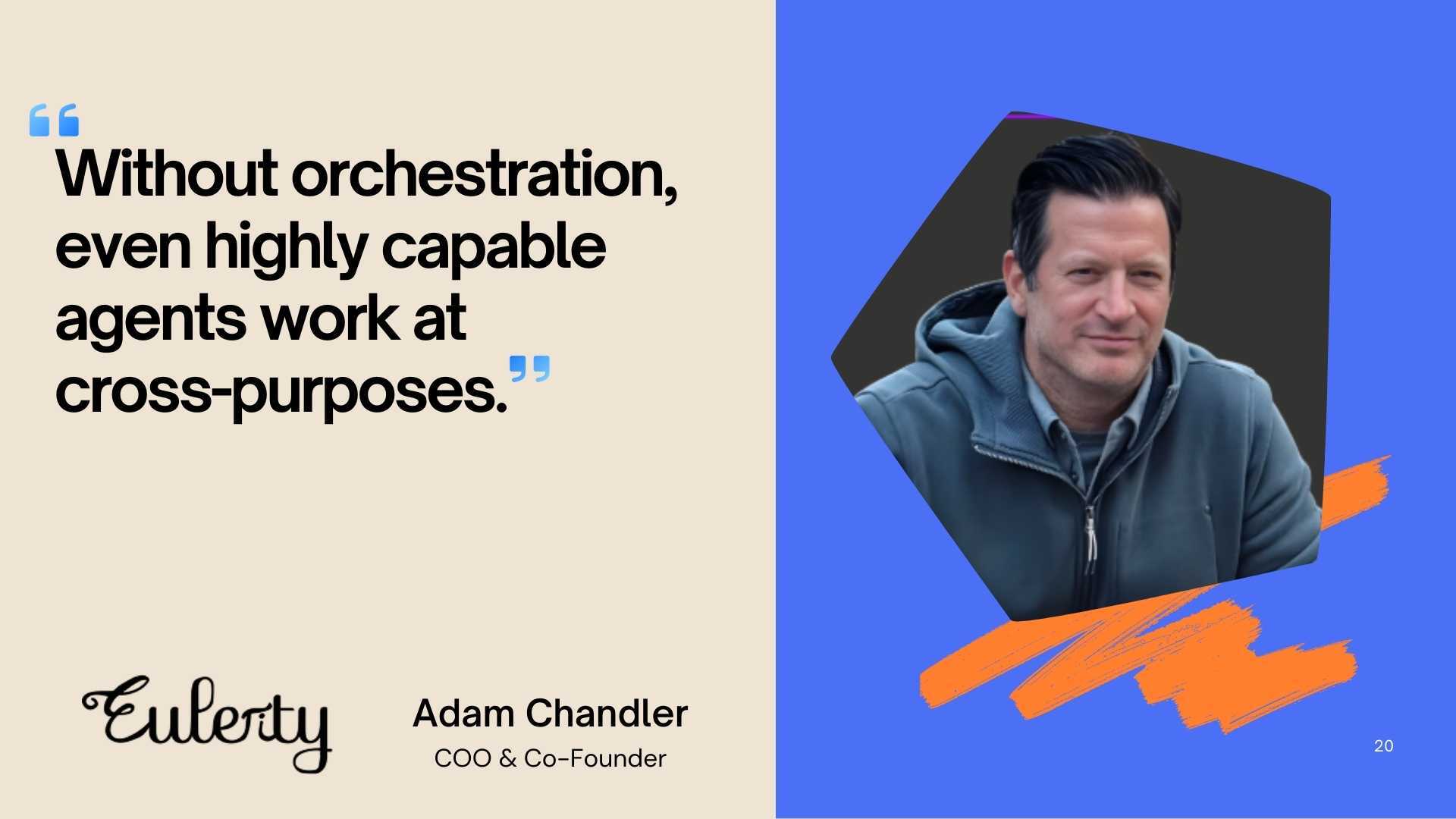
We are now entering a third wave. It is quieter, less visible, and far more consequential. Agents are starting to manage other agents. That shift introduces what I believe will become the most important layer in enterprise AI systems: orchestration. Without orchestration, even highly capable agents work at cross-purposes. Budgets drift out of alignment. Campaigns compete instead of compound. Signals from one part of the organization undermine performance in another. Each agent may be executing correctly in isolation, but the system as a whole becomes inefficient.
Orchestration solves this by changing the role of intelligence in the system. Instead of every agent acting independently, orchestration agents plan, delegate, monitor, and rebalance the work of other agents. They continuously evaluate priorities, resolve conflicts, and reassign effort based on performance, objectives, and real‑world context.
The result is not automation for its own sake. It’s a coordinated operating system that adapts continuously without requiring humans to micromanage every decision.
Why This Is Showing Up Now
This shift is not theoretical. We’re already seeing early signals in enterprise deployments.
Across industries, a growing share of technology leaders report actively deploying agentic AI systems rather than experimenting in isolation. Roughly a quarter of organizations piloting generative AI today are deploying agentic systems, and adoption is expected to accelerate materially over the next two years. That acceleration is not driven by novelty — it is driven by ROI. What’s changing is not trust in AI’s capabilities, but instead, trust in its coordination.
Many early agent deployments failed quietly because no one owned the system‑level outcome. Teams added agents to solve discrete problems, only to discover later that those agents created new conflicts elsewhere. Orchestration emerges as the correction to that mistake.
Marketing Exposes the Orchestration Problem Faster Than Most Functions
Marketing isn’t a linear workflow. It’s a dense network of decisions unfolding across channels, campaigns, locations, and audiences in real time. In multi‑location organizations, that complexity multiplies. A central team can’t manually optimize hundreds of local campaigns without becoming a bottleneck. At the same time, full autonomy without guardrails is neither realistic nor responsible. Brand voice matters. Timing matters. Local context matters.
This is where orchestration becomes a competitive advantage rather than a technical feature. Instead of choosing between control and scale, orchestration allows both. Automation handles execution at speed, while humans guide intent, priorities, and judgment where nuance actually matters.
Orchestration Already Works in Environments More Complex Than Marketing
If this sounds abstract, consider how orchestration is already being used outside of marketing. Toyota’s global supply chain is one example. The company has deployed agentic systems that provide real‑time visibility into vehicle delivery timing across regions and dealerships. These agents monitor live data, predict disruptions, adjust logistics plans, and surface exceptions for human review only when strategic judgment is required.
What once required dozens of manual handoffs is now managed continuously by agents coordinating with one another. Humans intervene at decision points, not at every operational step. Hewlett Packard Enterprise offers another instructive example. HPE built an internal agentic system called Alfred, composed of multiple specialized agents responsible for discrete parts of operational performance reviews. One agent gathers data, another analyzes it, another visualizes trends, and another prepares executive summaries.
The orchestration layer ensures these agents act in sequence, share context, and align toward a shared objective. Humans supervise outcomes rather than stitching together outputs from disconnected tools. This is what agents managing other agents looks like in practice.
What Orchestration Looks Like in Modern Marketing Platforms
In marketing, orchestration becomes most powerful when applied at scale.
Imagine a multi‑location retail brand running hundreds of campaigns across search, social, and display. Each location faces different competitive pressures, seasonality, and performance patterns. In an orchestrated system, agents oversee strategy holistically. They assign work to specialists responsible for bidding, creative rotation, and audience targeting. They monitor performance continuously and rebalance spend in real time.
When a location underperforms, the system doesn’t wait for a weekly report or a manual review. It reallocates budget, tests new creative, refines targeting, and escalates only when human judgment is needed. Local managers aren’t removed from the loop. They can still adjust messaging, respond to community events, or prioritize specific promotions. Those inputs feed back into the system and influence optimization across the entire network. This isn’t automation replacing humans; it’s automation amplifying human insight.
Trust Is the Real Constraint
The limiting factor for agentic AI adoption isn’t technical capability, it’s trust. Organizations hesitate when systems feel opaque or uncontrollable. Orchestration addresses this directly. It creates visibility into how decisions are made, how agents interact, and where trade‑offs occur. It surfaces recommendations and flags moments where human intervention is warranted. The role of humans does not diminish; it elevates.
Instead of spending time on mechanical adjustments, teams focus on strategy, interpretation, and judgment. They step out of execution and into stewardship.
The Companies That Win Will Understand This Layer
By 2026, the organizations that outperform their peers will not be those with the most agents. They will be those that understand orchestration. They’ll deploy agentic systems that operate quietly in the background, adjusting campaigns, budgets, and strategies in real time, while surfacing meaningful decisions to humans only when context truly matters.
They’ll maintain hyper‑local relevance while scaling efficiently and move faster without losing control. When agents begin managing each other, AI stops being a collection of tools. It becomes infrastructure and an operating system for business.
The orchestration layer is not a feature. It is the foundation for how agentic AI will deliver durable, scalable value in the years ahead.


 Rate us on G2