
The New Growth Equation
Mid-market companies face a difficult equation: growth expectations keep rising while marketing budgets remain flat or even contract. Too often, organizations simply roll last year’s budget forward without rethinking their approach, which is a missed opportunity in a rapidly changing environment.
The most competitive companies are re-engineering their marketing function for efficiency and agility. Increasingly, they are turning to fractional marketing leadership, which delivers executive-level strategy and modular execution without committing to full-time overhead.
The Budget Reality Check
Marketing budgets as a share of company revenue fell to 7.7% in 2024, which is the lowest level since 2021, even as most marketing leaders plan to increase investment in the coming year. The priority is no longer just “spending more” but spending smarter.
Budgets are shifting toward technology, training, and measurable outcomes rather than fixed salaries. AI adoption in marketing strategy has more than doubled in two years, from 28% in 2023 to 63% in 2025. Fractional marketing models fit this moment perfectly, enabling companies to redirect resources toward flexible leadership and high-ROI initiatives instead of permanent headcount.
When to Consider Fractional Leadership
Typical indicators that it may be time to explore a fractional approach include:
- Aggressive growth targets but stagnant marketing performance
- Disconnected campaigns with no unified strategy
- A team of “doers” without senior leadership to set direction
- Unpredictable lead flow or inconsistent brand positioning
- Limited in-house expertise in analytics, AI, or demand generation
If several of these issues are present, fractional marketing leadership may be the fastest, most cost-effective way to realign marketing with business objectives.
The High Cost of Traditional Teams
Building a full in-house marketing department can be expensive and slow. Recruiting, onboarding, and retaining senior leaders and skilled specialists all require significant investment and lock the business into fixed costs that are hard to adjust if strategy or market conditions change.
It’s no surprise that 39% of CMOs plan to reduce labor costs and agency spend this year, signaling the search for more scalable solutions. Fractional marketing transforms those fixed costs into variable investments, giving businesses the ability to scale capacity up or down as needed.
Choosing the Right Fractional Partner
The best fractional leaders don’t just advise. They own the marketing function. Look for partners who:
- Align marketing strategy to business goals and provide accountability for results
- Bring proven frameworks and repeatable processes for building strategy and measuring success
- Work with your existing systems and tools, introducing new ones only when necessary to drive ROI
- Provide access to specialized talent as needed, without overstaffing
- Offer cross-industry insights to keep your organization ahead of market shifts and emerging technology
A Modular, ROI-Driven Model
Fractional CMOs often bring a network of specialists, from content strategists to demand-generation experts, who can be deployed as needed. This modular model means businesses get the right expertise at the right time, with measurable improvements across key metrics, from stronger lead quality to greater pipeline value, because strategy and execution are aligned from day one.
Agility, AI & Future-Proofing
Agility has become a growth imperative. Whether entering a new market, preparing for a funding round, or repositioning a brand, businesses need a marketing function that can flex with their goals.
Fractional leaders are particularly valuable in the age of AI. They help organizations select the right tools, pilot initiatives, and implement governance frameworks while upskilling internal teams, ensuring that AI investments translate into meaningful ROI.
From Fixed Cost to Growth Lever
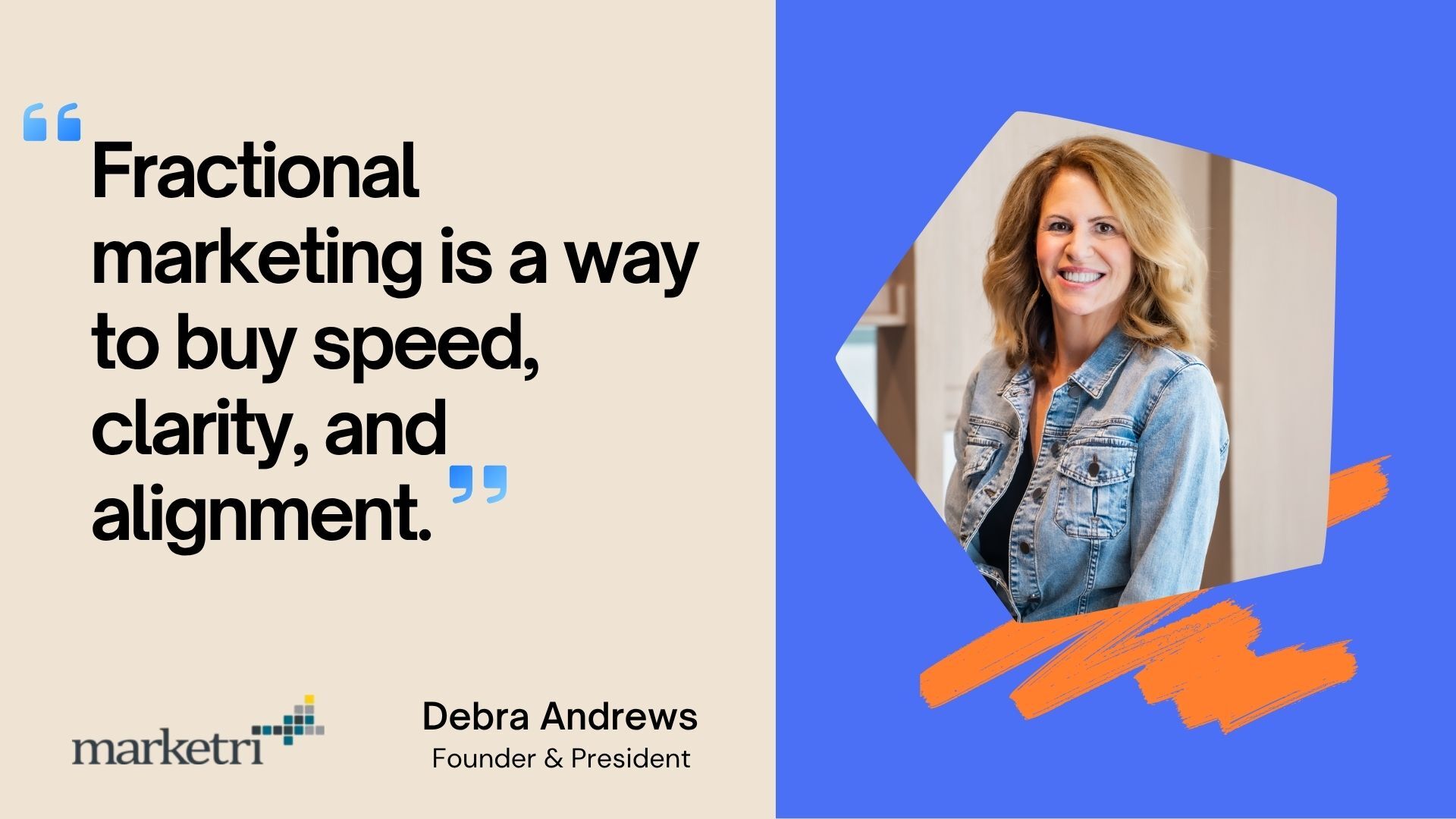
Fractional marketing is more than a cost-saving measure. It is a way to buy speed, clarity, and alignment. By turning marketing from a fixed expense into a flexible growth lever, companies gain the ability to respond quickly to changing market conditions and evolving business priorities.
The question is no longer whether you can afford a full-time CMO, but it’s whether you can afford to keep operating with a static, inflexible model. For many mid-market businesses, the answer is clear: the fractional route offers a smarter, more scalable path to growth.


 Rate us on G2