
For two decades, the communications function has been organized around a few stable disciplines: media relations, executive thought leadership, crisis response, and corporate reputation. Each of these had its own metrics, its own playbook, its own seat at the table. The function has been remarkably stable through several waves of digital and platform disruption.
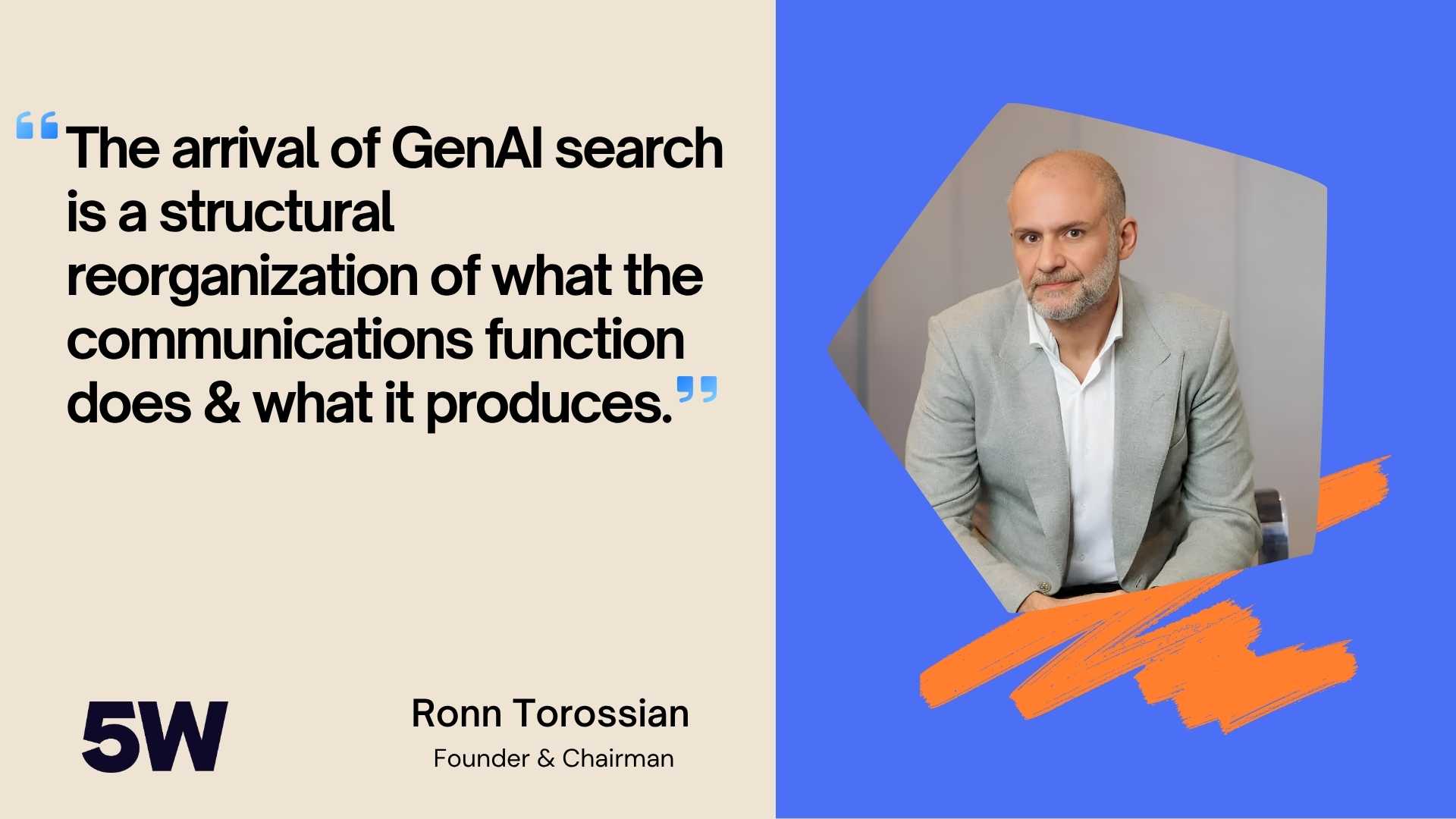
The arrival of generative AI search is not just another wave. It is a structural reorganization of what the communications function does and what it produces.
Here’s what is changing.
Earned media is no longer just credibility-building. It is the primary input to a brand's AI citation share. Across every category 5W has studied, published in our AI Visibility Index series, the brands ranked in the top 5 of their category index display three or more independent third-party citations per major brand claim, on average. The brands ranked in the bottom quintile typically display fewer than one. AI engines weigh third-party corroboration heavily because it is the strongest available signal of credibility. The communications function's traditional output, earned-media coverage, is now the structural infrastructure that determines whether AI engines recommend the brand at all.
Executive thought leadership is no longer a personal-brand exercise. It is a measurable AI visibility asset. Founders posting consistently on LinkedIn outperform their company brand pages by an average of 8x in engagement and 4x in qualified inbound, as 5W documented in research across multiple categories. AI engines weigh credentialed individual voices preferentially over brand voices because the individuals carry semantic authority that brand accounts cannot fake. The thought-leadership function is now responsible for an output the function did not previously have to deliver: a measurable improvement in the brand's AI citation share through founder content.
Crisis response is no longer just a damage-control discipline. It is also an AI-citation-correction discipline. When a crisis hits, AI engines will continue to surface stale, incorrect, or harmful information about the brand for as long as the AI's training data and indexed content reflect that information. Modern crisis response requires not just managing the press cycle but actively rebuilding the AI's understanding of the brand through new, structured, easily cited corrections. This is a discipline most communications teams have not formalized. It will become standard practice within 18 months.
Corporate reputation is no longer just a long-term equity-building exercise. It is a measurable, real-time AI-visibility metric. The brand's entity strength on AI engines, the consistency of the brand's positioning across cited sources, and the depth of corroborating expert voices about the brand are all measurable today. The reputation function should be reporting these metrics quarterly to the C-suite, with the same operational seriousness as the marketing function reports media-mix or attribution metrics.
The implications for how communications teams are structured are significant.
First, the function needs measurement infrastructure that did not previously exist. Quarterly AI citation share audits, peer benchmarking, factual-accuracy scoring, and ranking-position tracking are now standard practice. Communications teams that do not run them are flying blind in their primary discipline.
Second, the function needs new technical literacy. Schema markup, structured data, semantic content architecture, and AI parsing logic are now communications territory. They used to be technical-team territory. They are not anymore, or at least not exclusively. Communications leaders who cannot speak the technical language fluently are being left out of conversations that determine the brand's visibility.
Third, the function needs a different production capacity. Earned media production is largely the same. Owned content production is different – substantively different, structurally different, technically different from what most teams have been producing for the last decade. Communications teams that have not built capacity for high-quality, depth-of-category, schema-marked-up content production are being out-competed by teams that have.
Fourth, the function needs different leadership. The communications leader of 2026 is part traditional comms strategist, part technical SEO/GEO operator, part data-fluent measurement leader. Few people currently in the function are all three. The function will increasingly hire from technical and analytical backgrounds rather than exclusively from traditional communications backgrounds.
This is not a minor evolution of the discipline. It is a reorganization comparable to the integration of digital marketing into traditional marketing twenty years ago. Some firms will lead this reorganization and define what the modern communications function looks like. Some firms will resist it and lose share to the firms that lead. The pattern from the last reorganization is instructive: the firms that resisted digital integration in the early 2000s mostly do not exist as independent firms anymore.
The firms leading the AI-era communications function will define the next decade of the industry.


 Rate us on G2