For the past two years, the so-called “Copilot” era of artificial intelligence has been defined by a fundamental architectural limitation. At its heart, it was probabilistic text generation masquerading as true automation. Behind the curtain were sleek chat interfaces that could effortlessly suggest ad copy or draft persuasive emails. However, the actual execution, the imperative logic of clicking buttons, configuring Demand-Side Platforms (DSPs), and managing state across dozens or even thousands of campaigns, continued to be a manual, human burden.
With the release of Google’s Gemini 3, we’ve now crossed a critical threshold. This is a strategic leap from generative AI, where only assets were created, to agentic AI, meaning the models can now orchestrate themselves autonomously. This shift has implications for the “connective tissue” economy, which includes decentralized networks of businesses, financial services, and large multi-location brands. Gemini 3 is more than a feature update; it is the resolution of a distributed systems problem that has plagued local marketing for more than a decade.
The Distributed Orchestration Failure
To appreciate the profound technical significance of Gemini 3, we must first define the problem businesses have faced. Multi-location marketing is not fundamentally a creative problem, but an intractable distributed orchestration problem.
Consider a franchise system with 2,000 locations. It operates less like a unified corporation and more like a decentralized, high-latency network prone to drift. Central headquarters pushes a “packet,” a new promotion, a brand standard, or a compliance mandate, but the individual nodes (local franchisees) consistently fail to execute it with fidelity due to skill gaps, resource constraints, or simple human error. The big question has become what can be implemented to fix this.
Previous attempts to solve this fell short. Rigid, rule-based software and earlier Large Language Models (LLMs), when tasked with complex logic or multi-step processes, would inevitably hallucinate. The sought-after ideal solution, where a user simply declares their intent and the system handles the intricate execution, required three specific, previously absent technical capabilities. Gemini 3 delivers all three.
For years, engineering teams have struggled to ensure brand and legal compliance using Retrieval Augmented Generation (RAG). Teams would chunk massive brand guidelines into vector databases, retrieving only the relevant snippets for the AI to reason upon. RAG’s failure mode can be blamed on fragmentation. If a local operator asks to run a compliant advertisement, and the retrieval system misses the one specific clause on font usage in non-standard viewports, the AI generates a non-compliant asset. For a highly regulated industry, this is a catastrophic operational risk.
Gemini 3’s 1 million-token context window fundamentally alters this architecture. We no longer need to rely on lossy, high-risk retrieval methods. Now, we can load the entire operational state, including the 300-page Franchise Disclosure Document (FDD), every brand standard, all legal compliance mandates, and historical performance data, directly into the model’s active memory. This enables holistic reasoning. The model is not guessing based on a snippet; it is instantaneously, deterministically validating the output against the full, unified corpus of the brand’s rules. For financial services or healthcare, this shift from retrieved context to full context is the difference between a cool demonstration and production-grade safety.
Breaking Down Stateful Tool Use and Thought Signatures
One of the biggest flaws of previous agent architectures was their inherent statelessness. An agent might successfully trigger an action like "buy media," but if the API call failed or required a multi-step handshake with an external system, it would lose the chain of thought regarding why it made that initial decision.
That is why Gemini 3 introduced Thought Signatures, a critical mechanism that allows the model to encrypt and persist its reasoning chain across multiple turns and tool calls. This is the lynchpin for truly autonomous, enterprise-grade workflows.
When a local operator declares, "Spend $500 to drive weekend traffic for the new lunch special," the AI initiates a complex, multithreaded workflow. First, it ingests assets via Vision API, then formats creative for Connected TV (CTV) and social, then bids on inventory across two different platforms, and finally, allocates budget. If, for instance, the formatting step fails due to a resolution issue, the agent does not hallucinate or simply restart the entire process. It can now use its persisted thought signature to debug the specific error, retry the failed step, and seamlessly resume the workflow. This new capacity for autonomous error handling will become the bedrock of enterprise reliability.
What Is the Difference Between Native Multimodality vs. “Stitched” Models?
Until now, true multimodality was often a misnomer, involving the clumsy stitching together of disparate systems. These systems consisted of a Vision model that saw the image, a separate LLM that wrote the copy, and perhaps an Optical Character Recognition (OCR) tool to read text. Unfortunately, this introduced inherent latency, signal loss, and fragility between components. The result was a lagged and often error-prone generation, where a resource investment fell short of what businesses needed.
Gemini 3 is natively multimodal. It processes pixels and tokens within the same foundational vector space. Technically, this means the AI can perform semantic compliance checks on creative assets with a human-level nuance and context previously impossible. It does not just read the text on an image. Now, it understands the relationship between the image sentiment and a brand’s voice. This allows it to flag that a user-uploaded photo is too dark for brand standards or contains a competitor’s logo in the subtle background without needing a separate, costly computer vision pipeline.
The Move to Declarative Infrastructure
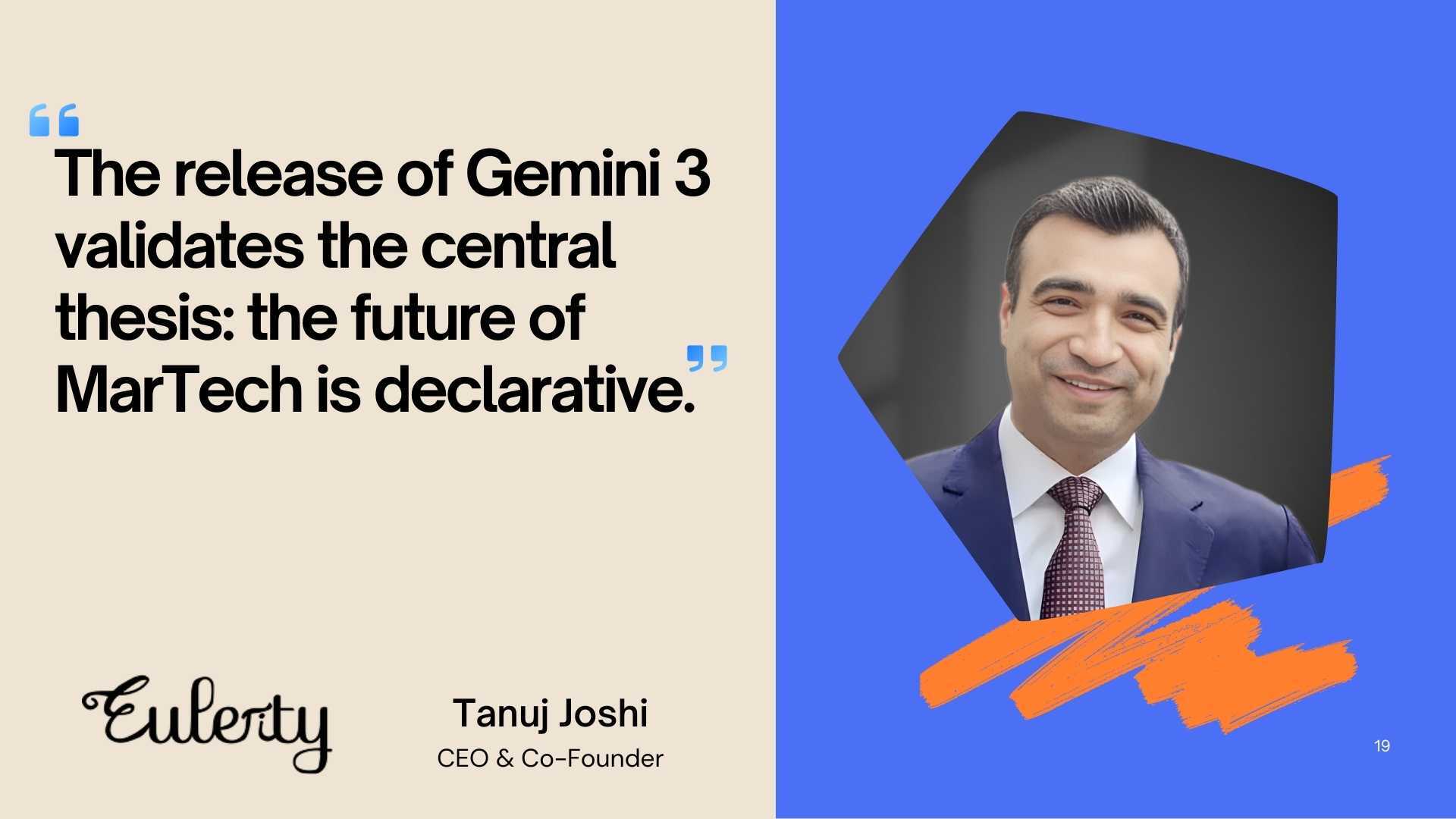
The release of Gemini 3 validates the central thesis: the future of MarTech is declarative. In software engineering, a paradigm shift occurred decades ago, moving from imperative coding (telling the computer how to perform a task) to declarative coding (telling the computer what the final state should be). Marketing is undergoing the exact same transition.
The “Copilot” era was imperative, with the human still serving as the compiler, checking the code, managing the state, and clicking the buttons. The Gemini 3 era is inherently declarative. The local business owner or central marketing team defines the desired end state, “I need 50 qualified leads for this offer while maintaining 100 percent brand compliance,” and the agentic infrastructure, powered by deep reasoning and stateful execution, compiles that intent into reality.
The focus is no longer on building tools to help humans work faster. It is on building the infrastructure that makes the work itself disappear.


 Rate us on G2