To unlock new levels of productivity, smarter decision-making, and sustainable competitive advantage, enterprises around the world are investing heavily in artificial intelligence (AI). Global AI spend is projected to pass $2.5 trillion in 2026. Despite this enthusiasm, 95% of AI pilots fail before they scale. Pilot projects often produce impressive demonstrations but limited business outcomes, largely due to adoption challenges at the user level.
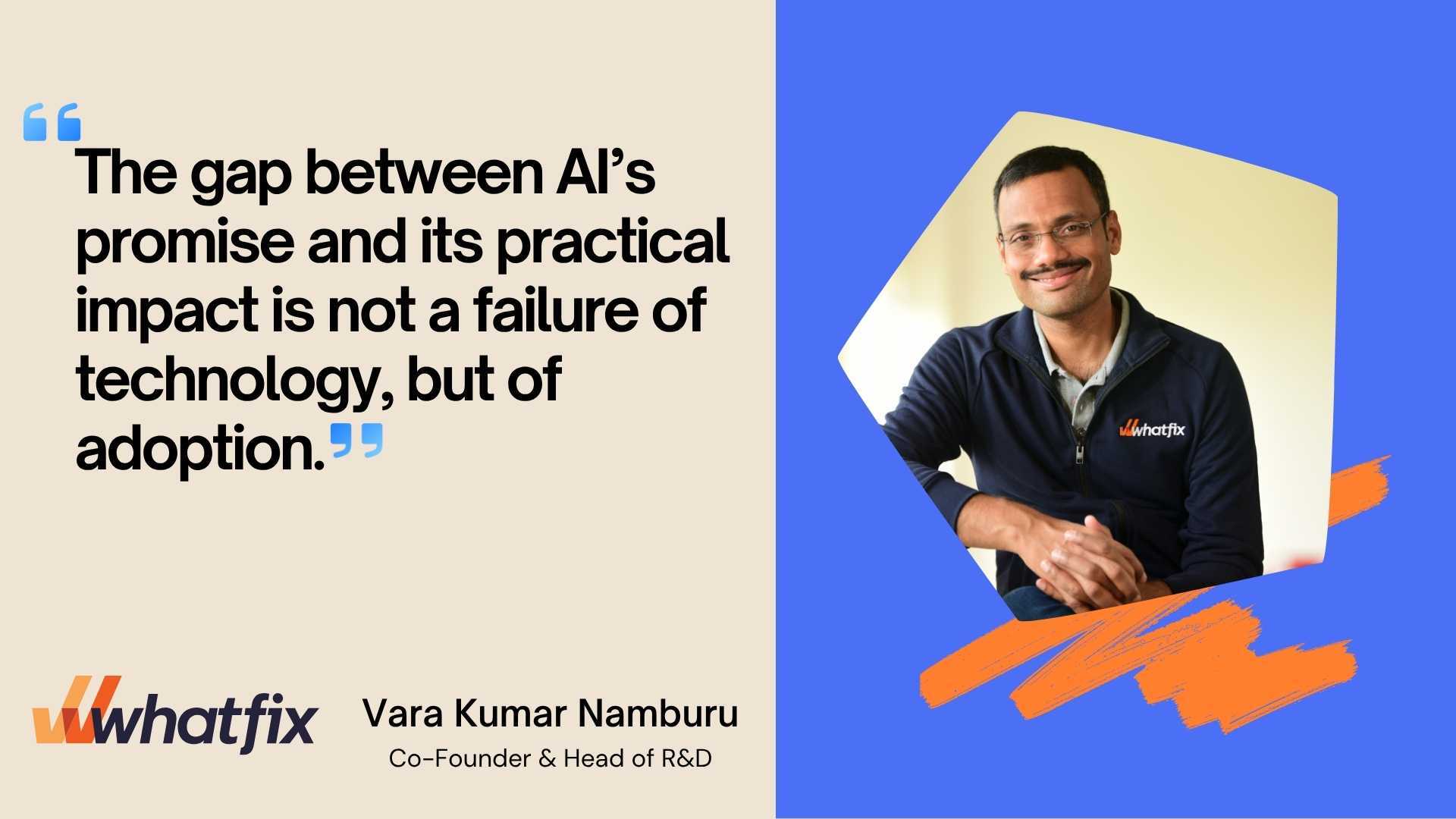
This gap between AI’s promise and its practical impact is not a failure of technology. It is a failure of adoption. Consider an AI sales tool that demonstrates impressive capabilities in tests, but is only regularly used by a small percentage of sales reps. This type of scenario plays out repeatedly across industries, preventing the true potential of AI solutions from being realized.
True transformation happens when we rethink how people experience AI, not when we simply deploy more algorithms. When intelligence is thoughtfully embedded into everyday workflows in ways that are contextual, trusted, and human-centered, AI shifts from being just another tool to becoming a natural extension of how people work.
The Core Challenges Blocking Enterprise AI Adoption
The Overload Crisis
Enterprises today operate in technology-saturated environments, with employees toggling between dozens of applications. As AI adoption grows, many such applications now include built-in AI capabilities or assistants, typically designed for broad, general use rather than specific roles or workflows.
This proliferation of disconnected, generalized AI systems overwhelms users with constant choices and notifications. When each assistant functions in isolation, without awareness of user intent or context, it leads to confusion, cognitive fatigue, decision paralysis, and disengagement. Without orchestration and context, AI becomes noise rather than intelligence.
The User Experience Gap
AI success depends on how people experience it. When tools are deployed without alignment to real-world workflows, adoption declines, employees are left to adapt independently, and measurable behavioral change remains unrealized.
Many enterprises still approach AI as a technology rollout, measuring success through deployment metrics alone. This overlooks the connection to business outcomes. Effective evaluation requires tracking user-centric and behavioral metrics such as time-to-proficiency, task success rates, and tool adoption.
Embedding AI in the Flow of Work
Enterprises that succeed with AI integrate it into everyday workflows rather than treating it as a separate system. The next generation of enterprise AI will be context-aware, understanding user activity, inferring intent in real time, and delivering relevant insights or actions within the flow of work. It can recognize specific tasks and proactively surface targeted intelligence and guidance without requiring users to switch applications.
Contextual integration reduces information overload and makes assistance intuitive rather than intrusive. Embedding intelligence directly into applications turns static processes into adaptive workflows. This enables users to access insights within existing tasks and prevent errors before submission or finalization.
Governance must evolve in parallel. Responsible AI frameworks provide guardrails for scale, including strong data protection to safeguard PII, prompt moderation to prevent misuse, and explicit human oversight to ensure accountability. At Whatfix, for example, all AI systems operate under the principle of being "assistive, not autonomous,” keeping human judgment central to the process.
When embedded seamlessly and governed responsibly, AI shifts from pilot initiative to production multiplier. The next step is to examine the practices that enable this transformation.
AI That Transforms Work
Task-specific AI agents are redefining how work gets done by embedding intelligence directly into everyday tasks.
They enable non-technical users to create sophisticated content through natural language prompts, significantly reducing the time required to produce in-app learning and guidance. They make analytics conversational, allowing users to ask questions in plain language and receive immediate visual insights. And provide just-in-time guidance within active workflows, answering questions and delivering nudges at the point of need.
Across these use cases, one principle stands out: AI is designed to augment human expertise, not replace it. It helps employees complete tasks faster and reduces the need for extensive training. When aligned with user intent and delivered in context, AI becomes a productivity multiplier rather than an added layer of complexity.
Best Practices for Scaling AI Adoption
- Deliver Immediate User Value: AI adoption succeeds when it solves specific, high-friction workflow challenges and delivers measurable near-term impact in time saved, errors reduced, and user confidence, building momentum for scale.
- Design for Human-AI Collaboration: AI augments rather than replaces human capability, requiring clear role definition, governance oversight, and a shift of repetitive tasks to automation so people can focus on creativity, empathy, and strategic decision-making.
- Build a Unified Intelligence Framework: A unified AI strategy establishes a coordinated intelligence layer across the enterprise, integrating insights, guidance, and automation into a single, consistent system. Instead of siloed AI deployments, organizations orchestrate capabilities across applications, using platforms like digital adoption solutions as control points. This approach reduces fragmentation, minimizes technical debt, and ensures that AI-driven experiences remain consistent, scalable, and maintainable.
- Human-Centric AI at Scale: Leading organizations design AI as a force multiplier for human capability, not a replacement. Routine and repetitive tasks are automated, while employees focus on judgment, creativity, and problem-solving. This shift requires deliberate investment in skills such as prompt design, output evaluation, and critical interpretation of AI limitations. The result is a blended workforce where humans and AI collaborate effectively, driving better decisions and outcomes.
- Measure What Matters: Sustainable AI scale requires tracking behavioral and business outcomes such as engagement, time-to-proficiency, decision quality, satisfaction, and productivity, creating a feedback loop that drives continuous optimization and long-term adoption.
The Competitive Advantage of Human-Centric AI
Organizations that treat AI as a purely technical initiative often deploy powerful systems with limited impact. Those who design AI around people, enabling systems to learn and act in partnership with users, build a durable competitive advantage.
AI’s purpose is not to replace human work, but to elevate it. By embedding intelligence into the flow of work, implementing strong governance, and measuring success through human-centered outcomes, enterprises can move beyond experimentation and realize the full business value of artificial intelligence.


 Rate us on G2