
The Limits of Traditional Quality Engineering
Quality engineering has been built around a model of software that has been predictable for decades. Apps used deterministic logic; stable requirements were the norm, and system behavior could be understood before going live. QE strategies were a reflection of this situation.
The conventional quality engineering was all about confirming predetermined requirements, testing familiar paths, and making sure that releases met functional as well as performance expectations. Often, quality was relegated to the end of the development life cycle, like a kind of safeguard, rather than being an element that could have a strategic impact.
This method was effective since the behavior of software was mostly unchanging after its deployment. Failures were exceptions, and when they happened, it was easy to spot, understand, and, most of the time, get them back to normal. A bug could be fixed with a patch. A release could be rolled back.
AI systems have, therefore, completely changed this premise. The behavior is never the same twice; there is a constant change, and failure is not always evident. Using old QE strategies on AI-driven systems results in a fundamental misalignment of the behavior of systems and the way quality is measured. What once guaranteed stability is now the source of long-term risk.
How AI Has Changed the Nature of Software Risk
Traditional software follows explicit rules. Engineers can trace logic paths, anticipate failure points, and design tests around known conditions. AI systems behave very differently.
AI infers patterns instead of following rules. It depends heavily on data quality, evolves after deployment, and responds probabilistically rather than deterministically. This introduces new categories of risk that older QE models were never built to manage.
Key characteristics of AI-driven risk include:
- outcomes that vary even when inputs appear similar
- reliance on external data sources that change silently
- gradual performance degradation instead of hard failure
- difficulty explaining why behavior changed after the fact
By 2025, enterprise AI reliability research consistently shows that most AI production failures are not caused by flawed models, but by insufficient testing of real-world data conditions, weak validation strategies, and the absence of continuous monitoring. Intelligence is rarely a limiting factor. Assurance is.
This matters because AI failures are harder to detect, harder to explain, and harder to undo once they affect customers or regulators.
When Quality Becomes a Business Risk
In traditional software delivery, quality issues were often contained within engineering teams. A defect might delay a release or require a hotfix, but the impact was usually localized and temporary.
AI failures behave differently.
When AI systems influence pricing, approvals, recommendations, fraud detection, hiring, or risk assessment, quality failures translate directly into business outcomes. The consequences are immediate, visible, and often reputational.
From a business standpoint, poor AI quality manifests as:
- inconsistent or unfair customer experiences
- decisions that cannot be clearly explained or defended
- declining trust in automated systems internally
- increased regulatory, audit, and compliance pressure
This shift is reflected at the leadership level. Executive surveys conducted in 2025 and early 2026 show that a growing majority of senior leaders now evaluate AI initiatives primarily on reliability, controllability, and assurance rather than feature velocity alone. Speed still matters, but uncontrolled speed has become operational risk.
Traditional QE vs AI-Era QE
The evolution of software demands an evolution in quality engineering. The contrast is stark.
Traditional QE was designed to:
- validate fixed requirements
- test deterministic outputs
- focus on pre-release correctness
- treat quality as a phase
AI-era QE must:
- assess probabilistic behavior
- monitor systems continuously after deployment
- evaluate outcomes across time, data shifts, and populations
- treat quality as an operational discipline
This shift is not incremental. It is structural. Organizations that continue to apply traditional QE models to AI systems often discover issues too late, when trust has already been eroded.
What AI Can Automate and What Quality Engineering Must Own
AI has significantly enhanced how quality activities are executed. Automated test generation, large-scale simulations, synthetic data creation, and anomaly detection have improved speed and coverage. These capabilities are valuable and necessary.
However, automation alone does not equal assurance.
AI automation is effective at:
- executing tests at scale
- identifying statistical anomalies
- recognizing patterns across large datasets
Quality engineering is responsible for:
- defining which risks matter
- interpreting anomalies in business context
- determining acceptable levels of uncertainty
- connecting system behavior to real-world impact
AI can run checks. QE decides which checks are meaningful. AI can flag deviations. QE determines whether those deviations pose customer, regulatory, or ethical risk.
This distinction is critical for organizations considering replacing QE with autonomous agents. Automation improves efficiency, but assurance requires accountability, and accountability requires human judgment.
Human-in-the-Loop Is a Structural Requirement
In AI systems that influence real decisions, Human-in-the-Loop is not a fallback. It is a design requirement.
Fully autonomous quality models may appear efficient, but they fail in scenarios where context, ethics, and responsibility matter. Human oversight ensures that systems align with business intent rather than purely statistical optimization.
Human involvement enables teams to:
- evaluate fairness and bias explicitly
- understand edge cases that automation cannot contextualize
- explain decisions to regulators and stakeholders
- intervene deliberately when assumptions no longer hold
Quality engineers define boundaries, challenge assumptions, and recalibrate systems as real-world conditions change. AI operates within those boundaries. It does not define them.
From Output Validation to Behavioral Assurance
Traditional quality engineering asked a simple question: Did the system produce the expected output?
AI forces a more complex one: Does the system behave as intended over time and under change?
Because AI outcomes are probabilistic, validating individual outputs is insufficient. Modern quality engineering focuses on behavioral assurance, evaluating how systems perform across time, data shifts, and usage patterns.
This includes assessing:
- consistency across comparable scenarios
- stability as data and user behavior evolve
- fairness across different user groups
- visibility and understanding of failure modes
This shift explains why quality engineers are increasingly involved earlier in product and design discussions. Assurance cannot be bolted on after decisions are finalized.
New KPIs for Quality in AI Systems
As AI systems continuously adapt, traditional pass-fail metrics lose relevance. Test coverage and defect counts offer limited insight into long-term system health.
By 2025, leading organizations have expanded QE KPIs to include indicators that reflect ongoing behavioral stability.
Common AI-era QE metrics include:
- data and model drift assessment
- outcome stability across defined time windows
- variance in confidence or certainty scores
- alignment between predicted and real-world outcomes
These metrics help teams detect silent degradation early. They surface weakening signals even when systems appear to function normally. Quality engineering is increasingly valued not for preventing visible failure, but for preventing invisible decline.
The High Cost of Silent Degradation
One of the costly AI failure modes is quite declining. The systems keep functioning, but their relevance fades steadily. Recommendation systems have become less effective. Bias goes unnoticed. Confidence goes down.
Because nothing breaks in a way that is obvious, intervention is postponed. Usually, the teams only become aware of the problem when customers stop engaging or when there are complaints from regulators. By that time, fixing the problem was expensive and very disruptive.
Quality engineering reduces the risk of such a scenario by placing the focus on patterns instead of events. By monitoring changes in data distributions, confidence levels, and outcome variance, teams are able to intervene early. Such interventions might not lead to immediate visible results, but they definitely save much bigger losses later on.
Trust as a Practical Competitive Advantage
In AI-driven products, trust is not abstract. It is operational.
- Users trust systems that behave consistently
- Internal teams trust systems; they do not need to constantly override
- Regulators trust systems that can be explained and audited
Quality engineering underpins this trust by reducing unpredictability and clarifying limitations. Over time, reliability becomes a differentiator in markets saturated with AI claims.
As one technology executive observed in 2025:
“In AI systems, accuracy gets attention, but reliability earns trust. And trust is what scales.”
Why Quality Cannot Be Occasional
AI systems do not stop changing after deployment. Models retrain, data sources evolve; usage patterns shift, and external conditions influence outcomes in unexpected ways.
This makes one-time quality checks ineffective. Assurance cannot be achieved through periodic validation alone.
Organizations that manage AI effectively treat quality as:
- an ongoing operational discipline
- a shared responsibility across engineering, data, and product
- a source of early insight rather than late correction
This approach enables systems to scale without losing control and supports faster, safer innovation.
The Expanding Role of the Quality Engineer
As AI systems take on greater responsibility, the role of the quality engineer has expanded significantly. QE professionals are no longer limited to execution and validation.
Their contributions increasingly include:
- interpreting system behavior rather than just test results
- translating technical risk into business language
- influencing design decisions before they become costly to change
- supporting governance, audits, and regulatory compliance
Quality engineering has become a bridge between technical capability and business responsibility.
Regulation Brings Quality into Focus
The landscape around AI regulations is always changing, and transparency, accountability, and fairness are becoming increasingly emphasized. To be compliant, one needs to have proven, not merely the intention. Hence, organizations should be able to show that their systems were tested, monitored, and governed throughout the time.
Quality engineering offers this kind of evidence through well-organized validation, documentation, and continuous supervision. Organizations that make the decision to implement these changes at an early stage are the ones who can easily adapt. On the other hand, those who postpone the matter are bound to have not only costly retrofits but also disruption of their operations, and loss of their credibility.
Quality as a Long-Term Investment
Quality engineering is sometimes considered a luxury, especially in rapidly evolving AI settings. However, this point of view misses the real cost of failure. Rework, delayed projects, loss of trust, and damage to reputation are some of the consequences that can last for a long time.
Sound QE is a foundation for fearless advancement. It makes it possible for companies to grow AI in a way that is ethically responsible, understand the environment through actual data, and create new things without releasing tension. Speed and quality are not two opposite things. Quality is what enables speed on a sustainable basis.
Closing Thought
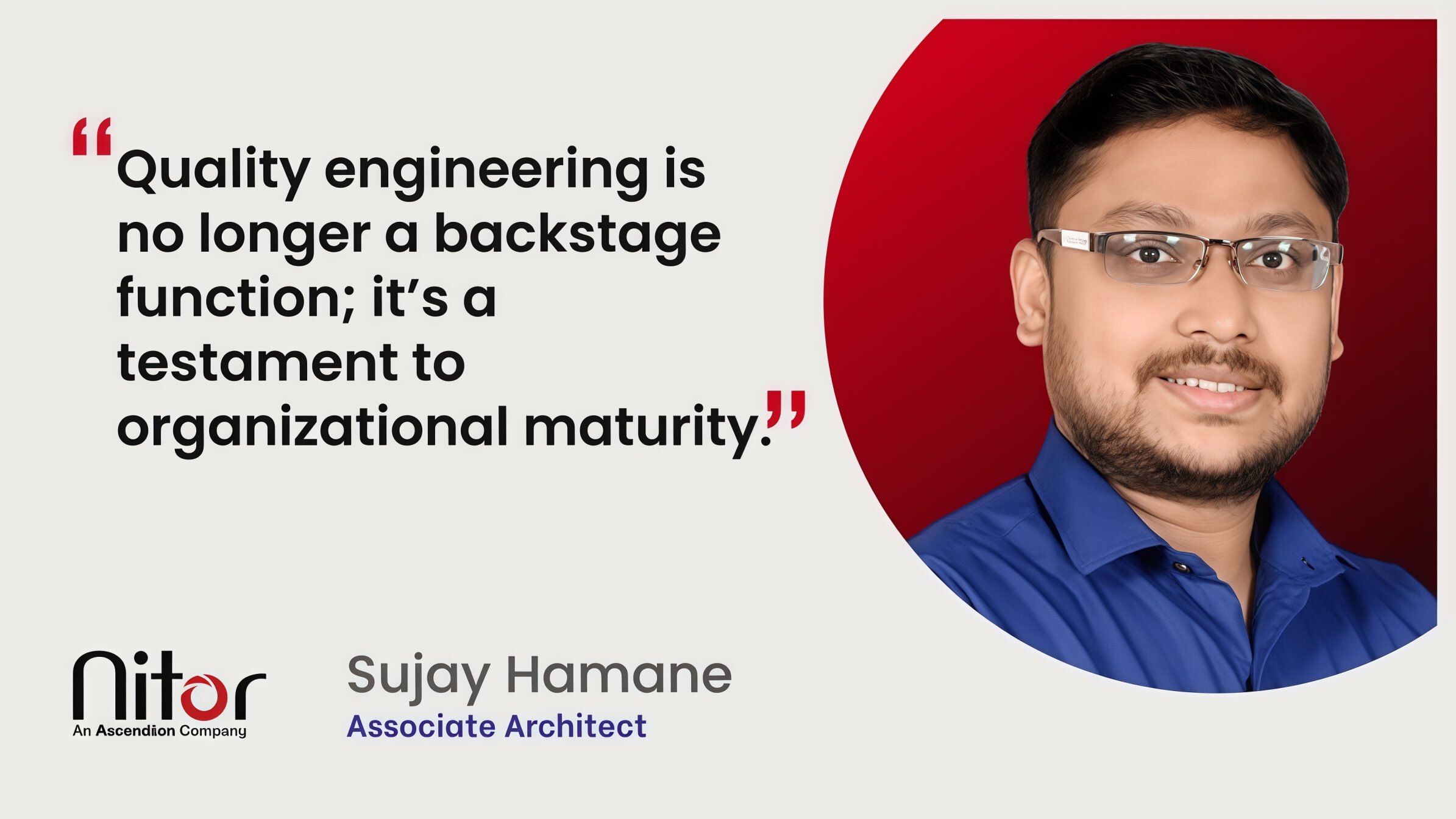
Artificial intelligence has enlarged the scope of software functionalities; however, it has also increased the costs in case of failure. In the current scenario, quality engineering should not be considered a backstage function anymore. It is a testament to organizational maturity.
Smartness is not the factor that sets one apart. Assurance is.
And that assurance is developed deliberately, continuously, and progressively through quality engineering.