
Generative AI has become a pivotal part of the enterprise operating fabric in 2026, a year that is now well underway. What had been limited experimentation in areas such as legal drafting, customer support, engineering productivity, and knowledge discovery has now become widespread, production-grade deployment across organizations.
Enterprise investment is a testament to this change. The world's generative AI spending went past the $30 billion mark in the last year, and industry surveys show that over 60% of large enterprises have at least one GenAI system running in continuous production.
For many organizations, GenAI budgets are now reviewed together with cloud and data platform investments, and there are already expectations about uptime, performance, and a business contribution that can be measured. However, with the wider adoption of GenAI systems, the difficulties associated with maintaining such systems at scale have become increasingly pronounced.
Among the "recurring issues" cited are performance instability, cost volatility, integration depth, and governance challenges, most of which have surfaced as problems rather than temporary growing pains.
This article delves into those challenges that arise from today's encounters and sets out the requirements needed to operate generative AI systems in a reliable manner as usage goes even deeper.
The Illusion of Generative AI Readiness
Early GenAI efforts were facilitated by a number of advantageous factors. Teams had access to curated datasets, restricted prompt designs, limited user groups, and isolated environments. In such situations, model outputs were consistently impressive, latency seemed to be at a satisfactory level, and system behavior was largely predictable.
These initial outcomes gave rise to both confidence and a sense of urgency. The scaling of GenAI was, in many instances, considered to be merely an infrastructural exercise.
However, reality turned out to be quite different.
When GenAI systems were deployed in the real world, they became subject to a wide range of variabilities. This, in turn, made variability unavoidable. Production data turned out to be not only inconsistent but also continuously evolving.
User demand was characterized by burst patterns instead of the planned usage curves. The number of integration points increased rapidly as GenAI capabilities were getting embedded into systems of record, operational platforms, and compliance with workflows.
Industry postmortems on the matter suggest that almost 50% of GenAI initiatives, which halted after the pilot stages, failed due to causes other than model quality. Most of them were performance degradation, cost increase, and integration fragility resulting from the emergence of real usage patterns.
Behind the Curtain: Hidden Challenges of Deploying GenAI
1. Performance and Latency Under Real Load
In today's enterprise deployments, GenAI interactions are seldom single-step operations. A single query might require embeddings, vector retrieval, tool calls, multi-stage reasoning, and a large number of tokens. When parallel users increase, token throughput grows very quickly.
The real-life situation of large-scale deployments shows that more than 40% of GenAI production incidents are caused by latency issues. These problems are usually initiated during the periods of the highest load.
In the case of internal productivity tools, response delays lower the rate of users' engagement. In operational workflows, latency has an immediate impact on SLAs, cycle times, and service continuity. When performance is unstable and the system is very large, the issue becomes a business problem rather than a technical one.
2. Data Complexity and Loss of Confidence
Enterprise GenAI systems rely on various data sources such as structured databases, unstructured documents, and continuously updated knowledge repositories. In retrieval-augmented generation pipelines, the data goes through several transformation stages before it has an impact on the model output.
If there is any inconsistency that is introduced along this path, it gets compounded downstream. For example, outdated embeddings, unsynchronized indexes, or poorly governed sources can lead to conflicting or inaccurate responses.
Surveys of regulated enterprises reveal that data quality issues are among the top three reasons for limiting the use of GenAI in compliance with sensitive workflows. Typically, a drop in trust in the quality of the output is what leads to a decrease in adoption.
3. Integration Depth and System Fragility
Generative AI has moved from the periphery of enterprise systems to their core. It is commonplace now for AI to be integrated with CRMs, ERPs, middleware layers, and external services.
The additional latency and failure scenarios are introduced with each integration. In case AI outputs are used as evidence in approval of flows, claims processing, or regulatory checks, a mere partial degradation can, thus, be propagated through the different systems.
The fragility of integration has become the leading cause of the increased risk on the operational side in large GenAI deployments.
4. API, Token, and Cost Pressures
While the large language models (LLMs) market has matured, the majority of enterprises still depend on external LLM providers. Rate limits, concurrency caps, and token quotas are still very much the limiting factors of these kinds of deployments, even as usage is scaled up.
Agent-based and retrieval-heavy workflows are high token consumers, and as a result, costs may fluctuate significantly. A look at the finances of big organizations reveals that it is quite common for the spend on GenAI to vary by 20-30% from one month to the next, in which case forecasting and governance become more difficult. Cost predictability cannot be achieved if there are no well-defined and disciplined usage controls.
5. Reliability and Operational Stability
Failures in the production of GenAI systems are seldom total. You can often see timeouts, throttling, partial responses, and degraded upstream dependencies.
Hence, reliability is increasingly determined by the system's capability to manage degradation in a controlled way. Companies that have not incorporated fallback behavior in their design note that their incident frequency doubles once the usage of GenAI spreads across the whole enterprise. It is necessary to engineer operational stability by a deliberate act.
6. Security, Privacy, and Regulatory Scrutiny
As GenAI systems handle sensitive enterprise and customer data, regulations have become more demanding. Requirements for data residency, auditability, access control, and explainability are getting stricter in different regions.
Security assessments performed in 2025 and early 2026 reveal that prompt injection and data leakage via retrieval pipelines are the most common GenAI-specific risks in production environments.
Organizations that have implemented static controls can no longer rely on them. They must engage in continuous validation, monitoring, and auditing to uphold trust and compliance.
7. Measuring Impact Beyond Accuracy
Early deployments often assessed GenAI success through the accuracy of metrics or user satisfaction alone. Experience has demonstrated that these measures provide an incomplete view.
More mature programmes evaluate impact through business-aligned indicators such as operational efficiency gains, cycle time reduction, error rate improvements, and cost optimization. Organizations that fail to establish these metrics early report slower executive buy-in and reduced long-term investment.
Engineering Production-Ready GenAI Systems
Organizations that have achieved relative stability in their GenAI deployments share common engineering foundations.
They operate elastic, containerized architectures that allow compute to scale dynamically, supported by caching strategies that reduce redundant inference. Event-driven designs decouple user interaction from long-running AI processes, improving responsiveness and resilience.
Fault tolerance is built intentionally through circuit breakers, fallback responses, and comprehensive observability. Systems are designed to surface degradation early rather than react after failure.
Hallucination risk is addressed through grounding techniques, confidence scoring, and post- generation validation. Security and compliance are embedded through identity-based access controls, encryption, and continuous auditing.
Accelerating Deployment Through Organizational Maturity
Technical capability alone has proven insufficient. Successful GenAI programmes demonstrate strong organizational alignment.
Clear governance frameworks guide AI usage. Cross-functional teams bring together engineering, data, security, and compliance expertise. Infrastructure readiness precedes aggressive scaling.
Deployments advance through controlled exposure using techniques such as canary releases and shadow deployments. Learning is driven by real production behavior rather than assumptions formed in isolated environments.
Conclusion
Generative AI has moved decisively beyond experimentation and into operational reality. Its effectiveness is now shaped less by model sophistication and more by the systems, processes, and disciplines that support it.
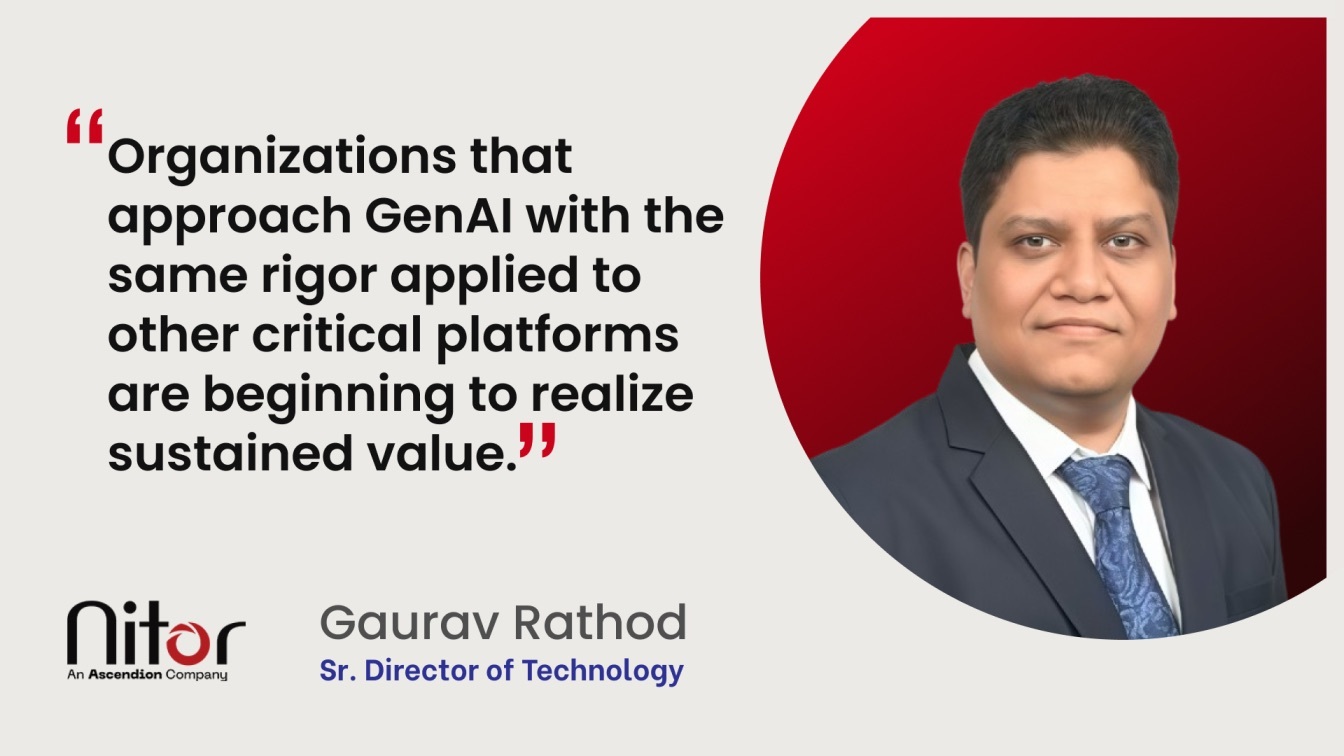
Organizations that approach GenAI with the same rigor applied to other critical platforms are beginning to realize sustained value. Those that continue to treat it as a collection of isolated use cases struggle with instability, cost volatility, and declining trust.
As adoption deepens further, the distinguishing factor will not be access to more powerful models, but the ability to operate GenAI systems that scale predictably, remain resilient under stress, and deliver clear business outcomes in real-world conditions.
That is the challenge, and the opportunity, that now defines serious GenAI deployment.