You’re working on the mightiest product of the organization so far. Numerous technical experts and product engineers are toiling day in day out. And AI is powering the entire play. As you near the production day, you suddenly encounter gaps in the data. At a time when you should be focused on deployment, you’re checking who is at fault – AI or your team.
These very gaps in the product engineering lifecycle and lack of accountability call for a foolproof human-AI collaboration. A tightly knit model where AI does the heavy lifting, while humans are always present to closely monitor the entire exercise. A space where there’s speed, but there’s no compromise with responsibility.
In this article, we’ll learn how to design a human-AI collaboration system so you can streamline your product engineering lifecycle and go on to create stellar products at scale.
Let’s dive in!
Why Human-AI Collaboration Matters for Next-Gen Product Engineering
The linear product engineering model is no more. Now, with soaring user expectations, a myriad of ecosystems are at play. Microservices, APIs, cloud, data pipelines, countless UIs – organizations need to deal with everything all at once. While automation did relieve teams from repetitive tasks, now it too cannot keep up with colossal data volumes.
Finally, we arrived at AI. Said that, human judgment is not out of the window. It never will. Thus, we’re talking about a human-AI collaboration that reflects speed with strategy, innovation with ethics and enormity with nuance.
As far as training of AI models is concerned, everything hinges on the firmness of human-AI collaboration. If you’re ready to invest in this chemistry, you’re on the way to building a robust and innovative product engineering mechanism.
The following statistics reflect the impact of human-AI collaboration:
- A recent report shows that organizations expect a 65% rise in human engagement in high-value tasks through effective human-AI synergy.
- According to a McKinsey report, AI will create 170M new jobs worldwide by 2030.
- Another source states that 70% of organizations think that AI agents will bring about change in operations, making leaders reconsider legacy workflows.
Transformation of Product Engineering with Human-AI Collaboration
The product engineering lifecycle has evolved from a mere technical sequence of tasks into a unique process combining AI and human aptitudes. All while keeping the end user in mind.
This alliance not only enhances efficiency but serves as a strategic advantage wherein your teams can align user, tech, and market at every stage, adapt quickly, and learn from both wins and failures.
Here’s how the human-AI collaboration fuels your product engineering lifecycle:
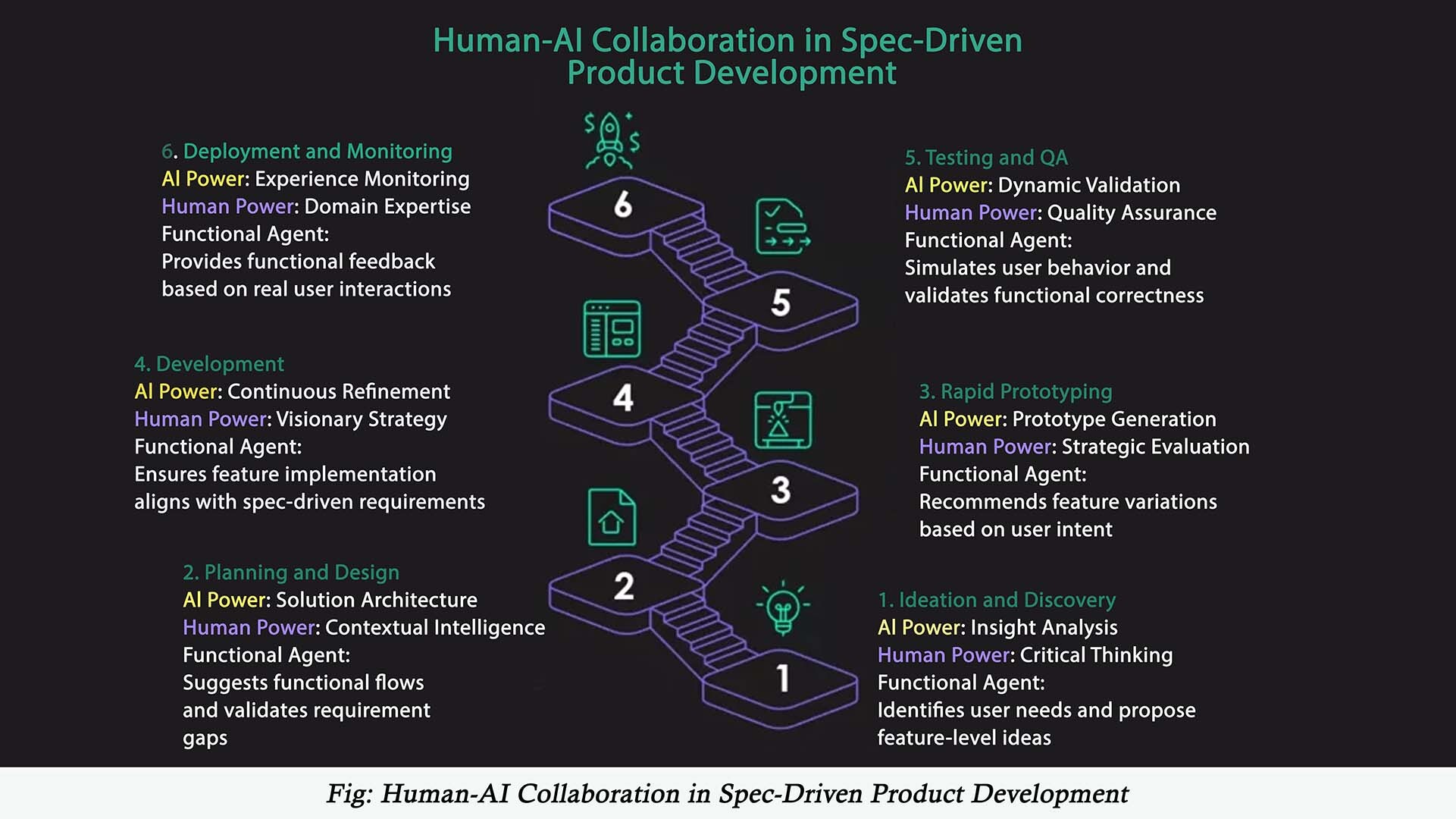
1. Ideation and Discovery
- AI: Gen AI and AI agents help analyze insights, spot issues, and identify critical needs that often go unnoticed, helping product engineers gain well-researched insights.
- Human: Product thinkers use their critical thinking and questioning capabilities to turn the insights into innovations that are feasible and market relevant.
2. Planning and Design
- AI: Advanced cognitive systems detail solution architectures, assess the trade-offs, and suggest UI changes that can be adjusted by the degree and applied to the entire design.
- Human: Product architects bring contextual intelligence, evaluating user psychology and aesthetic nuances to craft experiences that resonate. Their domain expertise helps validate trade-offs and align the design with your product’s strategic intent.
3. Rapid Prototyping
- AI: Gen AI helps produce diverse prototype versions, while agentic AI manages iterative testing, feedback documenting, and prototype optimization.
- Human: Product engineers and stakeholders come here to evaluate the prototype from all perspectives – user relevance, brand fit, and strategic alignment. This way, they can give detailed feedback to the LLM model/agent to make accurate iterations.
4. Development
- AI: Advanced AI assistants support continuous product feature optimization and integrations. This accelerates value delivery through data-driven optimization.
- Human: Product engineers blend strategies, ethical frameworks, and user-centric innovation. They ensure your product develops to be a sustainable solution beyond legacy standards.
5. Testing and QA
- AI: AI creates test cases (simulations) that can dynamically manage execution, refine strategies in real-time, and facilitate the validation process to be efficient. This helps you spot risks early and strengthen your product quality.
- Human: Product engineers get rid of ambiguities and set the highest level for quality. AI experts take the onus of training the model into a testing tool and incorporating all the shifts received from product testing.
6. Deployment and Monitoring
- AI: AI agents make for seamless product release management and monitoring user experience. Users get the benefit of fewer service interruptions and early issue detection.
- Human: Product leaders are in control of the right areas and moments to make tweaks, intervene, or turn.
Besides its decisive role in the various product engineering stages, agentic AI reshapes the entire process across three key dimensions, with humans sharing equal share of responsibilities:
- Engineering Agents: These agents are in charge of system-level tasks like architecture validation and code generation. They accelerate implementation by catching patterns that humans might overlook. Product engineers then contextualize these insights to match with strategic goals.
- Product (Functional) Agents: By decoding user needs and recommending functional changes, these agents facilitate feature development. Product managers tally these suggestions against market relevance and demand.
- Customer-Centric Agents: Handling user behavior and feedback, these agents inform product decisions, while your stakeholders can refine offerings according to these counsels.
Implementing Human-AI Collaboration to Engineer Robust Products
This roadmap shows you how you can create a solid human-AI collaboration framework to build robust products:
Phase 1: Identifying High-Impact Collaborative Zones (2-3 weeks)
- Start with outlining your product engineering lifecycle and mark the areas where a human-AI partnership would be valuable.
- Then, hold stakeholder workshops to create a thorough inventory of pain points, opportunities, and outcomes.
Phase 2: Building Collaborative Infrastructure (4-6 weeks)
- Your next job is to install AI platforms/partners that offer real-time co-authoring access. Remember, the platform/partner should have generative AI and agentic AI capabilities.
- Have a set of collaborative tools/platforms like cloud-based environments, data lakes, and governance modules.
- During this phase, train your teams on AI mechanisms and ethical standards.
Phase 3: Aiming for Scalability and Optimization (6-12 weeks)
- Now, test the impact of collaborative workflows in agile sprints, and continually evaluate performance and trust calibration.
- Set uniform customer input methods via dashboards, continuous integration pipelines, and automated incident reporting.
- Finally, regularly revisit and refine the rights to make decisions. This will keep your organization on top of the industry and regulatory standards.
Challenges and Considerations of Human-AI Collaboration
The collaborative model, though a boon, doesn’t come without pitfalls. Here’s what your product leaders and engineers should be careful about:
- Bias and Explainability: AI algorithms can be biased, depending on the data they’re trained on. So, human oversight is indispensable, where “humans in the loop” are responsible for sensitive spheres.
- Skill Gaps and Change Management: If you don’t set clear boundaries for human and AI roles, product engineers might either over-trust AI (leading to errors) or under-use it (losing potential). Further, skill gaps can limit the collaboration impact.
- Data Privacy and Governance: You need to make sure, without fail, that your data management practices are perfectly secure and in line with necessary regulations like GDPR, CCPA, etc. This calls for regularly updating your governance framework.
- Trust Calibration and Over-Reliance: Excessive trust in AI models might lead to human expertise being overlooked. So, teams must arrive at the appropriate balance to maintain quality and safety.
The Future of Product Engineering with Humans & AI
The fact is simple: human-AI collaboration in product engineering makes for technical innovation, product creativity and, of course, faster market launches. When AI ceases to be a tool and acts like a partner, products evolve beyond legacy frameworks.
To build this synergic intelligence, you need to foster an environment of trust and continuous learning in your organizations so that both AI and humans can flourish together. Without limiting each other.