The development of large language models has gone beyond the agentic era. Artificial intelligence systems are not only capable of generating text, but they can also reason, plan, call tools, retrieve data, and keep context for multiple steps.
As these features become more developed, there is one fact that has become obvious: in the world of agentic AI, context means everything.
Just like an operating system that regulates memory, today’s LLM-based systems are regulating context. The way a model keeps, arranges, and refreshes that context is the factor that decides whether it will work with accuracy or confusion.
This article delves into the topic of context engineering, the reasons why it has become indispensable for intelligent systems, and the way it is determining the next wave of agentic AI design.
What Exactly Is Context Engineering?
Andrej Karpathy, a computer scientist and co-founder of OpenAI, once likened big language models to a new type of operating system. In this comparison, the model is the CPU, and its context window is the RAM. That’s the place where all the temporary “thinking” is done.
The context of that work affects the model’s behavior in every way. A clever design can still fail if it gets a bunch of irrelevant or badly structured data. Context engineering is a way to solve that problem.
Basically, context engineering is the study of controlling the information that is given to and kept in a model during the process of reasoning. It is about managing which LLM uses knowledge from memory, documents, APIs, or previous conversations to be able to reason.
People often mix it up with prompt engineering, but they are quite different. Prompt engineering is about creating very clear instructions for the model. Context engineering is far beyond that. It makes sure that the model gets the right support information to help it think.
The Shift Toward Context-Centric Intelligence
When large language models were first introduced, it seemed like their potential was endless. However, developers quickly found out that intelligence is not defined by size alone. A 70-billion-parameter model can still provide bad results if it is given the wrong context.
The development of AI systems to the level of true agents that can read documents, query APIs, and keep histories has changed the importance of data flow from the model. The data flow has become just as important as the model itself.
Every move in the reasoning of an AI agent is now a challenge to find space in a limited context window. Inputs from tools, user queries, prior responses, and retrieved data are all looking for attention. That limitation compels designers to make more intelligent decisions about what stays, what goes, and how to prioritize the context efficiently.
This change is a transition to context engineering, which is at the core of the shift: creating the information flow that keeps the reasoning relevant, gives it a structure, and is purposeful.
Understanding the Building Blocks of Context
Context in an agentic workflow is usually considered to have four main parts:
- Instructions: The goals, objectives, or behavioral rules for the model.
- Knowledge: External information taken from databases, documents, or APIs.
- Memory: Past interactions, user preferences, or intermediate reasoning steps.
- Tool Outputs: The results of the tools or functions that the agent calls.
Even though these components combine into one prompt, they are not all of the same value. For example, long-term memory as persistent information is used to keep continuity, whereas transient information serves as situational awareness for a certain moment.
Finding the right balance between both is what enables AI agents to "think" properly in structured contexts.
Why Long Contexts Sometimes Go Wrong
Several companies have the notion that merely enlarging the context windows will lead to the accuracy of AI being doubled. However, the truth is quite different. Larger contexts can, in fact, lower the performance of the system if they are not handled properly.
Drew Breunig, a prominent strategist, has delineated the four manners in which long contexts frequently fail:
1. Context Poisoning: Once errors or hallucinations are introduced into the context and they keep being reused, this is the case of context poisoning. As an instance, DeepMind's Gemini 2.5 model at one time fabricated false game states and kept referring to them in subsequent reasoning.
2. Context Distraction: When an agent gets so wrapped up in its past that it loses sight of the current problem. Work with Llama 3.1 indicates that there are significant performance drops after 32,000 tokens.
3. Context Confusion: The presence of too many irrelevant data pieces in context results in poor-quality reasoning.
4. Context Clash: The existence of contradictory information coming from different sources makes the model inconsistent.
Agents are the ones who most deeply suffer from these failures since they, over many steps, gather information. If not accompanied by discipline, the same data that is supposed to be their assistance ends up being their downfall.
When Long Contexts Actually Improve Outcomes
Large contexts, to be fair, present some risks; however, if they are handled wisely, they can still be very influential. There are instances in which providing the model with more information always leads to better results:
Summarization: When there is an overwhelming amount of text that needs to be made concise.
Fact Retrieval: When the relevant facts are deeply hidden in various sources, and getting them together provides an understanding.
In such instances, the model is like a bird's eye view of the data and thus greatly benefits. Unfortunately, with multi-step reasoning, very often, having a lot of context defeats the purpose instead of helping the model. The secret is to focus on quality rather than quantity. Context engineering is a way of ensuring that each piece of information that is added to the context has a significant role.
The Four Pillars of Context Engineering
Context engineering, aiming to bring order into this intricacy, basically works on four founding principles: Write, Select, Compress, and Isolate. These combinedly represent the flow of information throughout an agent's life cycle.
1. Write - Collecting and Storing Information
A system is said to lose continuity when it keeps valuable information for a short time, and then it disappears after a few interactions. To solve this problem, agents have become equipped with scratchpads for taking temporary notes within a session and memory systems for keeping long?term information. Presently, programs such as ChatGPT and Cursor are generating-on-the-fly semantic and episodic memories to facilitate consistency in reasoning.
2. Select - Finding the Appropriate Information at the Appropriate Time
Memory writing is a simple task. However, selecting the proper piece of information from memory is difficult. To prevent the problem of being overwhelmed by data, agents employ retrieval methods, i.e., embeddings, vector databases, and knowledge graphs, which lead to retrieving the most relevant information.
3. Compress - Context Reduction While Retaining Meaning
Even the most sophisticated LLMs have limited memory. Keeping context clear and brief by summarizing or cutting is always an option. When the window of Claude Code begins to fill up, for instance, it automatically compacts old conversations.
4. Isolate - Managing Context for Sub?Agents
Generally, complex systems divide tasks among sub?agents. Different streams of context are isolated so as not to interfere with each other. The modular method used here guarantees that agents do not get each other’s reasoning mixed up or confuse one another.
These four columns, in conjunction with one another, serve as a mechanism transforming raw intelligence into structured thought.
Observability and Transparency: The Foundation of Trust
Effective context engineering is something that cannot be done without visibility. Engineering must be aware of the context that has been given to the model, how it gets changed from one step to another, and where it can fail.
Such platforms as LangSmith have enabled this to be achieved through context tracing and observability features. The teams, by looking at these traces, can find the very moments when the system is affected by context poisoning or confusion, and thus, they can adjust their systems accordingly.
Transparency is also very important for users. Simon Willison, a British programmer, gave a very funny example of how ChatGPT once remembered his location in a way that he was not expecting. It looked like the model "knew" something that it shouldn't have. This event is just one of the many that point to the necessity of user-facing transparency - letting users know what information the AI keeps and uses.
Dashboards, logs, and context panels can be the means to close this trust gap and guarantee that the users remain the masters over their data and the stories of their context.
Avoiding the Common Pitfalls
Designing context-driven AI systems is as much about what to avoid as what to build. The most common pitfalls include:
- Overly packed prompts that overload the model’s focus.
- Context that grows uncontrollably, resulting in repetitive responses.
- Feeding output back into input without abstraction, leading to self?reinforcing errors.
- Running parallel agents without a synchronized context, causing conflicting assumptions.
Avoiding these mistakes requires discipline, strong observability, and a design mindset grounded in clarity and control.
The Future of Agentic AI
Large language models have revolutionized the way products are created. Essentially, they have converted code into cognition and workflows into reasoning. However, as AI systems are getting more independent, the problem has changed. It is no longer just about making models intelligent. It is about effectively organizing that intelligence.
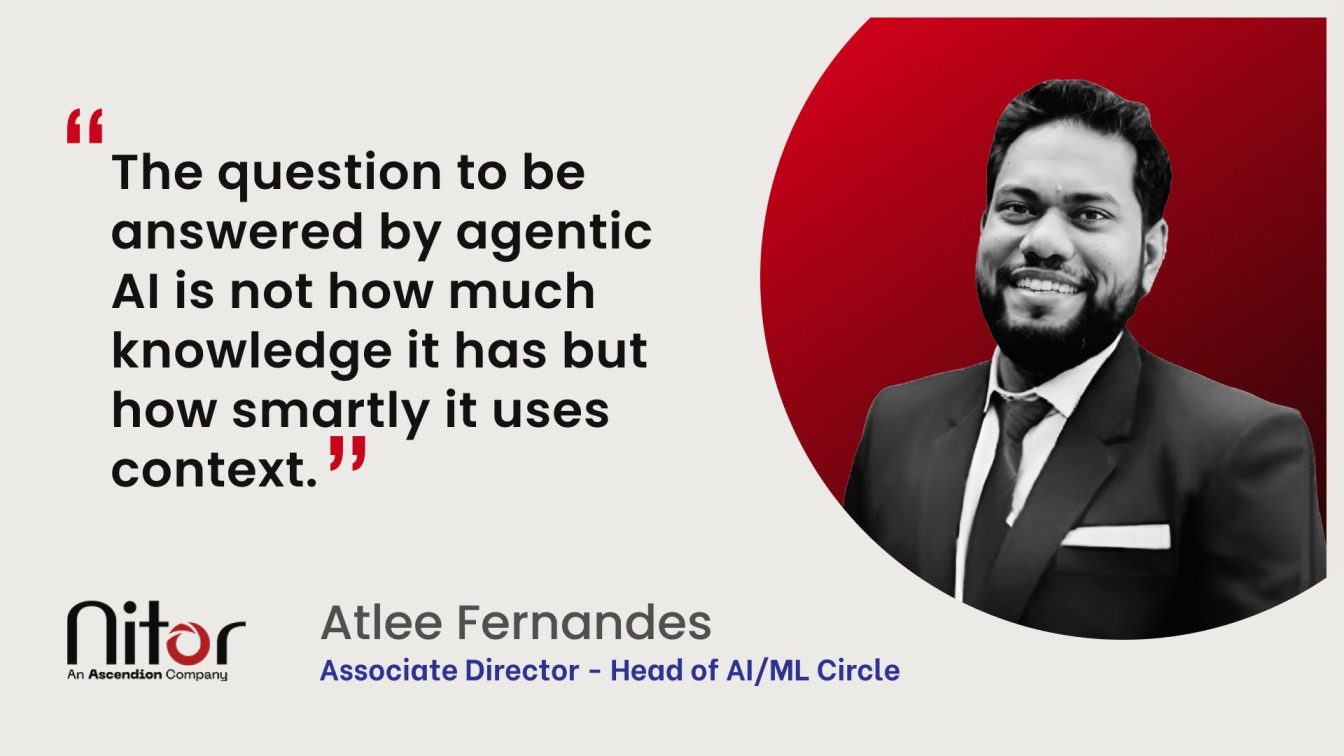
Context engineering is the technology that really gets the point across. It treats a model's attention as a limited resource and makes sure that every token results in the right outcome. The question to be answered by agentic AI is not how much knowledge it has but how smartly it uses context.
Knowing the four aspects of context engineering gives an AI the ability to reason, remember, and collaborate with a goal. Understanding LLMs as thinking in context is a step closer to the systems that not only respond but really reason.
The era of agentic AI is here, and context is what it values most.