When was the last time your firm really changed the way it works, not merely the tools it uses?
Most companies can quickly tell you about the platforms they have adopted in recent years. Cloud migrations, analytics tools, collaboration software, automation pilots. However, far fewer can actually demonstrate a fundamental change in how decisions are made, how teams operate, or how customers experience the business.
In 2026, this divergence has become impossible to overlook. Companies deal with tighter margins, volatile markets, and customers who demand not only speed but also relevance as standard. In these circumstances, digital transformation is no longer about just catching up with technology. It is about continuously aligning the whole organization.
Recent studies indicate that more than two-thirds of global organizations are in the process of revising their digital strategies. The reason is not that technology has let them down, but rather that the achievement of partial transformation has reached its limits in terms of producing results. Single tools and uncoordinated projects cannot handle the complexity of today's operations.
There is a simple but often overlooked difference. Digitization is about making existing processes more efficient. Digital transformation, on the other hand, is a deep change that affects the very nature of work, the creation of value, and the organization's response to change.
This piece delves into seven digital transformation trends that act as a blueprint for organizations in 2026. Individually and collectively, they illustrate how the most successful businesses are transitioning beyond.
1. The Evolution of Digital Transformation
-
From Digitization to End-to-End Change
Starting from very early times, digitalization of businesses has been executed in a very practical and step-by-step manner. Companies just substituted their paper with software, their spreadsheets with systems, and their manual reporting with dashboards. These changes brought about efficiency but hardly ever changed the overall ways the organizations worked.
In 2026, transformation has gotten to the stage of maturity. Now, emphasis is on leveraging connected ecosystems where systems, data, and workflows are inseparable. The scope of decision-making is no longer limited to departments. They are made based on a shared, up-to-date business picture.
-
Why Legacy Approaches Fall Short
Many legacy approaches struggle under modern demands. Siloed systems limit visibility. Rigid architectures resist scale. As complexity increases, so do delays, errors, and operational friction. What once worked adequately now becomes a constraint.
-
Changing Business Priorities
Business priorities have also evolved. Resilience now stands alongside growth. Speed matters as much as precision. Customer-centricity is judged by outcomes, not intent. Digital transformation efforts increasingly reflect these realities.
-
Example
Consider a manufacturing firm that once relied on paper records and manual planning. Over time, it digitized inventory and procurement. Today, leading manufacturers operate AI-enabled supply chains where forecasting, sourcing, logistics, and production planning are continuously aligned. Decisions that once took weeks are now made in near real time, with fewer disruptions and tighter control.
2. AI-Led Business Operations
-
AI Embedded in Core Processes
Artificial intelligence has moved decisively into everyday operations. In 2026, AI supports forecasting, demand planning, personalization, and internal knowledge access. Generative AI handles routine documentation, reporting, and analysis, quietly reducing operational load.
-
Smarter Decisions, Made Earlier
Predictive models allow organizations to anticipate change rather than react to it. This shift enables steadier planning and reduces last-minute interventions. Companies using AI-driven decision models report improvements of up to 25% in forecast accuracy, with clear downstream benefits.
-
Efficiency at Scale
AI does not simply automate tasks. It coordinates systems, aligns priorities, and supports scale without proportional increases in cost or complexity.
-
Example
Retailers increasingly rely on AI to manage inventory dynamically, adjusting stock levels based on real-time demand and local patterns. In several deployments, this approach has reduced waste by close to 30% while improving product availability.
3. Intelligent Automation and Integrated Workflows
-
Beyond Task Automation
Automation has evolved beyond isolated tasks. In 2026, organizations focus on automating complete workflows, from initiation to completion, supported by intelligent orchestration.
-
End-to-End Flow
Integrated workflows reduce handovers, manual checks, and delays. Exceptions are flagged early. Compliance is embedded rather than enforced after the fact.
-
Human Work, Refocused
As routine work recedes, human effort is redirected toward judgment, analysis, and improvement. Automation strengthens capability rather than diminishing it.
-
Example
Finance teams now automate approval cycles from purchase request to payment execution. What once required emails, follow-ups, and reconciliation now moves through a single, transparent flow.
4. Cloud-Native and Platform-First Thinking
-
Cloud as Foundational Infrastructure
Cloud computing is no longer viewed as a technical preference. It underpins flexibility, resilience, and reach. For many organizations, it is the foundation on which all other transformation rests.
-
Built for Adaptation
Cloud-native architectures allow systems to evolve without disruption. Individual components can be updated or replaced as needs change, supporting continuous improvement.
-
Faster Innovation
Development cycles have shortened. Teams deploy updates more frequently and respond to feedback with confidence rather than caution.
-
Example
E-commerce platforms depend on cloud-native systems to handle demand surges during peak periods, scaling seamlessly without service interruption.
5. Data-Driven Organizations
-
A Unified View
Breaking down data silos remains a defining challenge. Leading organizations invest in creating a single, reliable view of operations, accessible in real time.
-
Data at the Core
Data informs every layer of the organization, from operational decisions to strategic direction. It is treated as an active asset, not a reporting afterthought.
-
Greater Responsiveness
With timely insight, organizations respond faster to market changes and internal signals, reducing lag and uncertainty.
-
Example
Marketing teams monitor live dashboards to track performance and adjust campaigns as conditions shift, ensuring resources are used effectively.
6. Customer Experience Transformation
-
Personalized Journeys
Customer experience in 2026 is defined by relevance and continuity. AI enables organizations to tailor interactions based on behavior, context, and intent.
-
Alignment Across Touchpoints
True transformation aligns backend systems with customer-facing channels, ensuring consistency from first interaction to long-term engagement.
-
A Tangible Interaction
Consider a banking app that detects a customer reviewing international charges ahead of travel. Rather than waiting for a query, the app proactively offers a suitable travel card, adjusts alerts, and prompts activation. The experience feels considered, not automated.
7. Workforce Transformation and Digital Culture
-
Building Digital Fluency
Technology alone does not transform organizations. Continuous learning ensures teams understand new tools and use them with confidence.
-
Collaboration by Design
Digital platforms enable cross-functional collaboration, allowing ideas and insights to move freely across teams.
-
Embracing Change
Organizations that succeed foster adaptability as a cultural norm. Change becomes part of daily work, not a disruptive event.
-
Example
Companies with structured learning programs and internal mobility opportunities report stronger engagement and higher retention, reinforcing the link between culture and performance.
Conclusion
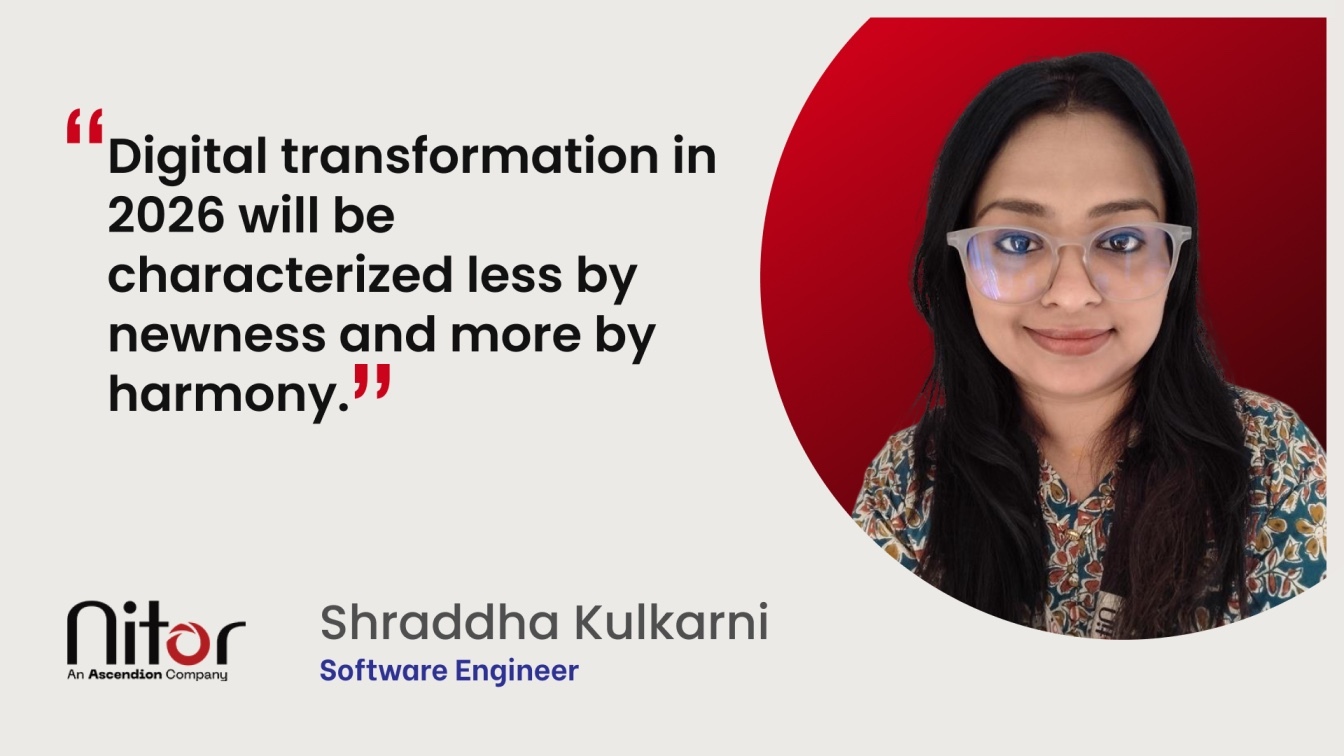
Digital transformation in 2026 will be characterized less by newness and more by harmony. The trends that shape top companies are very much intertwined, as each one effectively supports the other in the areas of technology, people, and processes.
Successful ones do not see transformation as merely a set of projects. Rather, they treat it as a continuous journey of unveiling, learning, and designing with wisdom.
Therefore, as organizations plan, the key question is not about which technologies to use, but whether they are ready to run their businesses with coordination and purpose in a world where change is the only constant.