Enterprises continuing to scale in 2026 have seen the cloud-first strategy go beyond mere adoption narrative to operational stress test. The majority of growing organizations now have their workloads running on public cloud platforms, which also include core transactional systems, data platforms, analytics pipelines, and, to a great extent, AI-driven workloads.
Worldwide spending on cloud infrastructure and platform services has gone beyond 600 billion dollars in the last year. At the same time, an internal survey across large enterprises reveals that more than 70% of new application developments are targeting cloud-native deployment models as the default.
However, incident reports and cost reviews at the same time reveal the same consistent pattern. Cloud environments are scaling quicker than organizational discipline, and the architectural shortcuts taken during the early adoption are surfacing as systemic risks under sustained load.
In 2026, cloud-first is no longer about the speed of migration. It depends on whether the systems can evolve, scale, and recover predictably amid continuous change.
Cloud-First as a Distributed Systems Discipline
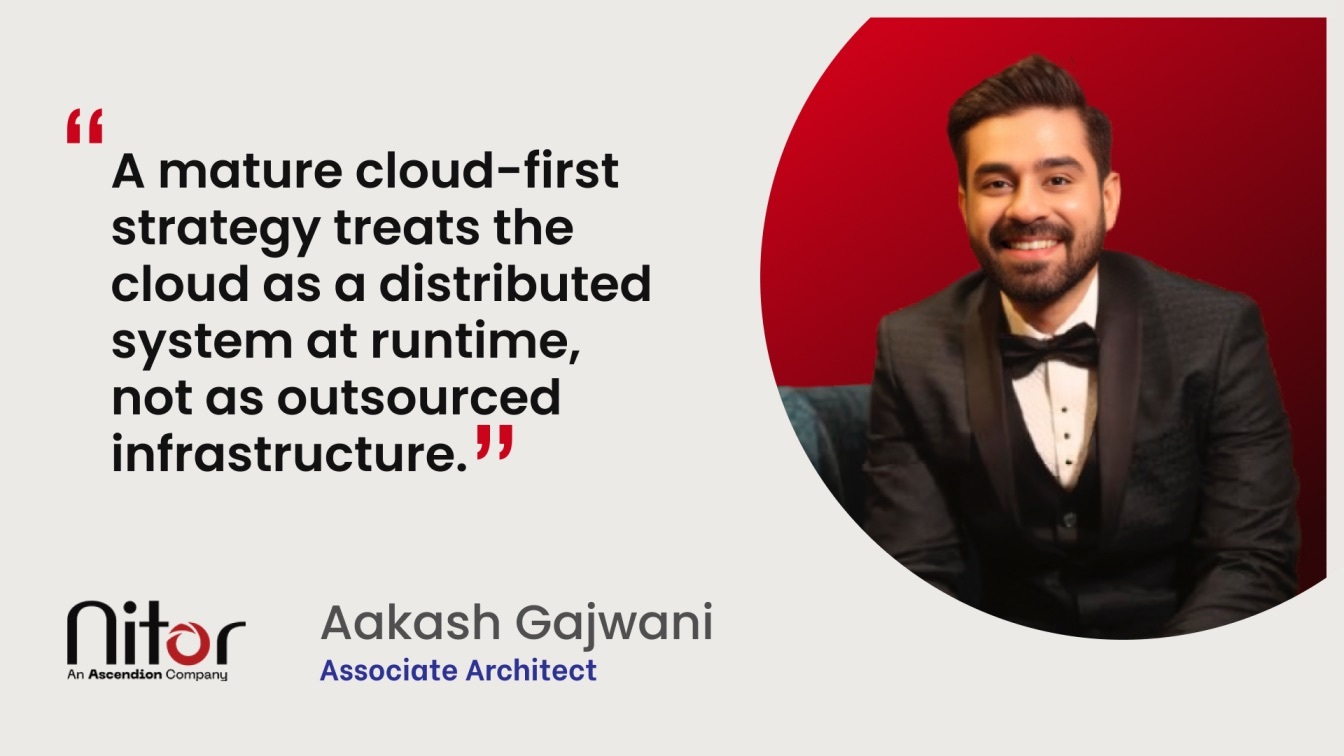
A mature cloud-first strategy treats the cloud as a distributed system at runtime, not as outsourced infrastructure.
This distinction is critical. Cloud platforms assume failure by design. Instances are ephemeral. Networks are unreliable. Resource availability fluctuates. Any architecture that assumes stable hosts, fixed capacity, or manual coordination is fundamentally misaligned with cloud operating conditions.
Cloud-first systems, therefore, adopt several non-negotiable properties:
- Infrastructure is entirely declarative and version-controlled.
- Runtime state is externalized from compute wherever possible.
- Scaling is horizontal by default, vertical only by exception.
- Failure is assumed and explicitly modeled in system behavior.
Enterprises that ignore these properties often recreate data center architectures in the cloud, inheriting their rigidity while increasing operational cost.
Control Planes, Not Snowflake Infrastructure
As environments grow, infrastructure consistency becomes more important than flexibility.
By 2026, leading enterprises treat cloud infrastructure as a productized control plane rather than a collection of bespoke deployments. Infrastructure is exposed through APIs and templates that encode standards for networking, security, observability, and deployment.
This approach typically includes:
- Standardized VPC and subnet layouts with enforced segmentation.
- Opinionated IAM models are based on workload identity rather than static credentials.
- Predefined environment classes such as ephemeral, staging, and production.
- Policy enforcement at provisioning time through automated guardrails.
Without a control-plane approach, cloud environments tend to fragment rapidly. Teams optimize locally, resulting in inconsistent networking, duplicated security models, and operational blind spots that become difficult to unwind at scale.
Scalability as a Property of Flow Control
Cloud platforms can scale resources quickly, but system throughput is constrained by flow control rather than raw capacity.
As enterprises scale, bottlenecks typically emerge in areas such as synchronous service chains, shared databases, and cross-zone network dependencies. A common failure mode is front-end services scaling successfully while downstream systems collapse under burst load.
Cloud-first architectures address this through explicit flow control mechanisms:
- Asynchronous messaging to decouple producers and consumers.
- Backpressure mechanisms to prevent overload propagation.
- Rate-limiting service boundaries rather than relying on upstream restraint.
- Idempotent processing to allow safe retries.
Event-driven architectures and streaming platforms are increasingly used not as integration conveniences, but as load regulators that stabilize system behavior under unpredictable demand.
Resilience Through Failure Isolation
Isolation, rather than redundancy alone, is the key to cloud-native resilience. It is indeed the case that multi-zone and multi-region deployments are the norm in 2026. However, a significant number of outages are still resulting from inadequate isolation.
The shared state, shared credentials, and shared deployment pipelines are some of the factors that create the so-called hidden coupling between components, which are supposed to fail independently.
To be resilient, systems must guarantee that they are isolated in:
- Compute: This can be achieved by using independent scaling groups and deployment units.
- Data: Here, the emphasis should be on ownership boundaries and replication strategies that are in line with access patterns.
- Networking: This is possible by limiting the blast radius through segmented routing and service meshes.
- Operations: This can be done by ensuring that there are no shared manual processes that become single points of failure.
Moreover, circuit breakers, bulkheads, and timeout budgets should not be considered optional safeguards. On the contrary, they represent core architectural primitives for cloud-first systems that operate at scale.
Data Architecture in Elastic Environments
Data systems often determine whether cloud-first strategies succeed or stall.
As enterprises scale, traditional assumptions about centralized databases and synchronous access break down. Contention, latency, and replication lag become dominant constraints.
Cloud-first data strategies increasingly favor:
- Domain-aligned data ownership rather than shared schemas.
- Read and write separation to optimize access patterns.
- Event streams as the primary source of truth for state change.
- Explicit consistency models chosen per use case rather than globally.
By 2026, enterprises that treat consistency, latency, and durability as explicit design choices outperform those that rely on default database behavior.
Cost as a Runtime Signal
Cloud cost is no longer a monthly accounting concern. It is a runtime signal that reflects architectural health.
In large-scale environments, cost anomalies often precede reliability incidents. Excessive retries, inefficient queries, uncontrolled fan-out, and poor caching strategies manifest first as cost spikes before causing performance degradation.
Advanced cloud-first strategies integrate cost visibility directly into engineering workflows:
- Per-service cost attribution tied to ownership.
- Budget thresholds are automatically enforced at runtime.
- Usage-based scaling policies rather than static allocations.
- Cost-aware routing and workload prioritization.
Treating cost as telemetry rather than finance data allows teams to detect inefficiencies early and correct them before they become systemic.
Security as Continuous Verification
Cloud-first security in 2026 is defined by continuous verification rather than perimeter defense.
Identity is the primary trust mechanism. Every service interaction is authenticated, authorized, and logged. Network location provides no implicit trust.
Mature cloud security strategies include:
- Workload identity tied to runtime rather than credentials stored at rest.
- Policy enforcement at deployment and execution time.
- Continuous compliance checks integrated into pipelines and runtime admission controllers.
- Automated remediation for non-compliant resources.
Most cloud security incidents continue to stem from misconfiguration rather than platform vulnerabilities, reinforcing the need for security controls that operate continuously and automatically.
Platform Engineering as the Enabler of Scale
As technical complexity increases, platform engineering becomes the primary mechanism for maintaining coherence.
Internal platforms encapsulate infrastructure, delivery, observability, and security into consumable abstractions. They reduce cognitive load for product teams while allowing platform teams to evolve capabilities centrally.
Technically mature platforms provide:
- Self-service service creation with prewired CI, IaC, and telemetry.
- Standard deployment pipelines with enforced policy gates.
- Unified observability with consistent metrics, logs, and traces.
- Runtime guardrails for reliability, cost, and security.
Without platform layers, cloud-first strategies degrade into fragmented implementations that scale organizational friction faster than system capacity.
Organizational Architecture Mirrors System Architecture
Cloud-first results cannot be separated from the organizational structure. Enterprises that effectively scale make the distinction between teams and domains rather than technologies. Teams have complete control of services, including reliability, performance, and cost.
On-call responsibility is most closely related to ownership. Operational maturity is also supported by the same metrics that measure deployment frequency, change failure rate, and recovery time.
These metrics help the architecture evolve instead of just being high-level indicators. If ownership is not clearly defined, the cloud environments will become complicated very quickly, and the organizations will receive lesser value.
Conclusion
As we have entered 2026, companies continue to scale their operations, and the adoption of a cloud-first strategy is no longer evaluated by the number of users but rather by the level of engineering discipline demonstrated.
Cloud computing favors systems that are designed for scalability, failure, and continuous change. It disfavors systems that assume stability, require manual coordination, and implicit trust.
Scalability, resilience, cost efficiency, and security become the result of architectural intent and operational rigor rather than tooling choices. Those enterprises that view cloud-first as a distributed systems discipline are the ones that are building platforms capable of scaling in a predictable manner and recovering gracefully.
Enterprises that consider it an infrastructure decision are still facing issues of fragility, volatility, and diminishing returns. The cloud has reached a level of maturity. It is now up to engineering organizations to rise to the same level of sophistication.