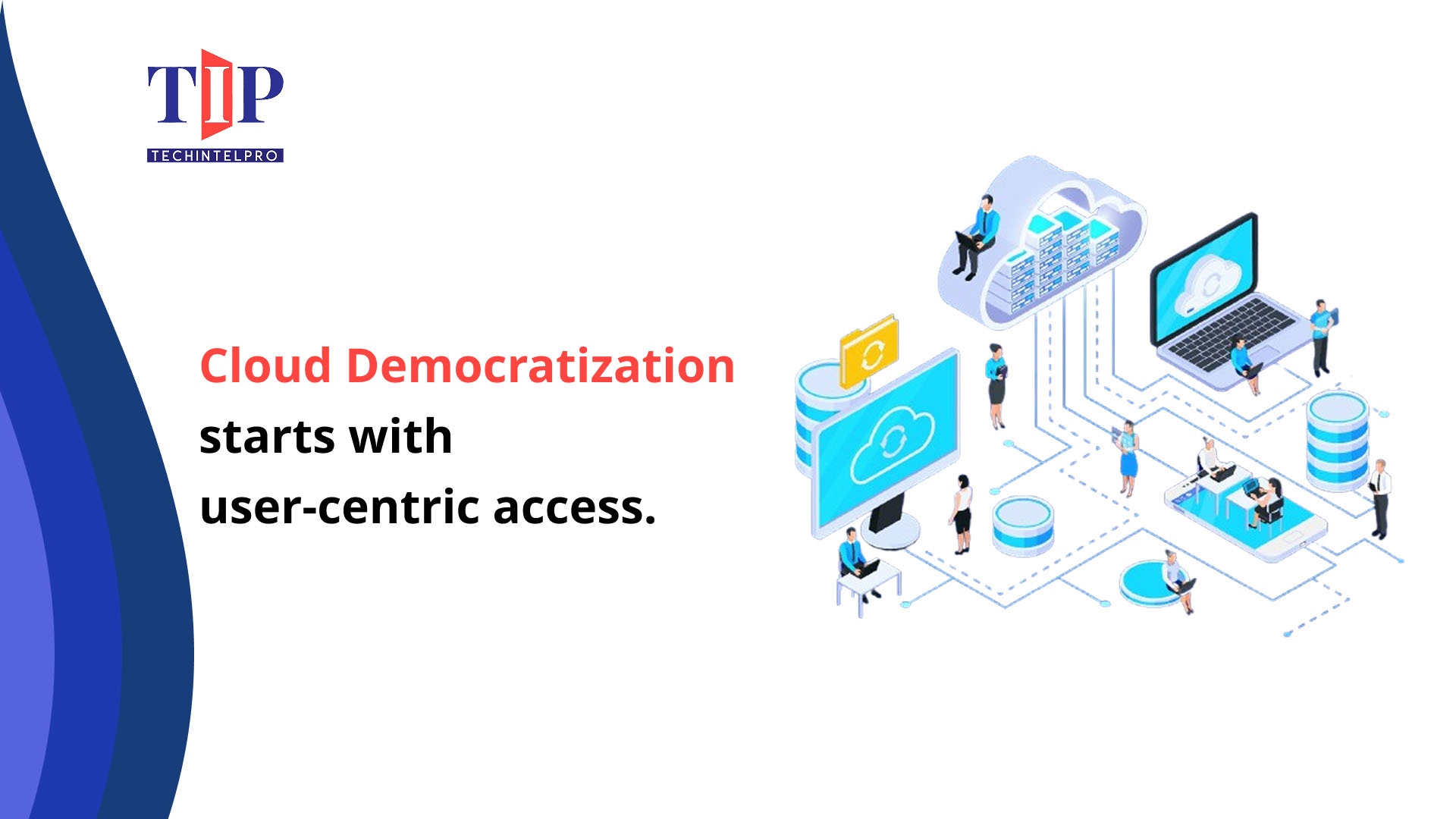
Originally intended as a specialised system, cloud technology is now a worldwide resource.
Cloud-native ecosystems enable teams across the organization to leverage robust infrastructure, and users from various fields, whether technical or non-technical, can experiment with workflows and tools.
Many companies use cloud-based tools to accelerate innovation and give business teams greater autonomy. Over the last few years, the way cloud environments operate has transformed how data is shared in real-time. Cloud-based collaboration has now become a core competency for cross-departmental teams.
Organizations have a fresh perspective on information sharing through a democratized environment, where access and innovation are no longer confined to IT teams.
Let us define cloud democratization based on these evolving user behaviors.
What Cloud Democratization Really Means
Cloud democratization refers to reducing both the technical and bureaucratic barriers to accessing and using cloud resources, thereby distributing the power to build and innovate from a few specialized individuals (IT teams) to the broader base of employees, teams, and departments across an organization.
This represents the transition of IT from a "Gatekeeper" model to an "Enabler" model.
Key Characteristics:
Universal Access: Providing self-service access to cloud infrastructure, data analysis tools, and application building blocks, such as low-code and no-code platforms.
Decentralized Innovation: Empowering business users, analysts, and operations teams to launch projects, automate workflows, and run experiments independent of centralized IT ticket queues.
Empowered Users: Placing the direct ability to provision resources, such as compute, storage, and databases, into the hands of the individuals who have the business problem to solve. Cloud democratization treats the cloud as a utility, making every employee a potential innovator. Together, these characteristics reshape how employees create value inside the organization.
These changes lead to key business benefits, which we’ll see next.
Why Cloud Democratization Matters: Key Benefits
The business value of democratizing cloud access shows up across the organization, from faster decision-making to optimized cloud spend and a more empowered workforce.
Fast Decision Making
Access to cloud-based data, analytics environments, and self-service tools allows teams to respond quickly. This results in less time spent waiting in line to access IT resources and faster creation of insights and decision-making.
Improved Innovation Cycle Time
By allowing anyone to access data, employees can develop prototypes, automate workflows, and experiment without relying on IT (and the associated delays). This allows for a shorter cycle time for innovation and enables teams to concurrently test multiple concepts, contributing directly to the improvement of product and process.
Decreased Reliance on IT & Blocking Points
With self-service provisioning, employees no longer have to wait for IT to provide requested infrastructure, environment, or data access. As a result, IT teams spend more time on governance for their business counterparts. This reduces operational delays and streamlines project execution.
Optimized Use of Cloud Services and Resources Cost
Using pre-configured environments and approved resources enables employees to use the right amount of resources. By pairing FinOps (Financial Operations) visibility with cloud democratization, companies can truly align consumption with intended use, enabling more effective cost optimization at the team and company level.
Key Enablers of Cloud Democratization
Organizations rely on specific tools and platforms that securely manage access, governance, and resource provisioning, moving from a centralized IT control system to a universally accessible utility.
Piyush Gupta of Vultr points out that accessible GPU and bare-metal performance are becoming key enablers, helping AI teams get enterprise-grade compute without the usual cost barriers.
Let's take a look at the critical enablers that transform the operating model:
1. The Centralized Cloud Platform
This is the one interface through which users access and control cloud resources. One will not have to struggle through complex, native cloud consoles.
Self-Service Catalogs: Standardized menus allow users, such as marketers or analysts, to provision pre-approved resources, such as a database or an analytics environment, with just a click, eliminating the need for IT tickets.
Internal Developer Platforms: Comprehensive portals provide a developer with a pre-configured environment and deployment tools, encapsulating complicated DevOps setup.
2. Guardrails and Governance
While access is universal, control shall be centralized to ensure security and manage costs.
Policy-as-Code (PaC): Standardized code, such as Terraform and Open Policy Agent, automatically enforces the rules. It will ensure that even in self-provisioned environments, security standards and compliance requirements, such as HIPAA and GDPR, and budget limits are met.
FinOps Tools: These provide automated cost management and optimization with immediate visibility into spending. This allows teams to monitor and manage their own budgets.
3. Abstraction Tools
Abstraction tools make using the cloud easier. They hide complex infrastructure from users.
Low-Code/No-Code Platforms (LCNC): Tools such as Microsoft PowerApps and OutSystems enable non-developers to create applications and automate workflows. These tools use a drag-and-drop interface.
Containers (for instance, Kubernetes): Containers are self-contained units of an application that contain everything necessary for it to run. Teams can use the cloud from anywhere and deploy containers without further setup, thereby achieving consistency and minimizing mistakes.
These tools empower users while allowing IT to maintain control, an essential element for successful cloud democratization.
That said, democratization brings its own set of challenges. These top three barriers can slow everything down if they’re not handled carefully.
Barriers That Slow Democratization (And How to Navigate Them)
Agility comes with risks. As organizations shift to a user-centric cloud, the following three critical risks emerge.
To succeed, enterprises must balance speed and safety.
- LLM Integration and Bias Control
All users can easily deploy LLMs. However, they may not have the detailed knowledge to manage them safely. That may result in the deployment of biased, non-transparent models in production. This limits trust and may expose users to ethical issues, increasing risk in internal governance.
How to Navigate It:
Establish an AI CoE that provides a pre-audited catalog of models and API offerings. Leverage ModelOps guardrails to perform bias checks, ensure explainability, and track model lineage. This ensures every deployment aligns with accountability and ethical standards. Another key challenge is financial oversight. -
Decentralized Cloud Costs and Fiscal Responsibility
When you allow your users to self-service access to resources, you remove the cost guardrails, which normally keep their spending in check. These teams, who do not understand cloud costs, can create unused resources, overprovisioned environments, and excessive bills; thereby, diminishing the value of moving to the cloud.
How to Navigate It:
Implement FinOps practices across the enterprise. Make cost accountability transparent. Automate budget limits, provide real-time cost visibility, and enforce strict tagging so every dollar is tracked and justified. -
Data Quality & Distributed Data Sprawl
To establish data governance, organizations should set up a centralized data catalog and a data governance framework or governance structure to manage all datasets, maintain consistent naming conventions, and provide a single 'master' dataset for all reporting.
How to Navigate It:
Encourage teams to work together to develop and validate datasets. Utilize processes that allow for rapid duplicate checks (through automated monitoring tools) as well as quality assurance checks on dataset accuracy and completeness.
The obstacles listed above demonstrate that cloud access alone is insufficient. To realize its full potential, organizations must strike a balance between control and freedom.
Conclusion
Piyush Gupta of Vultr highlights that affordable, easy-to-consume GPU and bare-metal performance are a practical step toward democratizing cloud access for AI teams. As cloud infrastructure becomes more open, organizations must balance ease of access with robust governance, ethical controls, and integrated security to manage rising complexity. The companies that achieve that balance will be leading the next wave of digital innovation.